
Tutor Intelligence’s robot data factory is still months away from construction-ready applications—but the investment behind it and the ROI it’s already delivering in logistics are a clear signal of where automation is heading.
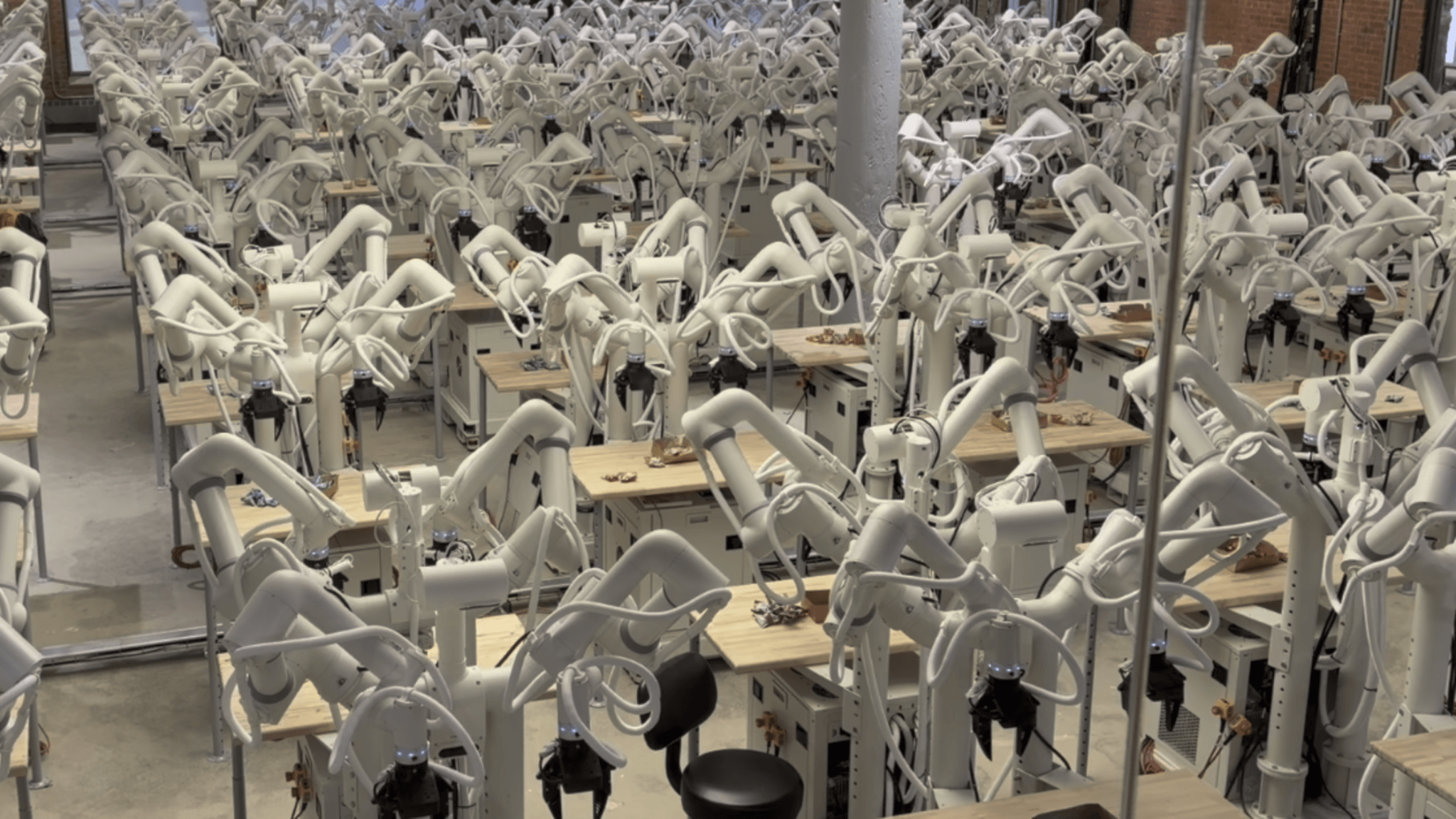
Massachusetts-based startup Tutor Intelligence has launched Data Factory 1 (DF1), which it calls “the largest data factory” in the U.S. DF1 is training 100 autonomous robots to perform physical manipulation tasks through a combination of real-world repetition and large-scale human supervision.
According to Construction Dive, the robots, named Sonny as a nod to one of the primary characters in the 2004 film “I, Robot,” are slowly learning to manipulate and move physical objects with their claws. This operation is being run cost-effectively using accessible cameras and vision-learning software instead of expensive sensors.
The firm’s other robot, Cassie, is already being used for autonomous case-picking and palletizing in logistics and industrial environments. The humanoid robot platform is currently handling boxed goods and materials while managing other tasks for different customers in the U.S.
Tutor has raised $42 million in funding and has received support from major tech players, such as AWS and NVIDIA, signaling industry interest in physical AI and robotics.
Companies like BetterBody Foods have already reported positive results. According to the firm, they saved 36% in costs after deploying two of Tutor’s palletizing robots in its factories. The team plans to add three more Cassie robots to its operations over the next year and a half.
That 36% cost savings is worth noting—not because construction sites will soon be filled with palletizing robots, but because it shows the ROI threshold for autonomous physical labor is being crossed in real-world conditions, not just labs.
Why this matters for construction and industrial sites
The barrier to construction automation has never been about capability—it’s been cost. Robotics systems were previously too expensive or fragile to be deployed at scale in unpredictable environments. Tutor’s approach—cameras over expensive sensors and human supervision to accelerate learning—is designed to close that gap by making hardware affordable enough for the ROI calculation to work.
Robotics and autonomous material handling are already being evaluated in construction and industrial settings, especially in areas where labor shortages and productivity hiccups are most evident. A few examples include: site logistics and material movement, repetitive assembly tasks, autonomous hauling and material transport, rebar tying and placement, masonry and layout assistance work, and inventory tracking.
Another challenge to consider is high-variability dexterity. Construction is much harder to automate than warehouse picking because most tasks involve significantly greater variability in conditions, materials, and environments. Warehouse robots, on the other hand, often operate in structured, predictable environments with well-defined workflows and standardized objects.
None of this means that constructions are immediately about to be filled with autonomous robots. The high-variability dexterity problem is real and won’t have a quick solution, but this signals where things are headed in the future. Contractors who understand where the ROI threshold is being crossed will be better positioned to evaluate when and where automation makes sense for their operations.
What the ROI question actually looks like for contractors
The construction tasks closest to automation are repetitive and labor-intensive, with lower workflow variability and measurable labor savings, such as material transport, inventory movement, indoor logistics, repetitive prefabrication tasks, and layout assistance.
The question that contractors should be asking themselves is not whether a robot can perform a particular task, but rather, at what cost per hour does a robot become competitive with a skilled worker for a specific task? They should consider other factors like worker availability, schedule compression, rework reduction, downtime risk, and utilization rates.
It’s also worth following firms experimenting with construction robots and automation to improve workflows, such as Dusty Robotics, KEWAZO, Built Robotics, and Tutor.
The construction industry’s massive labor shortage is what’s accelerating this. With fewer skilled workers, climbing labor costs, and tighter schedules, contractors are now considering the shift to automation that was previously too expensive to justify. Tutor’s launch—backed by AWS and NVIDIA—signals a major investment in physical AI reaching that threshold. Contractors who stay curious and evaluate where automation fits into their operations will have a head start when that time comes.
Physical AI and construction automation are moving faster than most contractors expect. For ongoing coverage of the technology, equipment, and workforce shifts shaping the industry, subscribe to the Under the Hard Hat newsletter.
Source: Manufacturing Dive — Massachusetts startup launches ‘largest robot data factory in the US’ — published May 12, 2026.