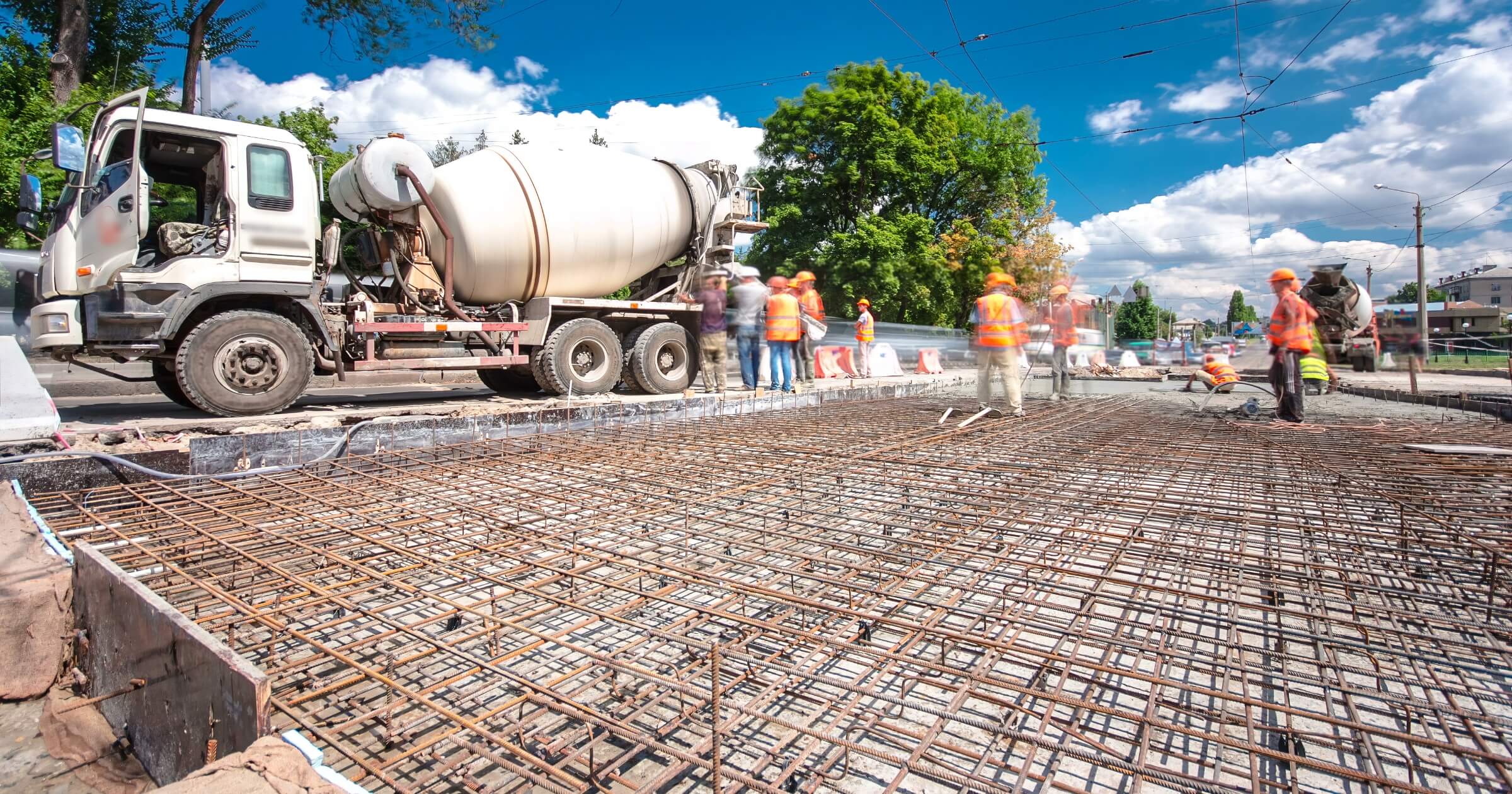
Concrete is everywhere you look; bridges, highways, homes, and skyscrapers all depend on it. But behind every smooth slab or sturdy wall are the biggest concrete companies, concrete suppliers, and contractors that make it possible. As the U.S. construction industry continues to grow, producers like Holcim, Cemex, and Vulcan are scaling up to meet demand for everything from residential construction to massive infrastructure projects. In this article, we’ll look at the biggest concrete companies in the United States that are driving the future of building in America.
State of the concrete industry heading into 2026
The U.S. cement and concrete industry is changing fast. After a few slower years, experts expect steady growth in 2025 and 2026 as more roads, bridges, and housing projects are built. Concrete is one of the most widely used building materials in the world, and the concrete companies that produce it play a huge role in keeping construction moving.
Concrete industry valuation
According to the U.S. Geological Survey (USGS), American cement producers shipped around 110 million tonnes of cement in 2023, worth roughly $16 billion. The ready-mix concrete market was valued at about $68 billion in 2024, based on research from Concrete Financial Insights.
While overall production has leveled off, prices continue to rise due to demand for infrastructure and commercial projects. Experts say this demand should stay strong thanks to government spending. The federal Infrastructure Investment and Jobs Act (IIJA) and local public-works programs are expected to drive billions in new construction over the next few years.
What’s driving growth
- Infrastructure spending: Billions are being invested in roads, bridges, and transportation upgrades, boosting demand for cement and concrete.
- Urban growth: As cities expand and more people move into multi-family housing, construction of apartment buildings and mixed-use spaces is rising.
- Sustainability goals: Major cement companies are introducing low-carbon cement and blended products to reduce emissions.
Challenges and new ideas
The industry faces some big challenges— rising costs, labor shortages, and pressure to lower emissions—but technology is helping. Many concrete contractors are turning to digital sensors and AI-driven mix-design tools to save time, reduce waste, and improve quality control.
At the same time, cement manufacturers are investing in energy-efficient plants and experimenting with concrete strategies, such as carbon capture systems that trap CO₂ before it reaches the atmosphere. Many also use recycled aggregates, like fly ash or slag, to make cleaner mixes that still meet strength requirements.
Trends to watch
- Recycled aggregates: Producers are using more recycled stone, sand, and gravel in ready-mix concrete to cut waste.
- Carbon capture: The cement industry is testing ways to store carbon from cement production underground or reuse it in mixes.
- AI mix design: Tools that use artificial intelligence are helping companies balance strength, cost, and sustainability.
Overall, the cement industry looks steady as it heads into 2026. Growth may be moderate, but innovation is reshaping how cement and concrete are made. Cleaner mixes, digital monitoring, and new technologies will help concrete companies, contractors, and producers stay competitive and promote sustainable building materials nationwide.
Top 10 concrete companies dominating the U.S. market
1. U.S. Concrete (now part of Vulcan Materials)
Market cap/revenue: Total revenues $7.42B
Employees: Vulcan total ~11.4k (includes U.S. Concrete)
CEO: Tom Hill
Founded: 1997 (U.S. Concrete); acquired by Vulcan in 2021
Headquarters: Birmingham, Alabama (Vulcan)
U.S. Concrete brought a large ready-mix concrete network into Vulcan, which is the largest U.S. aggregates producer. Vulcan’s sustainability program focuses on efficiency and mix optimization across its concrete and asphalt businesses.
2. Buzzi Unicem USA
Market cap/revenue: 2024 revenue €4.7B
Employees: 1,300+
CEO: Antonio Buzzi (appointed in 2025)
Founded: Parent roots to 1907
Headquarters: Bethlehem, Pennsylvania
Buzzi Unicem produces Portland cement and blended cements, and supplies ready-mix partners and concrete product manufacturers nationwide. Ongoing investments in alternative fuels and lower-carbon clinker factors are part of the group’s sustainability plans.
3. GCC (Grupo Cementos de Chihuahua) – U.S. Operations
Market cap/revenue: 2024 consolidated net sales $1.37B
Employees: Not publicly split by country; company runs 8 cement plants, 96 concrete plants
CEO: Enrique Escalante
Founded: 1941 (Mexico)
Headquarters (U.S.): Glendale/Denver area, Colorado (GCC of America)
GCC manufactures cement, ready-mix concrete, aggregates, and asphalt for infrastructure and commercial work in the central and mountain states. Recent results highlight U.S. price gains and strong margins; the company publishes EPDs and invests in efficiency.
4. Argos USA (now Quikrete)
Market cap/revenue: Now part of Summit Materials, which Quikrete acquired in November 2024
Employees: Not broken out separately.
CEO: Will Magill is CEO of Quikrete
Founded: U.S. footprint built over 2005–2014
Headquarters: Alpharetta, Georgia (Argos USA)
Argos USA, now part of Quikrete, is a major ready-mix and concrete supplier across the Southeast and Texas. With Summit and now Quikrete, the platform combines cement plants, ready-mix, and aggregates to serve large construction projects and infrastructure projects.
5. Martin Marietta Materials
Market cap/revenue: 2024 revenue $6.8B
Employees: Varies year to year
CEO: C. “Ward” Howard Nye
Founded: 1993
Headquarters: Raleigh, North Carolina
A top aggregates and cement producer with select ready-mix operations, Martin Marietta Materials is actively re-shaping its portfolio and trading assets with Quikrete to focus on core aggregates while still supplying downstream concrete in key markets.
6. Heidelberg Materials North America (formerly Lehigh Hanson)
Market cap/revenue: 2025 Q3 results: an increase of 5% to €1,179M
Employees: ~9,000
CEO (North America): Chris Ward
Founded: 1897
Headquarters: Irving, Texas
Heidelberg provides vertically integrated cement, ready-mix, aggregates, asphalt, and precast across the U.S. and Canada. Innovation focus includes carbon capture pilots and lower-clinker cements.
7. Holcim US (now “Amrize,” after 2025 spin-off)
Market cap/revenue: About $11–12B pre-spin
Employees: Not broken out in a single public figure
CEO (Amrize): Jan Jenisch
Founded: 1912 in Holderbank, Switzerland
Headquarters: U.S. operations hub in the Chicago area; Amrize listed in the U.S. and Switzerland
Holcim is a major supplier of cement, ready-mix concrete, aggregates, and building material solutions. Their flagship ECOPact low-carbon concrete reduces CO₂ ≥30%, with expanded availability across U.S. markets.
8. CEMEX USA
Market cap/revenue: Reported 2024 revenue of $16.2B
Employees: Global ~43,000 after 2025 restructuring; U.S. portion undisclosed
CEO: Jesús González, President of CEMEX USA; Jaime Muguiro became global CEO in April 2025
Founded: 1906, Mexico
Headquarters (U.S.): Houston, Texas
Cemex maintains a broad U.S. network in cement, ready-mix, and aggregates serving residential, commercial, and infrastructure customers, with ongoing cost-efficiency and digital initiatives under the new leadership team.
9. Vulcan Materials Company
Market cap/revenue: 2024 total revenues $7.42B; 2025
Employees: ~11.4k
CEO: Tom Hill
Founded: 1909
Headquarters: Birmingham, Alabama
Vulcan is the nation’s largest aggregates producer with significant asphalt and ready-mix positions in specific markets, including the former U.S. Concrete network. They have strong public infrastructure exposure, and pricing discipline drives results.
10. CRH Americas Materials (Oldcastle/CRH)
Market cap/revenue: Parent CRH 2024 revenue $35.6B
Employees: Global ~78k
CEO: Parent CEO Jim Mintern; Jason Jackson is President, CRH Americas Materials
Founded: 1970
Headquarters (Americas Materials): Atlanta, Georgia
The biggest integrated construction materials platform in North America, CRH Americas Materials spans cement, ready-mix, aggregates, and asphalt with thousands of sites. Active in sustainability and innovation, including acquisitions in low-carbon cement production and SCMs to promote sustainable mixes.
Bottom line
The U.S. cement and concrete industry is holding strong heading into 2026. While overall growth is steady rather than explosive, the biggest concrete company will push hard on innovation to stay competitive. From ready-mix concrete producers improving digital monitoring to cement manufacturers investing in low-carbon mixes and carbon capture, these industry leaders are proving that sustainability and progress can go hand in hand.
The largest concrete companies are balancing scale with smarter production methods that reduce emissions and waste. They’re also embracing AI tools, recycled aggregates, and energy-efficient cement plants to create a more sustainable future for the construction industry.
Want to learn more about the new tech shaping concrete and cement? Check out these related reads:
- XtreeE 3D concrete printing
- Heat-resistant concrete
- How to price concrete jobs
- Concrete Masonry & Hardscapes Association
- Leading methods to make concrete construction more sustainable
- How Cemex is decarbonizing the concrete industry
Subscribe to our newsletter for the latest insights, tools, and trends shaping the future of construction.