
Universities today face a triple threat: shrinking budgets, limited urban space, and the need for extreme flexibility. To solve these problems, many institutions are looking up instead of out. This article explores why vertical campuses are becoming a strategic solution for modern education and whether this high-rise model is truly the future of the academic world.
Why universities are building up
Traditional sprawling campuses are becoming a luxury that many urban institutions can no longer afford. Several forces are driving the shift toward verticality in 2025 and 2026.
- Urban land constraints: In cities like Toronto and Pittsburgh, there is simply no room left to expand sideways without spending a massive amount of money to buy new land.
- Sustainability and footprint: Building up reduces the physical footprint. This helps universities meet 2026 net-zero targets by saving ground-level green space.
- Economic tradeoffs: High-rise construction is expensive. However, buying multiple city blocks often costs much more than building a single, dense academic tower.
- Community integration: Modern vertical campuses are designed to be gateways to the city. They connect students directly to transit hubs and city life, which we are seeing in many 2025 developments.
What problems do vertical campuses solve?
Vertical campuses offer unique advantages that a traditional, spread-out layout cannot match in a crowded city.
Program density
These buildings allow schools to stack different departments. For example, a school can put research labs right above the classrooms that use them. This makes it much easier for students and teachers to move between different types of work without having to walk across campus.
Social collision
Traditional buildings often keep different faculties in their own separate areas. Vertical buildings use central atriums and “vertical neighborhoods” to change this. These spaces bring people from other departments together, fostering greater idea sharing and new learning approaches.
Energy efficiency
Stacking floors often creates a better thermal envelope than several smaller, separate buildings. This reduces heating and cooling costs. In 2026, many of these towers will be equipped with smart systems that adjust temperature based on occupancy.
Transit connectivity
Vertical designs allow a university to sit directly atop or adjacent to major train and bus stations. This makes the campus easier for students who live far away to reach. It also reduces the need for large, expensive parking lots.
Examples of vertical campuses
Recent projects show us how useful these high-rise buildings have become. They are more than just tall offices—they are hubs where students live, learn, and work together.
York University — Markham Campus (Markham, ON)
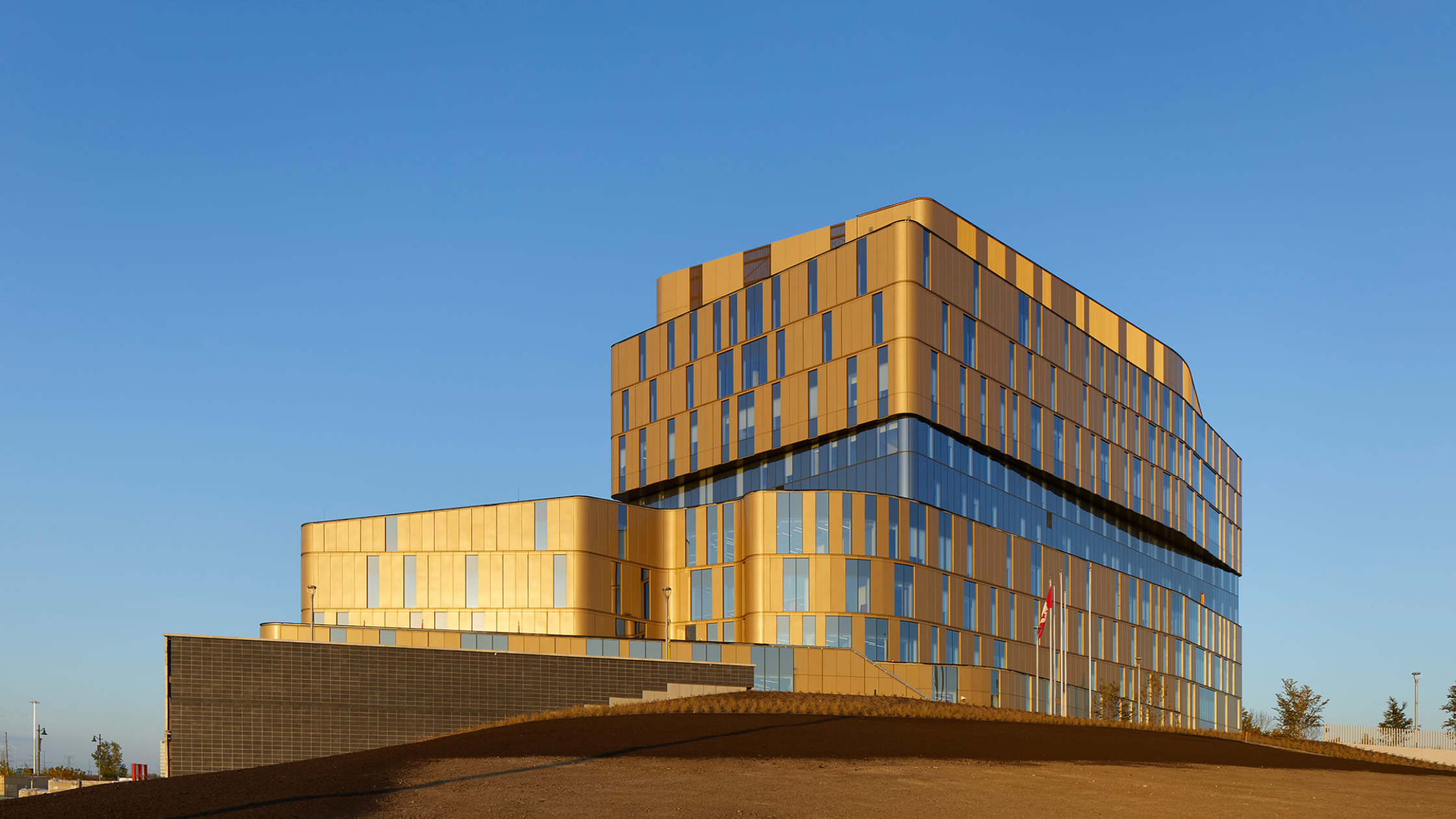
Opened in late 2024 and fully operational in 2025, the York University Markham Campus is a great example of a modern tower. Designed by Diamond Schmitt Architects, the building is 10 stories tall and has a special “podium” at the bottom that is five stories high. The floors are designed to facilitate communication and idea sharing among students from different classes.
University of Toronto — Academic Wood Tower (Toronto, ON)
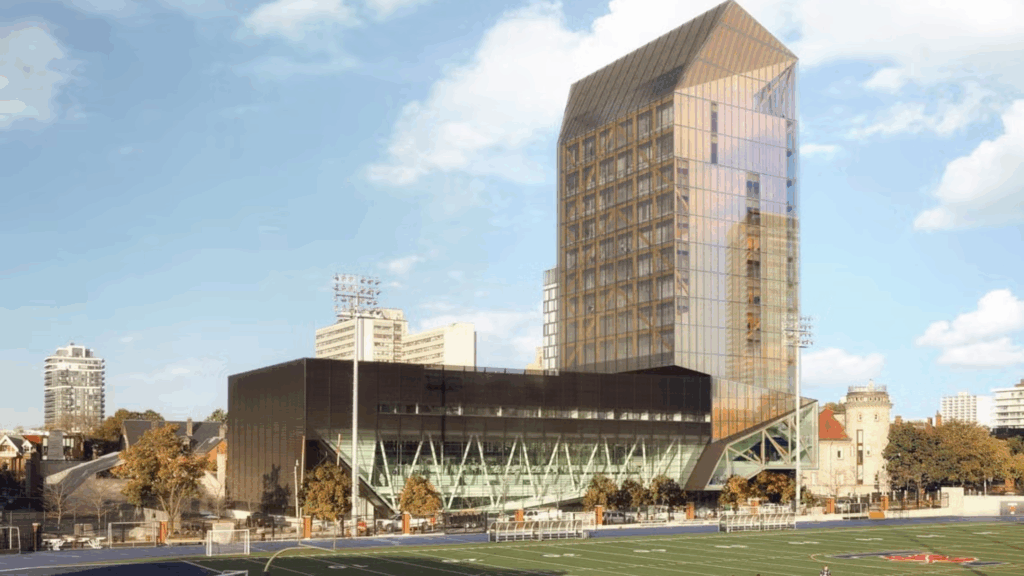
This landmark project from 2025 is notable because of what it is made of. Standing 14 stories high, it is the tallest “mass timber” academic building in North America. Mass timber is a strong, sustainable building material that uses wood instead of steel and concrete. It houses multiple departments within a high-tech, eco-friendly framework.
Roosevelt University — Wabash Building (Chicago, IL)
This 32-story tower is a true “vertical campus” in the heart of Chicago. It stacks almost everything a student needs into one building. You can find student services, classrooms, and even dorm rooms all in the same tower. It is the second-tallest educational building in the Western Hemisphere.
University of Pittsburgh — Cathedral of Learning (Pittsburgh, PA)
This is an older example, but it still shows how well vertical buildings work. It is 42 stories tall and built in a beautiful Gothic style. The Cathedral of Learning serves as the heart of the university. It proves that a single tall structure can hold enough classrooms and offices to support a major school for decades.
Trend or exception?
Is the vertical campus model growing, or is it only for big cities? As we look at data from 2025 and 2026, the trend is growing in specific places.
- Regional adoption: Sprawling campuses still exist in the countryside. However, vertical towers are emerging in crowded city centers worldwide.
- Strategic choice: Building up is not always the first choice because of costs, but it is the main strategy when a school wants to be part of a new “innovation district” in a city.
- Mixed-use success: The best vertical campuses act like a “mini-city.” They work best when they mix classrooms with shops and student housing.
Final thoughts
Vertical campuses are no longer just a way to save space. They are a smart choice for schools that want to be green, connected, and efficient. While the traditional sprawling campus will always be around, the academic high-rise is the best tool for the crowded city life of 2026 and beyond.
Further reading
- How mass timber is transforming sustainable building practices
- Excavator essentials: How to choose the right machine for the job
- Reimagining America’s Schools: A conversation with Ron Bogle, Hon. AIA
Want to stay updated on the construction trends and designs shaping our world? Subscribe to our newsletter for more stories on the future of building!