
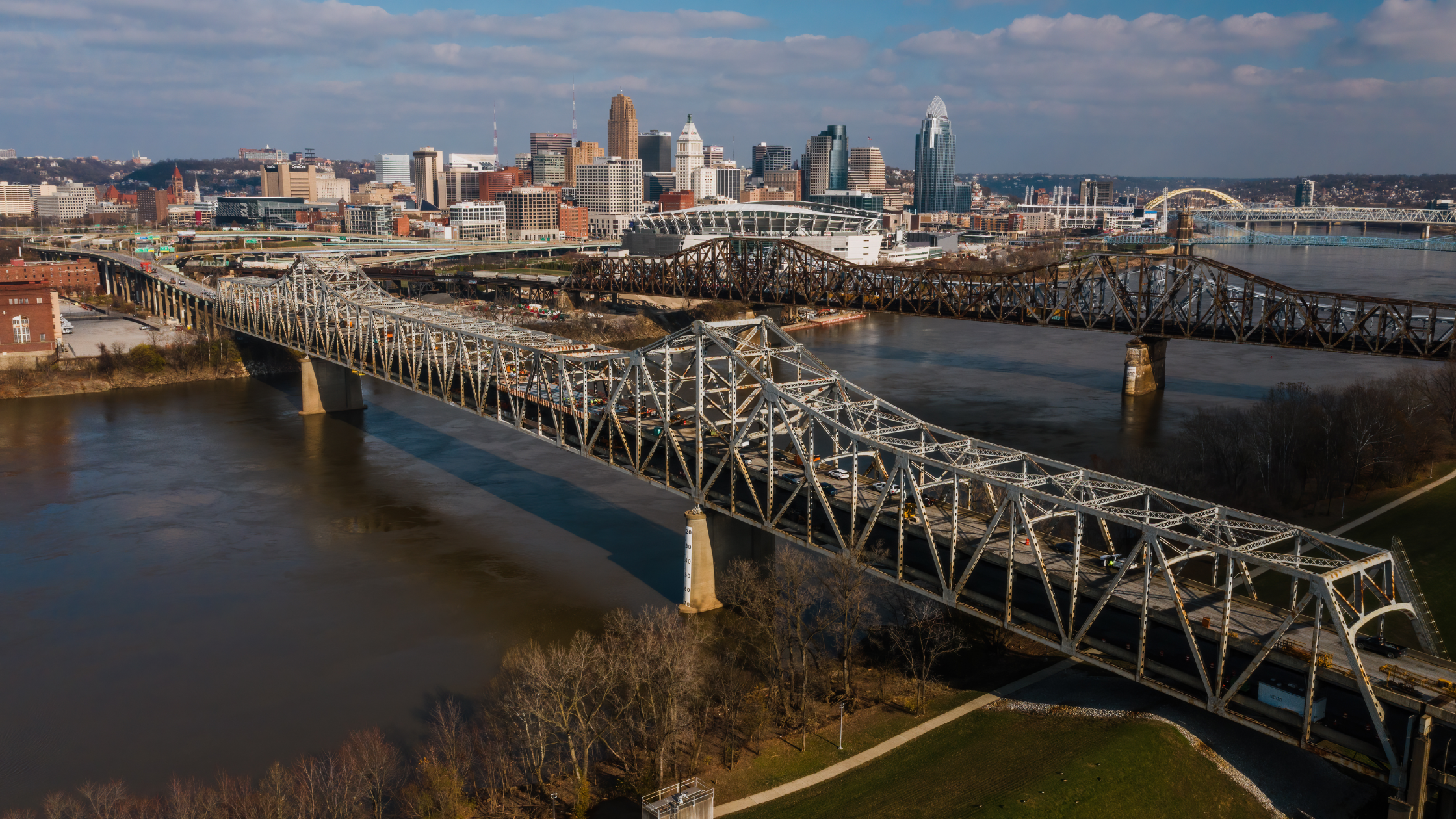
After decades of delays, one of America’s most critical freight corridors is finally under construction—and the way it’s being built says a lot about where infrastructure delivery is heading.
The Brent Spence Bridge received the go-ahead from the Ohio Controlling Board last month to finalize construction plans and begin work this spring. The Ohio Department of Transportation (ODOT) and the Kentucky Transportation Cabinet (KYTC) have invested over $4.4B in the Brent Spence Bridge Corridor.
This initiative is seen as having major regional impacts due to its prime location between Northern Kentucky and southwest Ohio—according to ODOT, $1 billion of freight moves through this corridor every day. The infrastructure project has been announced in response to overcapacity and aging assets.
It aims to address one of the hardest-hit traffic bottlenecks in the U.S. The bridge was built to handle around 80,000 vehicles per day and is currently handling close to 160,000—nearly double its intended capacity. The long-delayed infrastructure overhaul is now an active megaproject and is finally ready for construction. Contractors can expect more work like this to materialize in the near future.
“This project has been discussed for decades, and we are now at the point where plans are becoming reality,” said ODOT Director Pamela Boratyn. “This project will make travel safer, strengthen the economy, and build a transportation system that reflects the importance of this region to Ohio, Kentucky, and the nation.”
The new cable-stayed companion bridge, which will focus on increasing capacity without affecting existing flow, is being built along the existing Brent Spence Bridge. It features a bi-level, independent deck design and is intended to reduce the burden on the existing bridge, which is more than 60 years old and currently handling around double the intended traffic, leading to significant infrastructure strain and safety risks.
For contractors, this marks a clear shift. Teams are increasingly handling live-traffic construction work while juggling risks and sequencing challenges. Complex retrofit and expansion work is on the rise because infrastructure pushed beyond its limits presents a dangerous scenario that needs to be resolved as soon as possible.
What construction will look like
The Brent Spence Companion Bridge will be a complex operation, involving utility relocations, staging, and the construction of foundations and pylons using barges and cranes. Contractors will also be responsible for maintaining traffic flow during construction.
A few staging challenges will include tight site constraints, as construction teams will focus on executing in phases within an active corridor. For contractors, this will mean paying close attention to logistics, sequencing, and engineering.
The river crossing adds another challenge that’s not typical of land-based builds. Barge operations in an active waterway mean crews must coordinate shifting water levels, vessel traffic, and environmental regulations alongside the demands of the highway construction above.
The $4.4B megaproject is being delivered by the Walsh Kokosing joint venture—a collaboration between Walsh Construction, Kokosing, and AECOM. For contractors, this is another trend worth noting: higher coordination demands and a sharp rise in large-scale collaborations.
A broader shift in infrastructure delivery
The 8-mile corridor upgrade involves major improvements to the existing bridge. It includes traffic-flow optimization, along with pedestrian and local infrastructure enhancements. This is part of a larger shift and is a system-level upgrade that prioritizes making the required upgrades to existing infrastructure while addressing safety and efficiency concerns.
Large-scale infrastructure replacement is no longer optional—it’s long overdue. The American Society of Civil Engineers’ (ASCE) 2025 Report Card gave the U.S. infrastructure a C grade, which was bumped up from a C- in 2021, with roads and bridges presenting the greatest concern. With a five-year, $1.2 trillion investment package aimed at upgrading aging infrastructure across the United States, the Brent Spence Bridge is one of the first places this funding is showing up.
Freight and commuter demand are likely to increase, which means more megaprojects will take place in live environments and require a combination of phased delivery and tighter coordination. Firms that rise to the challenge and tactfully handle complex, high-pressure, and in-use infrastructure builds will be best positioned to compete.
The infrastructure pipeline is filling up. For ongoing coverage of the projects, funding shifts, and industry trends that matter to contractors, subscribe to the Under the Hard Hat newsletter and follow us on LinkedIn.