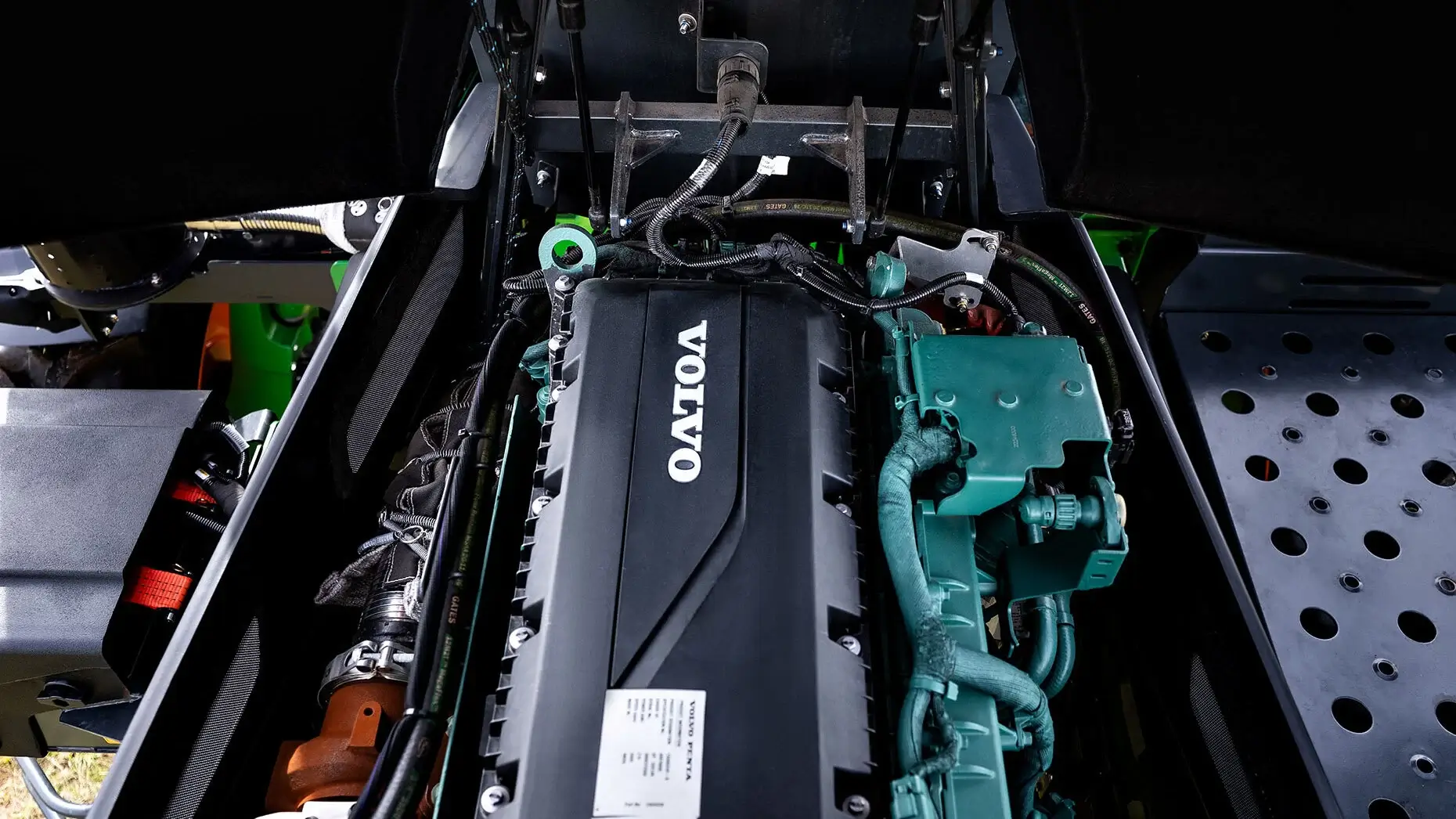
Rising fuel costs, uptime pressure, and heavy labor shortages are driving a key shift in several machine-reliant industries, including construction, forcing them to rethink equipment efficiency. A case in point is the new Volvo Penta-powered Stara Hércules 9.0, which offers a glimpse of what’s in store for off-highway equipment: significant long-term gains in engine performance.
Agriculture is already seeing measurable productivity gains from engine optimization—this points to a trend that construction fleets shouldn’t ignore. Optimizing engine performance can significantly benefit off-highway machinery by improving uptime consistency, reducing idle time, and extending engine life.
Performance gains from Volvo Penta signal a bigger shift in equipment design
The Volvo Penta D8 engine enhances productivity and improves operator performance with a 10-15% increase in working speed, reduced vibration and noise, and more consistent operation under load. It also allows operation at high torque at low RPM and a 15-20% reduction in fuel consumption.
More work completed per shift, lower fuel spend, and more consistent operation under load all have a direct impact on productivity, operating costs, and operator performance. The pressures that pushed agriculture toward engine optimization have already begun to reshape construction fleet design for the same reasons.
Why low RPM and high torque matter
Whether you’re working with dozers, excavators, compact track loaders, or generators, heavy equipment performance in construction remains a crucial talking point. It is increasingly tied to maintaining power and control under heavy load and achieving more efficient fuel usage.
Contractors are also concerned about improving machine consistency and longevity. So, how can improved designs help? With low RPM, contractors can easily reduce unnecessary fuel consumption and avoid engine strain and wear, thereby reducing the need for maintenance checks and supporting a longer lifespan.
High torque at low RPM also enables contractors to maintain steady operation under heavy loads, which is particularly important for tasks such as grading, lifting, and trenching. Meanwhile, achieving stable engine performance makes it easier to plan predictable production schedules and reduce idle time. Construction buyers increasingly care about factors like fuel burn per hour rather than just horsepower.
That shift in equipment evaluation—fuel burn per hour over raw horsepower—is significant. A machine with lower horsepower but better efficiency and lower RPM operation can outperform a high-spec machine in job-site economics. It’s the difference between buying a spec sheet and buying real-world performance.
Total cost of ownership is becoming the bigger conversation
Across the construction industry, patterns are shifting beyond the initial price tag of an asset—total cost of ownership (TCO) is becoming more important than upfront costs alone. With TCO, contractors can assess the true long-term financial impact, including operation, maintenance, and disposal costs.
The highest costs often come from fuel, maintenance, and downtime. A stalled machine, for example, can negatively impact labor scheduling, project timelines, and productivity targets.
Also, engine efficiency now affects competitiveness. Simply put, more efficient fleets can enable contractors to bid with more confidence, protect margins, and reduce operational volatility. Similarly, a 15% fuel improvement across a multi-machine fleet adds up over time.
Consider this: a contractor running a fleet of 25 machines at 1,500 operating hours per year, with each machine burning four gallons of diesel per hour, spends around $825,000 on fuel each year at current prices. With 15% fuel efficiency, they can save around $123,750 every year.
For most contractors, small productivity and efficiency gains scale massively across an entire fleet and cannot be underestimated.
How operator comfort is tied to jobsite productivity
The Volvo Penta D8 engine aims to enhance operator comfort by reducing vibration, lowering noise, decreasing fatigue, and improving comfort during long shifts. Operator fatigue and comfort are directly tied to productivity, with greater fatigue leading to reduced focus, inconsistent performance, and slower reaction times.
Skilled operators are difficult to replace due to the widespread labor shortage in construction, and one of the best ways to retain and recruit them is to ensure they have easy access to better machine environments. Less fatigue translates to better awareness, decision-making, and safety on the job. Operator-centered designs are now essential and increasingly becoming a competitive differentiator.
Prioritizing operator comfort is also a strong retention strategy. In a market where it’s becoming increasingly hard to find experienced operators, providing better working conditions through machines that offer a quieter, more comfortable, and lower-vibration environment gives operators a reason to stay.
What construction can learn from agriculture
Construction can pick up important lessons from agriculture. The latter often drives innovation in fuel efficiency, precision performance, long-duration operation, and machine uptime optimization, all of which are directly relevant to construction efficiency.
Additionally, the two industries are highly equipment-dependent and often grapple with harsh operating environments, rising costs, and labor shortages. Construction firms can benefit from watching adjacent sectors like agriculture for machine innovation trends, as many of these translate across sectors, including operator ergonomics, precision systems, and autonomous machine functions.
And while electrification is the focus of many discussions, diesel optimization continues to play a major role in construction.
Is smarter diesel the bridge before electrification?
While electrification is growing, its adoption is still uneven in heavy equipment. Infrastructure challenges remain, including power availability, runtime limitations, remote job sites, and limited access to charging. High-output diesel optimization remains highly relevant, especially for large machines and continuous-duty operations.
Smarter diesel is becoming a transitional technology—it offers several benefits like lower RPM, lower fuel burn, and improved machine performance. The industry will not switch from traditional diesel to fully electric equipment overnight, so contractors will continue to rely on diesel during this transition.
This Volvo Penta launch reflects a broader shift in off-highway equipment toward maximizing machine intelligence, fuel efficiency, and operator-centered design, ahead of zero-emission technology becoming the norm.
If sectors like agriculture are already seeing productivity gains, fuel savings, and reduced operator fatigue through engine optimization, construction fleets should expect a similar pattern to unfold and influence future equipment development. Contractors may achieve a competitive advantage not from bigger machines but by adopting smarter, more efficient systems.
Heavy equipment is getting smarter—and the gap between efficient fleets and inefficient ones is widening. To stay updated on the equipment trends and performance shifts affecting construction operations, subscribe to our weekly newsletter and follow us on LinkedIn.