Mass timber, crane-free assembly, and zero-carbon certification on a single high-rise residential project
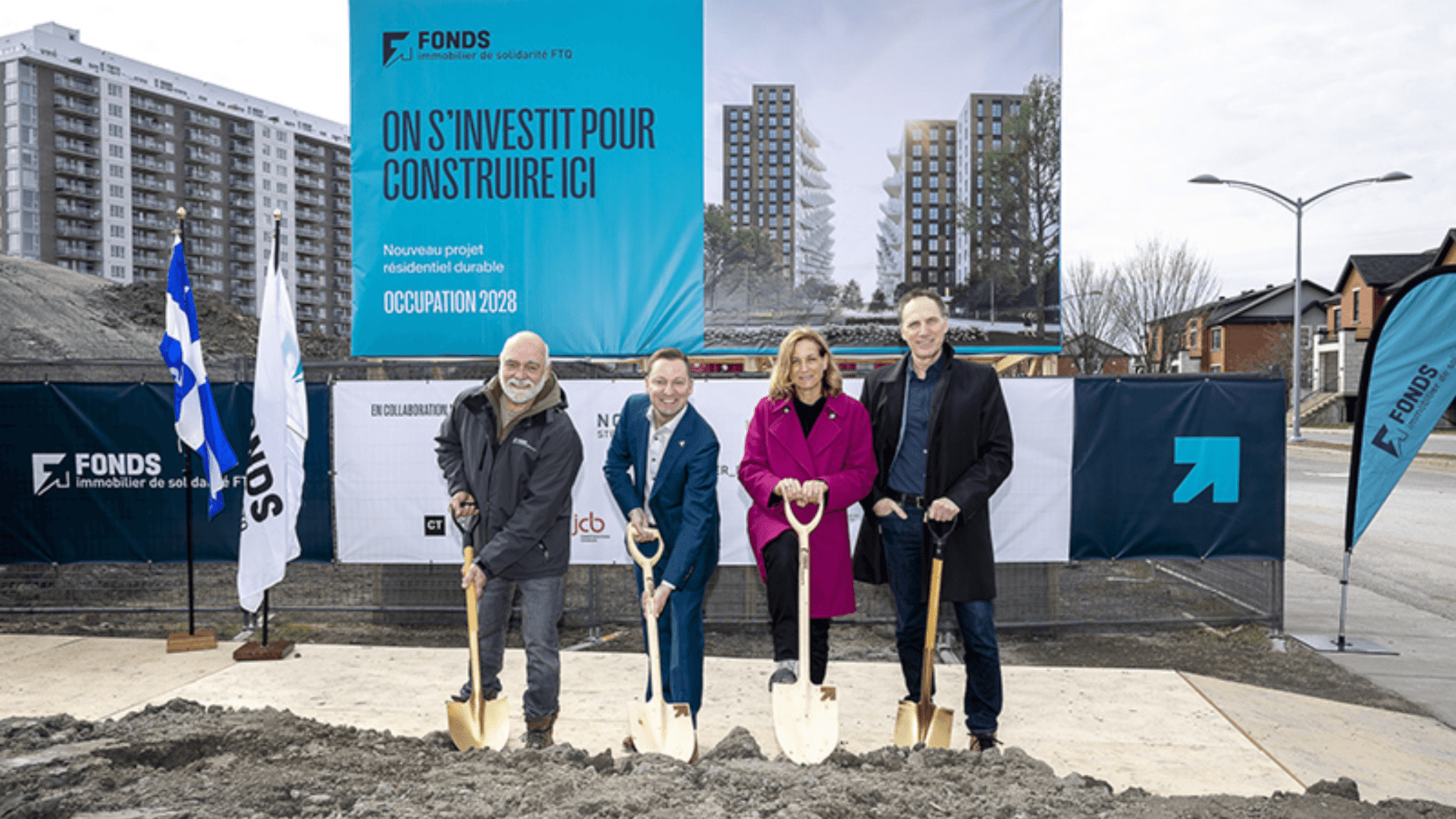
A 12-story project featuring the construction of 164 rental residential units just broke ground in Terrebonne, Quebec. Led by JCB Construction Canada, this project could potentially expand to include more than 400 residential units, built across high-rise mass-timber buildings of 12 and 18 stories on the site, making it among the first of its kind in the province.
What makes this project worth paying attention to isn’t just the height—it’s that it combines three things that haven’t been done at this scale in Canada before: mass timber high-rise construction, a crane-free assembly system, and a Zero-Carbon Building certification target. Each of those is its own story, but together they signal where high-rise residential construction in Canada is heading.
What makes this project different: 3 things worth paying attention to
Mass timber is making waves across construction projects in Canada, and it’s moved well beyond experimentation. Practically speaking, 12 stories is a significant development because it represents a shift from mass timber as a mid-rise option to a viable high-rise construction system.
With more height, mass timber projects tend to face more complex structural and fire-performance requirements than mid-rise wood buildings. Some of the key challenges include: adhering to fire-resistance and code-compliance requirements, controlling vibration and acoustics, managing moisture exposure during construction, and ensuring strong structural connections and lateral systems for taller buildings.
The industry has been proactively addressing these challenges through encapsulated mass timber systems, prefabrication, hybrid concrete-and-steel designs, advanced fire testing, performance-based engineering, and improved coordination among engineers, fabricators, and contractors.
Mass timber is moving into mainstream adoption. Institutional investors like Fonds de solidarité FTQ are increasingly backing mass timber projects because they align with ESG and decarbonization goals, support government sustainability initiatives, and enable faster, more predictable construction through prefabrication.
The upbrella system
The upbrella system is another thing worth paying attention to. It is a reduced-crane or no-crane construction system that uses a self-climbing platform, enabling construction teams to assemble floors beneath a protected enclosure. In simple terms, it creates a temporary protective roof, and the structure lifts as work on each floor is completed.
Normally, traditional systems involve exposed construction sites with open-air assembly and tower cranes moving externally. With the upbrella system, teams gain access to a more enclosed, protected area and adopt a different material-handling approach, reducing dependence on traditional crane sequencing.
The benefits are meaningful for urban high-rise sites: less congestion, a smaller footprint, improved worker safety, fewer weather-related risks, and more predictable floor-by-floor installation. In dense urban projects with limited crane space and neighborhood restrictions, these aren’t just conveniences; they’re schedule and cost variables that impact whether projects are completed on time.
The residential project in Terrebonne is unique because it is the first time the upbrella system has been used on a high-rise residential project in North America. This may point to a shift toward growing trends in high-rise construction, such as prefabrication, enclosed construction methods, modular systems, and more.
Zero-carbon certification and what it requires
This project is working towards achieving the Canada Green Building Council’s ZCB-Design certification. This certification requires operational carbon reduction, tracking of embodied carbon, and energy performance targets, along with detailed documentation.
Contractors and construction teams focusing on this certification would have to manage material reporting, emissions documentation, and increased coordination with suppliers and consultants.
The project is being supported by Quebec’s Wood Construction Innovation Program, which was created to advance taller and more advanced timber buildings. It signals continued government support for low-carbon construction and the adoption of mass timber in large-scale projects.
The broader implication is that ZCB and similar sustainability certifications are increasingly appearing as procurement requirements for institutional and public projects. Low-carbon documentation and reporting capabilities are becoming a part of what it takes for contractors to be competitive on this type of work.
What this means for contractors
There is a growing pipeline of mass timber high-rise residential projects in Canada. Contractors who want to pursue this kind of work will need to focus on growing their expertise in prefabrication, timber installation, carbon reporting, and integrated project delivery.
They’ll also need to coordinate with experienced subcontractors who can support them. Mass timber projects depend on precise sequencing, prefabrication, and installation expertise, making subcontractor relationships even more important to avoid performance issues.
Integrated project delivery is often an essential part of mass timber projects, which means early coordination among architects, structural engineers, fabricators, and GCs is critical, leaving little room for siloed workflows.
Contractors will also need to keep embodied-carbon reporting expectations in mind, as ZCB and similar certifications require them to actively document and report on the carbon impact of construction activities and materials. Sustainability compliance will essentially become a crucial part of project delivery.
Where high-rise mass timber is heading in Canada
Building code changes have enabled construction teams to focus on taller wood buildings in Canada. There is a growing pipeline of multi-family construction, along with institutional and mixed-use timber projects in Canada, reflecting a trend contractors should pay attention to.
Over the next five years, contractors can expect more hybrid timber systems and prefabrication, increased contractor specialization, and wider adoption in more provinces beyond Quebec and British Columbia as mass timber projects become more mainstream.
This project points to a strong possibility—high-rise residential projects in Canada may increasingly be low-carbon, timber-based, and highly coordinated. Contractors who focus on mass timber delivery, carbon compliance, and integrated project coordination will likely be better positioned as this segment continues to grow.
Mass timber is one of the fastest-moving segments in Canadian construction. Stay updated with the latest developments and trends shaping how it gets built by subscribing to the Under the Hard Hat newsletter.