
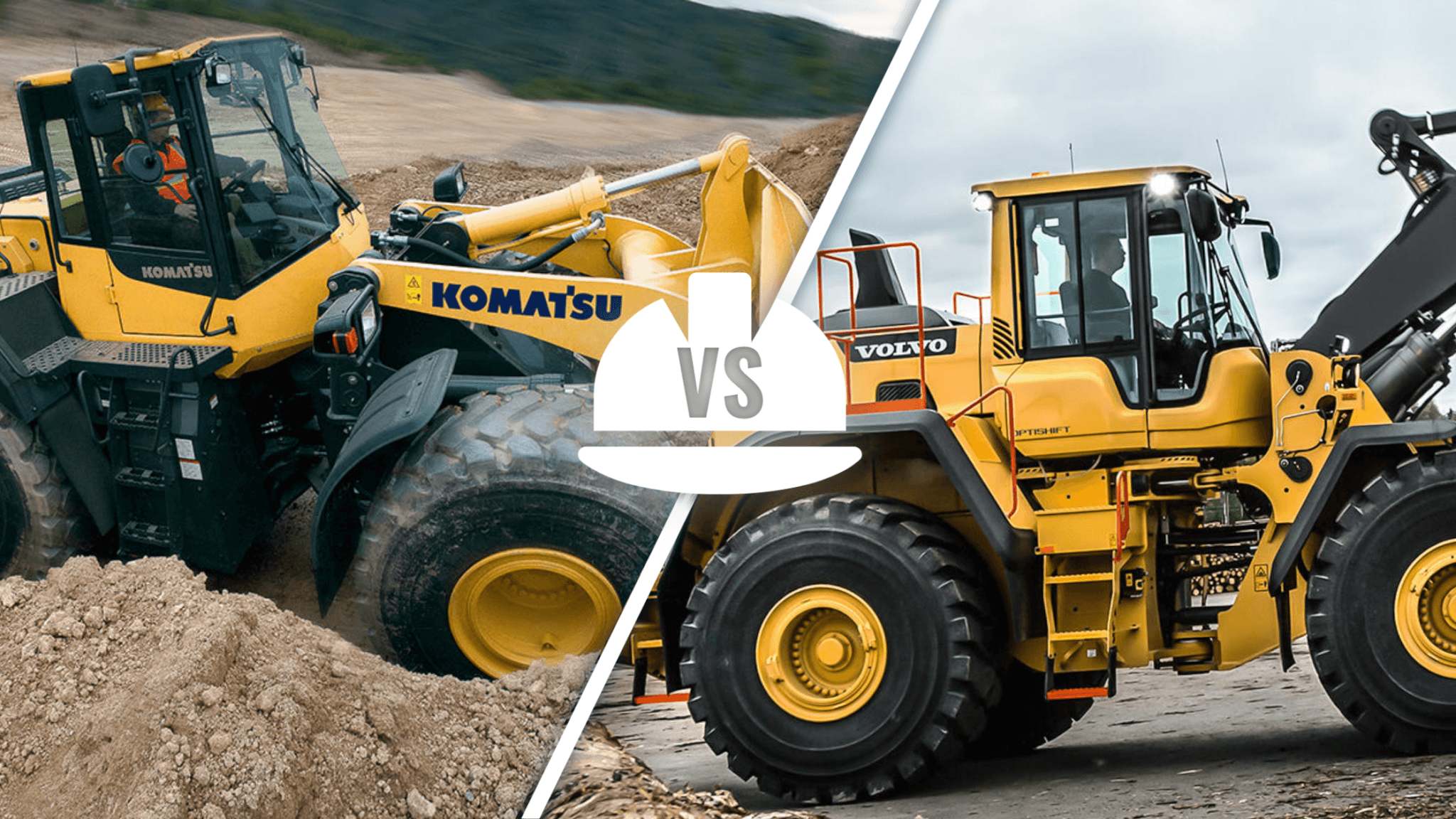
If you’re comparing Volvo and Komatsu wheel loaders, you’re looking at two companies that build machines for heavy-duty production work. These loaders show up on sites where uptime matters, and delays cost money. This breakdown compares the Volvo L150H and the Komatsu WA470-8—how each performs in terms of power, comfort, cost, and day-to-day usability. They’re close in size and purpose, but they approach the job a bit differently.
Volvo L150H
The Volvo L150H is built for high-output work. With 300 horsepower and a focus on operator comfort, it’s designed to move material fast without wearing out the operator in the seat. The cab is quiet, visibility is top-notch, and the controls feel smooth through a full shift—this matters when you’re loading for hours on end.
Komatsu WA470-8
The Komatsu WA470-8 takes a more balanced approach, trading some horsepower for consistency. It delivers steady, controlled performance through the full work cycle. Komatsu’s systems focus on reducing fuel consumption without forcing the operator to adjust their work. The cab is practical, durable, and built for long-term use. It’s the kind of machine that performs the same way from the first hour to the last.
Volvo L150H vs Komatsu WA470-8 specs comparison
| Spec | Volvo L150H | Komatsu WA470-8 |
| Engine power | 300 hp | 272 hp |
| Operating weight | 56,000–61,000 lbs | 53,000–55,000 lbs |
| Bucket capacity | Up to 9.5 yd³ | Up to 7.2 yd³ |
| Transmission | Volvo automatic power shift | Komatsu automatic |
| Hydraulics | Load-sensing | Closed-center load sensing |
| Fuel systems | Eco mode | SmartLoader Logic |
| Focus | Power + fuel savings | Control + consistency |
Volvo vs Komatsu: which one packs more punch?
Volvo L150H: a major boost for heavy-duty applications and high productivity

Because the Volvo L150H packs a punch with 300hp, there’s extra room to breathe when things start getting tough. That extra power really comes into play when you’re pushing against a dense pile, loading wet or compacted material, or grinding in a quarry where resistance can sneak up fast.
That extra power makes a difference during a full work cycle:
- You can keep on working when digging into a hard-packed pile; there’s no need to keep fussing with the throttle.
- On jobs where buckets are loaded to the max, the Volvo keeps moving without stumbling mid-cycle.
- In places where you’re pumping out material at top speed, that quicker response pays off by getting more done in less time.
The machine is built to stay productive when conditions aren’t ideal. Heavy loads, uneven material, or longer push distances are where it starts to separate. The trade-off is fuel consumption. Running at full output all day burns more than a machine that manages power automatically—something that’s worth factoring into operating costs on long shifts.
Komatsu WA470-8: precision power for a steady, repetitive grind

The Komatsu WA470-8 doesn’t have as much horsepower as some comparable machines, but it has a real ace up its sleeve. This system lets you dial in power in a way that keeps the machine working steadily, rather than just revving up to max and then falling back off.
That’s a different feel in the real world:
- Loading cycles are a breeze: it settles into a smooth rhythm and keeps working all day long.
- When you’re dealing with consistent material, you get a machine that works at a steady clip with no surprises.
- When your site has multiple tasks underway, it’s easier to keep the machine from getting overworked.
The WA470-8 uses systems such as SmartLoader Logic to automatically adjust engine torque, helping match power to the task without requiring constant operator input. For sites where work is repetitive and predictable, the automatic adjustments are worth more than raw power. Because the machine manages itself, fuel costs stay manageable, and there’s less stress on operators over long shifts.
Ease of use and ergonomics: which is more beginner-friendly?
Volvo leans into comfort. The cab is quieter, controls are more refined, and visibility is excellent. That makes long shifts easier, especially for operators who spend full days in the seat.
Komatsu keeps things straightforward. The layout is simple, controls are predictable, and there’s less of a learning curve for someone stepping into the machine.
For newer operators, Komatsu may feel easier to pick up. For experienced operators running long shifts, Volvo’s cab comfort pays back over time in less fatigue and more sustained output. If you’re training new operators regularly, that learning curve matters.


Which one gives you the most bang for your buck?
Both machines are similarly priced, so their value depends on how you plan to use them.
Volvo tends to deliver value by focusing on getting the job done faster. With faster cycle times and more power on tap, you can get through the big pile of material in half the time, which, on high-volume jobs, is a big deal.
Komatsu, on the other hand, delivers value differently. Its systems help you use less fuel without changing how you operate, which may not sound like much, but can really add up over time.
Here’s an easy way to think about it: if you run a site with high-volume production work, the Volve’s faster cycle times likely justify paying more in fuel costs. If your site runs steadier and more varied work, the Komatsu’s better fuel efficiency isn’t visible day-to-day, but becomes visible in monthly operating costs.
What extra features do they come with?
Volvo’s main goal is to make your work easier and more efficient:
- They offer an eco mode that helps save fuel when you’re not under a heavy load.
- Their hydraulics provide a smooth response, allowing you to complete the job faster.
- The cab is designed so you can see exactly what you’re doing.
Komatsu, on the other hand, prioritizes reducing waste and streamlining your operations:
- With SmartLoader Logic, the engine automatically adjusts to give you just the right amount of power.
- There’s the auto-idle shutdown, which saves fuel when the machine isn’t in use.
- They also have a system called closed-center hydraulics, which helps with controlled movement.
The main difference is how you use the machine. Volvo’s features are great if you’re often loading up and down. Komatsu’s features are better suited to managing downtime and maintaining consistency.
Pros and cons summary
Volvo L150H
Pros:
- Higher horsepower
- Faster cycle times
- Operator comfort within the cab
Cons:
- Fuel use can be higher when you’re working flat out
- The systems are a bit more complicated
Komatsu WA470-8
Pros:
- The operation is smooth and controlled
- Fuel use is good even when workloads are changing
- It’s easy to set up and reliable
Cons:
- Not as much horsepower as some of the other models
- Cycle times can be slower in high-production work
Which wheel loader should you buy?
If your work involves heavy material, tight timelines, and high production targets, the Volvo L150H is hard to beat. It’s built to move more material in less time.
If your work is a bit more varied with some steady loading, plenty of mixed-up tasks, and perhaps some downtime in between, then the Komatsu WA470-8 might be what you need. It’s reliable, consistent, and easy enough to manage on a day-to-day basis.
Both are good options; the deciding factor is which one fits your workplace better.
Final thoughts
Comparing loaders like these comes down to how they perform over full days. Power, comfort, and fuel use all show up over time. Small differences in cycle speed, operator fatigue, and fuel burn don’t always stand out right away, but they add up across weeks and months of work. The better machine is the one that fits your site conditions and maintains steady productivity without adding unnecessary strain on the operator or the budget.
Check out our other gear comparisons here:
- Ryobi vs Milwaukee: Who makes the better shop vacuum?
- Stihl vs Husqvarna: Who makes the better chainsaw?
- The 7 best portable band saws
- The best space heaters for the construction site
Choosing the right equipment starts with understanding how machines actually perform on site—not just what’s on the spec sheet. For more practical gear comparisons and equipment breakdowns, follow us on LinkedIn and subscribe to the Under the Hard Hat newsletter.