

If you’re an avid stock market investor, it likely doesn’t come as a surprise that the hype around artificial intelligence (AI) is translating to an AI spending frenzy. At first, this spending on AI resembled the dotcom bubble. However, more recently the AI investments have been boosting the economy due to the need to build the infrastructure to power Ai. But whether or not that’s a long-term trend remains to be seen.
It’s not the output of how AI companies are using new tech that boosts the economy. Rather, the boom comes from a tidal wave of investment into data centers. These facilities serve as semiconductor factories, supplying computing power to the ever-increasing demand from AI products and users.
The investment bank UBS estimates that in 2025, companies will spend $375 billion globally on AI-related infrastructure, and it is projected to grow to $500 billion by next year. Outside of the data center buildings themselves, investments in the software and other computer equipment account for a quarter of all economic growth this past quarter.
Both private equity and big tech have been contributing to the wave of cash, which was sparked in part by the fading of Biden-era infrastructure subsidies. The stop-and-go tariffs have been halting decision-making and inflating borrowing costs, deterring more historically lucrative projects, such as warehouses and residential housing.
The data center boom has been a positive for those in the trades. Engineers, heavy-equipment operators, and electricians in the thousands have been finding new work. These jobs partially account for steady construction employment, as warehousing, commercial, and residential work has lessened.
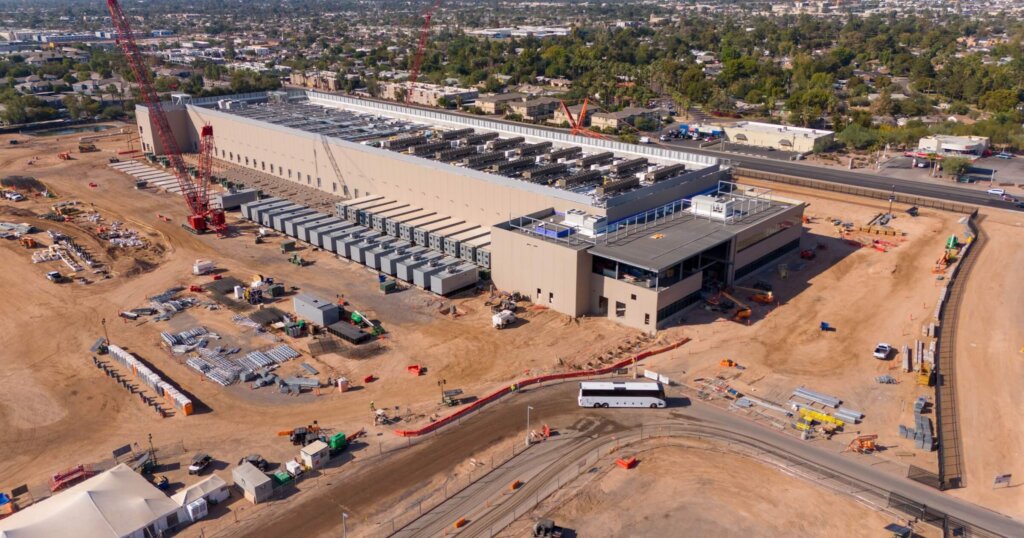
Data centre being built in the US. Photo courtesy of Shutterstock.
The spike in the economy doesn’t come without fear of a pullback, though. OpenAI’s CEO, Sam Altman, recently raised concerns by remarking on the “overexcited” sector, warning that some key players will lose a significant amount of money. Investors are currently reassuring themselves that while there may be a dip, it won’t be catastrophic. A diverse group of lenders finances data centers, and leases are typically ironclad, meaning landlords are well protected in the event a tenant pulls out.
And in the small chance AI doesn’t live up to the hype? Internet tech is still growing quickly. The use of these data centers is likely to be absorbed, AI or not. As it stands, the vacancy for these centers is close to zero. And any future projects are already spoken for well in advance.
In the next several quarters, the shift in AI demand and data center construction is more likely to be driven by resources. Labor, water, energy, and computing equipment may be more challenging to source than other elements, especially as inflation rises. Local communities have started to resist and protest the new developments, as in some cases, concerns of poor land use and drinking-water contamination have arisen.
So whether your company or industry is all-in on AI or not, the tech you use is driving the data-center demand and boosting the economy. Hopefully, we’ll see a swing in sustainability efforts in tandem, sooner rather than later.
For the latest on AI tech in the AEC space, subscribe to the Under the Hard Hat newsletter, and follow us on LinkedIn!

