
Many communities across the United States still struggle to access fast, reliable internet, and this gap limits access to schools, jobs, and basic services. This first article in our Radical Ideas in AEC series looks at a simple question that could change that: What if broadband were treated like water or power in every project we build?
Quick look
- Broadband should be treated like a core utility to close digital divides and support access to education, jobs, and public services.
- The AEC industry can lead change by integrating broadband infrastructure into projects from the start, just as water or power is.
- Cities like Miami and Chattanooga offer real examples of integrating broadband into community design to improve equity and opportunity.
- Federal funding and partnerships are key to making universal internet access a reality, and AEC teams play a crucial role in delivering it.
Public reporting shows that wealthy neighborhoods often get fast service while many low-income areas still do not. This digital gap holds people back and makes it harder to move ahead. That is why some leaders are calling for the internet to be seen as a basic utility.
Why broadband should function like a core utility
A lot of real life happens online. The UN’s Universal Declaration of Human Rights highlights everyone’s right to participate in their community’s culture and to share in new ideas. This doesn’t imply that everyone should have access to memes and cat videos, but it does show why access matters.
It is virtually impossible to live, work, or learn without the internet. Online access now supports almost every part of daily life, including school, healthcare, and most jobs. When people can’t get online, they miss out on learning, on connecting with others, and on taking part in everyday life. That is a big reason why more cities are starting to see broadband as a basic service, not a luxury.
Internet access is also tied to economic mobility. People with reliable service can search for jobs, join training programs, take online classes, and stay connected to their communities. Without that access, it becomes much harder to move ahead. Wealthier neighborhoods often enjoy fast, dependable service, while many low-income communities still struggle to receive the same level of support.
Global research also shows a clear link between digital access and a person’s ability to build a stable career and improve their quality of life. When people can get online, they can join the modern economy. When they can’t, the gap grows wider.
Treating broadband like a core utility would help close these divides and give more people a fair shot at the tools they need to succeed.
The digital divide as an equity challenge AEC can help solve
Across the United States, many communities still live in broadband deserts. These gaps often line up with poverty, race, and places that have faced years of low investment. In many cities, families in higher-income areas get fast and reliable internet, while lower-income neighborhoods continue to wait for the same level of access. Reports also show that internet providers often build first in affluent zip codes, widening the gap further.
This divide creates real issues for children and schools. Students in neighborhoods without strong internet have a harder time joining online classes, finishing homework, or accessing digital tools that other students use every day. Leaders who study school design and citywide planning have identified how fair access to technology is now a key part of building strong learning environments.

School children using laptops in developed high-income school.
This is where the AEC industry can play a major role. When broadband is included early in planning and design, it becomes part of the basic infrastructure that supports communities. Future-ready neighborhoods, schools, and public spaces can be built with digital access at the same level as water, roads, and power. This mindset helps close the divide and gives more families a fair chance to learn, work, and grow.
Miami is a proving ground for treating broadband like water
Miami shows how a city can rethink its basic services. When Manny Diaz was mayor, he wanted every resident to have a fair chance to learn, work, and stay connected. He pushed for clear goals and practical steps that could help the whole community, especially families that had been left out in the past. “You have to set a goal, you have to set a vision, you have to communicate that to people,” he said. “For me, those ought to be big ideas, big dreams.”
While serving in state leadership roles, Diaz supported state efforts to speed up broadband expansion in unserved parts of Florida. One key 2021 bill made it easier for internet providers to attach equipment to existing utility poles at a low promotional rate, helping reduce build times and costs.
Later, as Florida’s Commissioner of Education, Diaz also focused on growing the workforce needed to install and maintain new fiber networks. Strong broadband requires trained people in the field, and the state worked on programs to prepare students and workers for these jobs.
Digital access has been part of his work for a long time. Earlier in his career, after serving as Miami’s mayor, Diaz was vice chairman of the Alliance for Digital Equality. The group raised awareness about access to technology in underserved communities and pushed for fair opportunities for all families to connect.
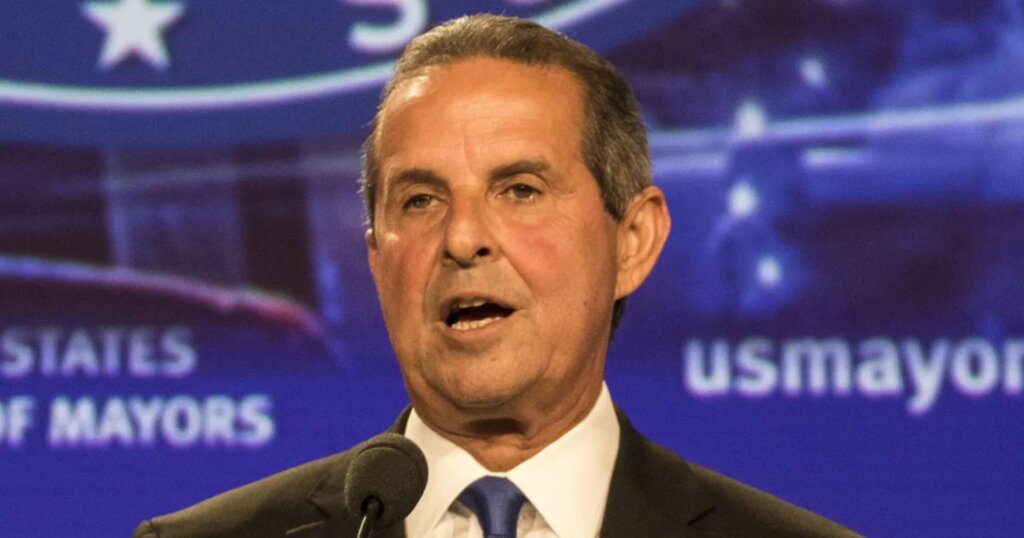
Manny Diaz, former Miami mayor giving a speech.
Many of Diaz’s ideas match today’s push to treat broadband like a basic utility. He believed that digital equality was part of economic opportunity, along with housing, jobs, and education. He also believed that the government had to show communities that it cared. “That’s something that has to be true in every neighborhood in your city,” said Diaz. “You have to be a true partner when you’re out talking to the private sector about investing in your city. They need to feel that a handshake means something, that your word means something, and that you’re going to be their partner.”
Miami continues to explore strategies to expand access to technology for families and schools. Diaz’s leadership with Miami 21 shows how a city can think about infrastructure in a more holistic and human way. “Miami 21 repeals an archaic zoning code with sustainable zoning and land use policies that promote great urban design,” said Diaz. “It is a code that does not focus on what is forbidden, but rather on what is desired.”
Lessons from other U.S. cities and states
Miami is not alone in treating broadband like a fundamental building block of city life. Across the country, other places are testing what it looks like when the internet is planned more like water or power and less like a luxury product.
Chattanooga, Tennessee
The public utility EPB built a citywide fiber network that delivers high-speed internet to homes and businesses. Over 10 years, independent research has found that the network has generated billions of dollars in community benefits and supported jobs, power grid upgrades, and improved service for local schools. One program, HCS EdConnect, uses that same network to give free high-speed internet to low-income families with K–12 students so kids can stay connected to their classes at home.
Detroit, Michigan
Detroit is taking a different but related path. The city has a Digital Access Policy and Strategic Infrastructure Plan that asks a simple question. What if schools, health systems, and residents could connect directly over public fiber rather than relying solely on traditional internet providers? Detroit is using detailed maps and community data to target neighborhoods with the greatest need and guide new open-access fiber projects in areas left behind.
Colorado and Utah
Out west, some states are showing how open-access fiber can invite more competition and reach more people. Colorado has supported middle-mile fiber that local networks can use to extend service into rural and small-town communities. In Utah, the UTOPIA Fiber network is owned by a group of cities and operates as an open-access network, meaning many private internet companies can offer service over the same public fiber. This model helps bring high-speed connections to homes and businesses while giving residents more choice.
New York
New York City offers another important lesson. Its Internet Master Plan set a goal of universal, affordable broadband, with a special focus on public and affordable housing. The city has launched projects that bring high-speed service at no or low cost into selected buildings, with clear rules on speed, pricing, and privacy for tenants. Programs like Big Apple Connect and newer pilots build on that vision and demonstrate how housing and broadband policies can work together.
How broadband as a utility changes AEC
Treating broadband like a utility would reshape how cities plan, design, and build. It affects everything from zoning and permitting to the way communities think about long-term growth. If internet access is expected in every home and public space, then planners and builders can make it part of the basic checklist, just like water, power, and roads. This helps create stronger neighborhoods and avoids delays or costly retrofits later.
For new builds:
- Plan space for fiber pathways, smart panels, and network equipment early in design.
- Add shared connection points in multi-family buildings, schools, and public facilities.
- Building this in from the start makes projects smoother and gives residents fast, reliable service on day one.
For older buildings:
- Many homes and schools still use old wiring or layouts that slow down installation.
- Planning for retrofits helps older neighborhoods catch up to new developments.
- Communities can save money by pairing broadband upgrades with other improvement projects.
For workforce and training:
- Strong broadband helps workers take online classes, join training programs, and build new skills.
- Tradespeople can access safety courses, certifications, and continuing education at their own pace.
- Employers benefit from a larger and more flexible pool of talent.
When AEC professionals treat broadband as a core utility, they help build cities where everyone can join the modern economy. It creates fairer access to learning, better job opportunities, and stronger communities that are ready for the future.
Policy, funding, and cross-sector partnerships
Cities can’t do this work alone. They need support from federal programs, state partners, and the private sector.
The National Endowment for the Arts’ Mayors’ Institute on City Design brings mayors and design experts together to talk through real planning challenges. The conversations help leaders see how design, equity, and funding connect, which makes it easier to treat broadband as part of a city’s basic toolkit instead of an afterthought.
There is also a major wave of federal funding available right now. The Infrastructure Investment and Jobs Act includes about $65B for nationwide broadband expansion. The largest piece is the BEAD Program, which provides $42.45B to help states build networks in unserved and underserved areas.
Other NTIA programs support this work too:
- The Middle Mile Broadband Infrastructure Program helps fund fiber routes between communities, lowering the cost of reaching homes.
- The Tribal Broadband Connectivity Program supports service, equipment, and digital skills on Tribal lands.
For the AEC industry, this means policy and design must work together. Cities manage zoning and permits, broadband providers handle network operations, and AEC teams know how to build the physical infrastructure. When these groups coordinate, projects move faster, cost less, and reach more people. When they work alone, progress slows.
Working together also helps make new homes, schools, and public buildings “broadband ready” from day one, which is the foundation of more connected and more equitable communities.
What equity-focused broadband infrastructure could look like
Thinking of broadband as the “new waterline” means treating internet access as a basic right for every home, school, and neighborhood. Manny Diaz often talked about setting big goals for the future. He said leaders should “aim high” and build systems that match the needs of a modern city. Broadband fits this idea because it supports everything people rely on today, from schoolwork to job training to basic public services.
At the subdivision level, a broadband first approach means adding fiber pathways, shared connection points, and smart panels the same way builders plan for water and power. This helps new homes stay connected from day one. At the street level, cities can place conduit under sidewalks and roadways during construction.
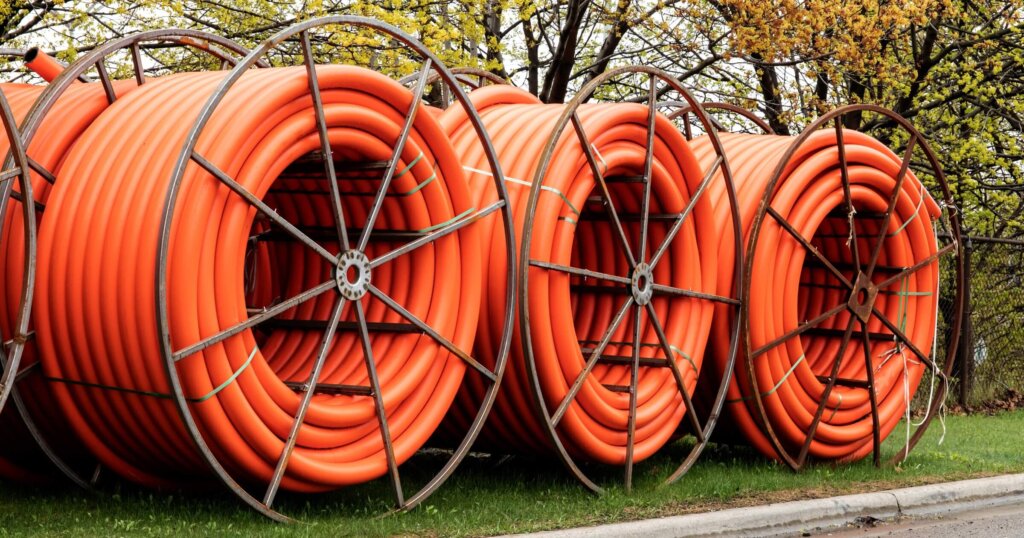
Spools of orange fiber optic conduit on a mobile reel for fiber optic cable installation.
Schools would see major benefits too. Diaz viewed education as the center of community life and said, “The sustainability of a city and of the people in that city begins and ends with education.” His Elevate Miami program, which provided free laptops and internet to sixth graders who completed a life skills curriculum, showed how digital access can help students learn and grow. A school built or updated with strong broadband can support digital assignments, online classes, and community programs after hours.
At the city scale, broadband-as-a-utility benefits everyone. People can find jobs, join training programs, or learn new skills online. This helps families build better futures, which connects directly to the World Economic Forum’s Social Mobility indicators (health, education, technology, work, and institutions). Telehealth becomes easier, especially for older adults or people without transportation. Public services like emergency alerts, school updates, and permit applications also work better when everyone can get online.
Community-wide broadband creates the kind of opportunity that helps people move ahead. It supports education, jobs, health, and daily life. When cities and builders treat broadband like a core utility, they create stronger neighborhoods and give more residents a fair chance to succeed.
Final thought
The goal of the Radical Ideas in AEC series is to look at bold ideas that help communities grow in fair and meaningful ways. Treating broadband like a utility is one of those ideas. It asks us to see internet access the same way we see water, power, and safe streets. When we build stronger digital foundations, we open doors for education, jobs, health, and everyday connections.
Radical Ideas in AEC also reminds us that infrastructure is more than pipes or pavement; it is a tool for equity. When we plan with people in mind, we help every neighborhood move forward. Cities like Miami and others across the country show what can happen when leaders set a clear vision and follow it with strong partnerships and smart investment.
Broadband as a utility is a direct way to help people compete and thrive in a changing world. As Manny Diaz said, “If your residents can’t compete, then your city can’t compete.”
If you enjoyed this piece and want more stories like it, subscribe to our newsletter to stay connected.