

Carpenters play a primary role in building homes, offices, and community spaces across the country. As older workers retire and demand for new buildings continues, there are thousands of job openings each year for people ready to pick up the trade. The main pathway into the field is through a carpenter apprenticeship, where you can earn a paycheck while learning skills that prepare you for a stable and rewarding career. In this article, you’ll learn what a carpenters apprenticeship is, how long it lasts, sample programs, entry requirements, daily life, salary expectations, and whether this path might be right for you.
Quick look
- A carpenter apprenticeship combines on-the-job learning (with pay) with classroom instruction.
- Most carpenter apprenticeships last 3–4 years with thousands of hours of training.
- Pay for apprentices starts around $18–$25/hour, moving up to $28–$35+/hour as journeymen.
- Carpenters union apprenticeship, non-union, and specialty programs offer multiple entry routes into the trade.
What is a carpenter?
A carpenter is a skilled tradesperson who builds, erects, and repairs structures made of wood, steel, and other materials. That means they frame walls and roofs, install finishes, build stairs, or even craft custom woodwork. Their day-to-day work blends planning and hands-on skills.
Their work is essential because almost every building needs a carpenter’s touch. With strong demand for housing and infrastructure, there is an ongoing need for skilled carpenters. At the same time, many in the construction trades are aging. Over 20% of U.S. construction workers are 55 or older, meaning many will retire in the years to come.
The U.S. Bureau of Labor Statistics reports that carpentry employment is projected to grow 4% between 2024 and 2034. In that same period, about 74,100 job openings per year are expected, accounting for both growth and replacing workers who leave or retire. Because carpentry demands both technical knowledge and hands-on skills, an apprenticeship—a mix of on-the-job training and classroom instruction—is the most common route.
What is a carpenter apprenticeship?
A carpenter apprenticeship is a structured program that combines on-the-job training (OJT) with classroom instruction. Instead of sitting in school full-time, apprentices split their learning between working on real jobsites and attending scheduled training sessions. This “earn while you learn” model enables individuals to gain skills, gain experience, and earn a salary simultaneously.
Initially, apprentices concentrate on straightforward yet essential tasks, such as measuring lumber, learning to handle tools safely, and grasping fundamental construction principles. As skills grow, responsibilities expand. By working under the mentorship of experienced journeyman carpenters, apprentices progress from basic support work to more advanced tasks, such as framing, finishing, and interpreting blueprints.

A tutor guides a student in a workshop as they study for a carpentry apprenticeship. Photo courtesy of Shutterstock.
The classroom side of training usually covers trade math, blueprint reading, materials science, and building codes. Safety is emphasized throughout, along with carpentry techniques and project planning. Together, these lessons prepare apprentices for the full range of tasks they’ll face in the field and give them a strong foundation for a long and successful career in the trade.
How long is a carpenter apprenticeship?
Most carpenter apprenticeships take approximately 3 to 4 years to complete, although some can extend to 5 years depending on the region and program standards. During that time, apprentices typically log between 6,000 and 8,000 hours of on-the-job training (OJT) in addition to 400 to 600 hours of classroom instruction. This balance ensures that new carpenters develop both technical knowledge and practical skills.
A good example is the Carpenters Training Institute, which runs a program that requires about 7,000 hours of OJT and 640 hours of classroom study. Apprentices progress through a clear structure, starting with basics and gradually taking on more complex projects under the supervision of a journeyman.
Pay also improves as apprentices progress. Most programs use a wage scale where apprentices earn a percentage of journeyman pay. Each year, as skills increase, so does the paycheck, making it easier to learn the trade without taking on debt.
Top carpenter apprenticeship programs across the U.S.
If you’re ready to start training, here are some of the best places to look. These programs offer a combination of hands-on experience and classroom learning, while compensating you as you progress.
| # | Program name | Location(s) / region | Length/structure | Application/info link |
| 1 | Carpenters Training Institute (CTI) | Midwest U.S. (Iowa, Minnesota, Nebraska, North Dakota, South Dakota, Wisconsin) | 4 years, ~7,000 OJT + 640 classroom hours | CTI Apprenticeship Programs |
| 2 | Ohio Carpenters’ Joint Apprenticeship & Training Program (OH-CAP) | Ohio | 4-year union apprenticeship; wages ~60–95% of journeyman scale | OH-CAP Apprenticeship Info |
| 3 | Central Midwest Carpenters Regional Council (CMCRC) Apprenticeship | Indiana, Kentucky, Ohio | 4 years, earn-while-you-learn | Central Midwest Carpenters Apprenticeship |
| 4 | Northeast Ohio Carpenters JATC (Joint Apprenticeship Training Committee) | Northeast Ohio | 4 years; ~650 OJT hours per half-year + 160 classroom hours annually | Cleveland Building Trades JATC |
| 5 | North Atlantic States Carpenters Training Fund (NASCTF) | Northeast U.S. (CT, MA, ME, NH, NY, RI, VT) | 4 years, competency-based classroom + OJT | NASCTF Become an Apprentice |
| 6 | Nor Cal Carpenters Training (CTCNC) | Northern California | 4-year union apprenticeship under the UBC model | Nor Cal Carpenters Training |
| 7 | New York City District Council of Carpenters Training Center | New York, NY | Multi-year; includes orientation, testing, and classroom + OJT | NYC Carpenters Training Center |
| 8 | Western States Carpenters Training Fund (WSCTF) | Western U.S. (AZ, CA, CO, NV, NM, UT, WA) | Offers pre-apprenticeship and apprenticeship pathways | WSCTF Training Info |
These programs are among the largest and most established nationwide, offering aspiring carpenters multiple paths depending on their location.
General entry requirements for carpenter apprenticeships
Entering a carpenter apprenticeship typically involves meeting a few basic requirements. While each program can be a little different, most of them look for the following:
- Minimum age: You must be at least 17 or 18 years old, depending on the program.
- Education: A high school diploma or GED is often required, though some programs may accept equivalent experience.
- Identification: A valid driver’s license or state ID, especially if job sites require travel.
- Math and reading skills: Since carpenters read blueprints and work with measurements, many programs test for basic aptitude in these areas.
- Physical fitness: Carpentry is a hands-on and physically demanding profession. Apprentices should be able to lift heavy materials, climb ladders, and work outdoors in different weather conditions.
- Drug screening and background checks: Many union programs require drug testing, and some also run background checks for safety reasons.
- Letter of intent to hire: Certain union apprenticeships may ask for a letter from a signatory contractor before enrollment.
- Legal work status: Most U.S. programs require proof of eligibility to work in the country.
Meeting these requirements helps ensure that apprentices are well-prepared for both the classroom and the job site’s demands.
Types of carpenter apprenticeships
Not all carpenter apprenticeships look the same. Depending on where you live and what kind of career path you want, you’ll find several types of programs:
- Union vs. non-union: Union apprenticeships are some of the most common. They usually offer substantial benefits, collective bargaining power, and access to job placement networks after graduation. Non-union programs may not have the same benefits, but they can sometimes be more flexible and vary depending on the employer or region.
- Employer-based programs: Some large contractors and government agencies run their own apprenticeship tracks. These programs often train workers for specific types of projects, such as public buildings or infrastructure.
- Pre-apprenticeship programs: If you’re not quite ready for a full apprenticeship, pre-apprenticeships are a stepping stone. For example, the Eastern Atlantic States Regional Council of Carpenters (EASRCC) CARP program gives participants a pipeline into union apprenticeships, helping them prepare for the rigors of both training and jobsite work.
- Specialties/subclasses: Carpentry has many branches. Some apprenticeships focus on formwork carpentry for concrete, finish carpentry for detailed interior work, cabinetmaking, scaffolding, or other specialties. Choosing a focus can shape your career path and the kinds of projects you’ll work on long-term.
What daily life looks like during a carpenter apprenticeship
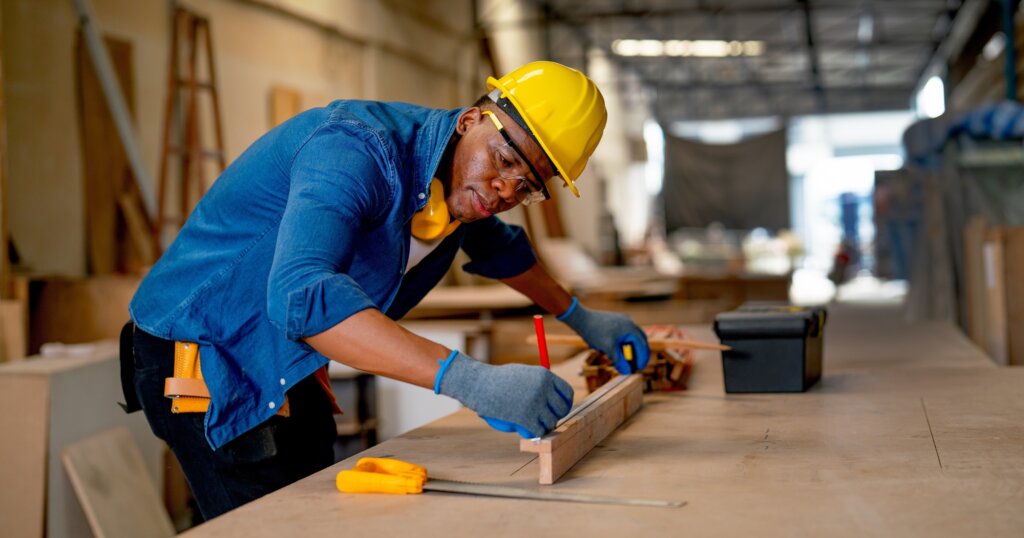
A carpenter marks a piece of timber with a pencil while working in a wood factory. Photo courtesy of Shutterstock.
Life as a carpenter apprentice is a blend of learning and hands-on work. Most days start early on the jobsite, and the work can be physical and demanding. You’ll spend a lot of time outdoors, lifting materials, using tools, and working alongside journeyman carpenters who guide you through new tasks.
Classroom instruction is also built into the schedule. Many programs offer classes in the evenings or dedicate one day a week to training. That’s where you’ll learn trade math, blueprint reading, safety, and the theory behind the hands-on skills you practice on site.
Initially, the work is straightforward. Apprentices often start by assisting journeymen, cleaning up job sites, and measuring or cutting basic materials. Over time, you’ll move into framing, finishing, and more detailed work. By your third or fourth year, you may be laying out projects, mentoring new apprentices, or even leading small portions of the work. Travel is sometimes part of the job as well, especially for larger projects that require extra manpower.
Average carpenter salary in the U.S.
Figuring out what you might earn as a carpenter depends on experience, location, and whether you’re union or non-union. But here are some real numbers to help you get a ballpark idea.
Entry-level/apprentice pay
- According to the BLS, the bottom 10% of carpenters earned about $18.00/hr in May 2023.
- Many apprenticeship programs pay a percentage of the journeyman wage, typically ranging from 40% to 60% of the full journeyman pay.
- Some estimates for more beginner or apprentice-level carpenters put the range closer to $15 to $20/hr.
Journeyman carpenter/post-apprenticeship pay
- Fully-trained carpenters earned a median hourly wage of $27.09/hr (that’s the 50th percentile) as of May 2023.
- The 75th percentile is about $34.75/hr, and the 90th percentile reaches $45.47/hr.
- Online sources list the current average hourly wage for a journeyman carpenter at around $30.34.
- Union carpenters often command higher rates.
Regional and union/non-union differences
- Wages tend to be higher in big cities, states with a high cost of living, and in unionized markets. For example, in Northern California, the NorCal carpenters’ union shows journeyman rates as high as $67.01/hr (for some districts), including benefits.
- In contrast, non-union or rural markets often pay less, especially where competition is fierce and the cost of living is lower.
- Union wages also frequently come with benefits such as health insurance, pension plans, apprenticeship training funds, and overtime protection, which non-union jobs may not always guarantee.
Regional carpenter wage comparison
| Region / City | Example Rate / Figures | Notes / Source |
| National Median | ~$27.09/hr | BLS: median hourly wage for carpenters as of May 2023. |
| Northern California (Union, UBC locals) | $67.01/hr | Journeyman carpenter rate effective 7/1/2025 in certain Bay Area districts. |
| San Diego / Southern California (Union contract) | Journeyman ~$48.86/hr | Under the SCCA Master Labor Agreement, apprentice and journeyman rates are published; journeyman rate ~ $48.86/hr. |
| California (overall union average) | ~$36.27/hr | The average union carpenter salary in California (across all regions), according to a recent estimate. |
| High-percentile UBC average across many localities | $40.76/hr (total compensation average) | According to a union pay scale aggregator, the “average of all cities” base plus benefits total is ~$40.76/hr. |
Is a carpenter apprenticeship right for you?
Choosing to become a carpenter apprentice is a big decision, and it’s helpful to weigh both the challenges and the rewards.
On the challenging side, the work is hands-on and physically demanding. You’ll spend long days on your feet, often outdoors in all kinds of weather. Carpentry also involves working at heights, lifting heavy materials, and staying alert around power tools and equipment. Some projects require irregular hours or travel to different job sites, which can take getting used to.
The rewards, though, are just as real. Apprenticeships offer steady pay while you learn, plus benefits like health insurance and retirement plans in many union programs. Carpenters are in strong demand nationwide, which means job security and opportunities for advancement. Many apprentices go on to become foremen, superintendents, or choose specialties like finish carpentry or cabinetmaking. And there’s something uniquely satisfying about being able to point to a building and know you helped create it.
If you’re hands-on, enjoy building, and want a stable career with good pay and room to grow, a carpenter apprenticeship is a proven, debt-free way to get started. It’s a trade that rewards effort and skill with long-term earning potential and a sense of pride in your work.
Learn More About Trade Apprenticeships
Starting a career in carpentry opens the door to a lifetime of building skills and opportunities. If you’re ready to dive deeper, check out these helpful guides and resources:
- Get the right tools for the job with our roundup of the Best Framing Nail Guns
- Understand the difference between finishing tools in Finish Nailers vs. Brad Nailers vs. Pin Nailers
- Explore other options for entering the trades in The Best Trade Apprenticeships in Construction
Want more like this? Subscribe to our newsletter and get the latest apprenticeship news and trade resources delivered straight to your inbox.