
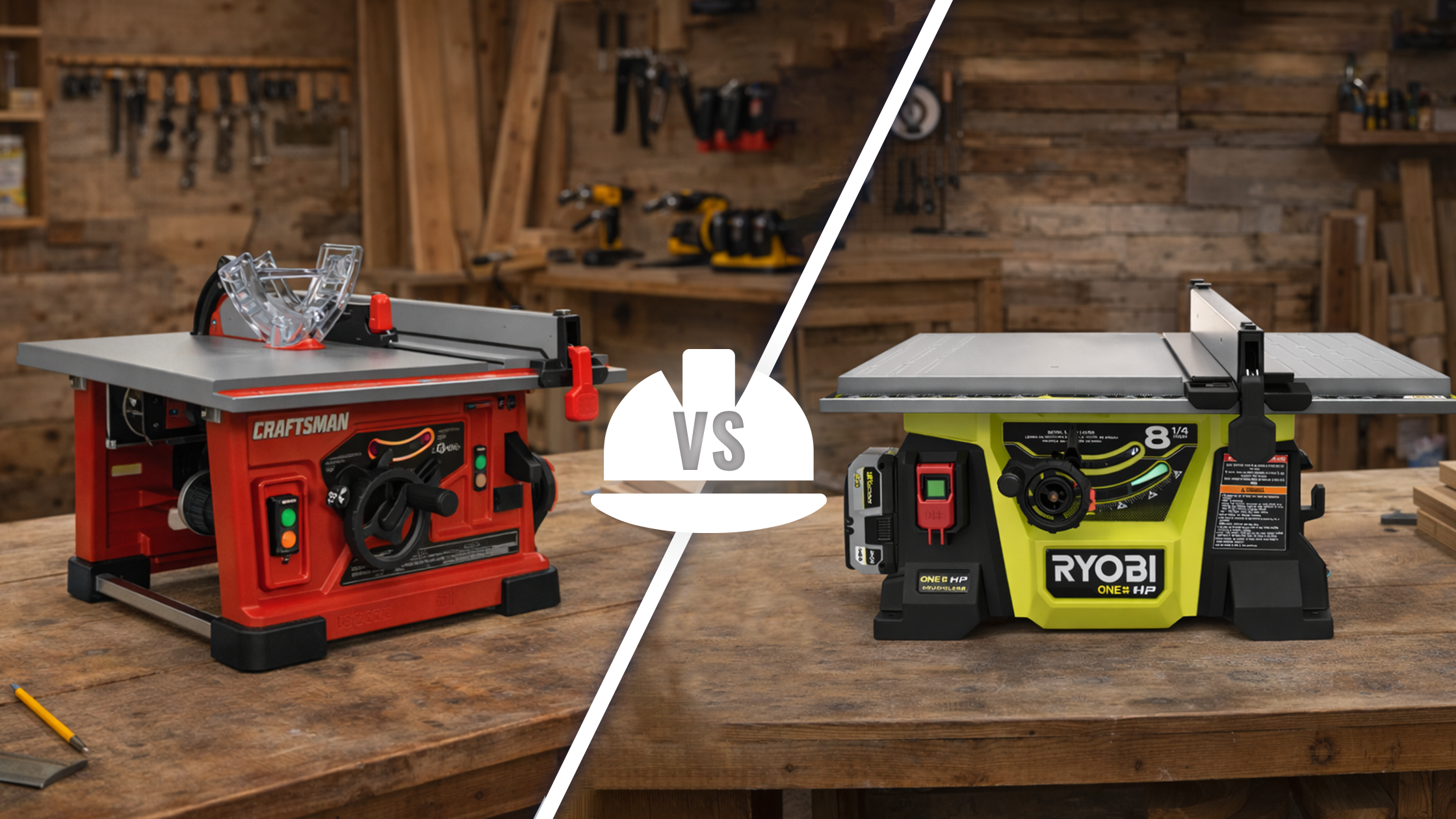
Whether you’re a construction worker or a DIYer, finding the right table saw can be overwhelming. In this article, we’ll compare two of the most popular brands head-to-head in terms of power, performance, price, ergonomics, and more. Here’s what you should know about the CRAFTSMAN 8.25-in 13.0 Amp table saw and the Ryobi ONE+ HP 18V Brushless Cordless table saw, so you can shop smarter and get back to your project.
Overview of the CRAFTSMAN vs Ryobi table saw
CRAFTSMAN 8.25-in 13.0 Amp table saw in a nutshell
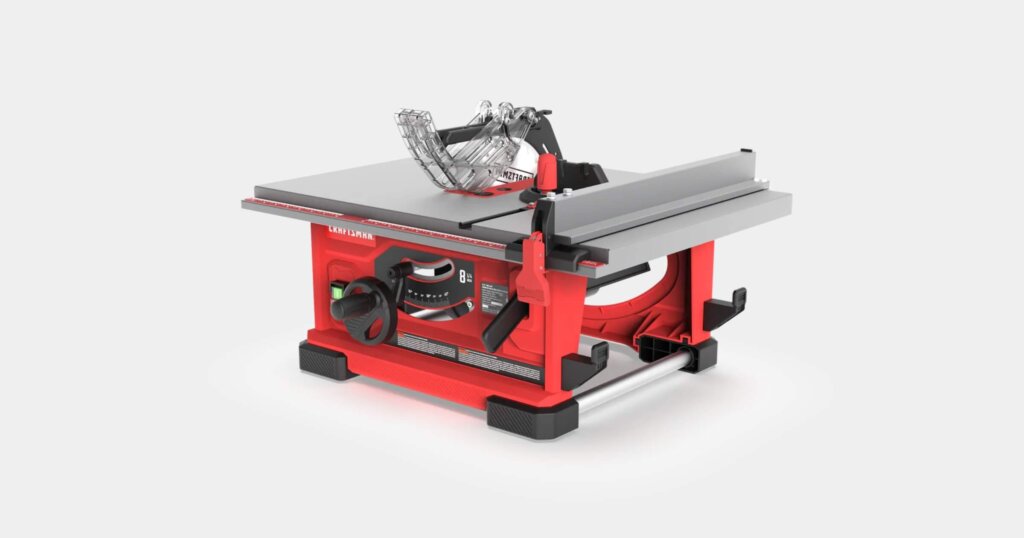
The Craftsman 8-1/4in table saw has an impressive 13-amp motor that generates a maximum 5700 RPM. Designed for precision cutting of various wood materials, this table saw is well-suited to almost any workshop task. The steel frame provides durability for the long haul, including the steel table, making it easy to feed longer stock.
This Craftsman table saw features a carbide-tipped blade that stays sharper longer for maximum accuracy and speed when cutting hardwoods. It comes with integrated storage for all your tools and accessories, and the easy-lock rip fence promotes clean and accurate cuts for materials beyond wood.
Ryobi ONE+ HP 18V Brushless Cordless table saw in a nutshell
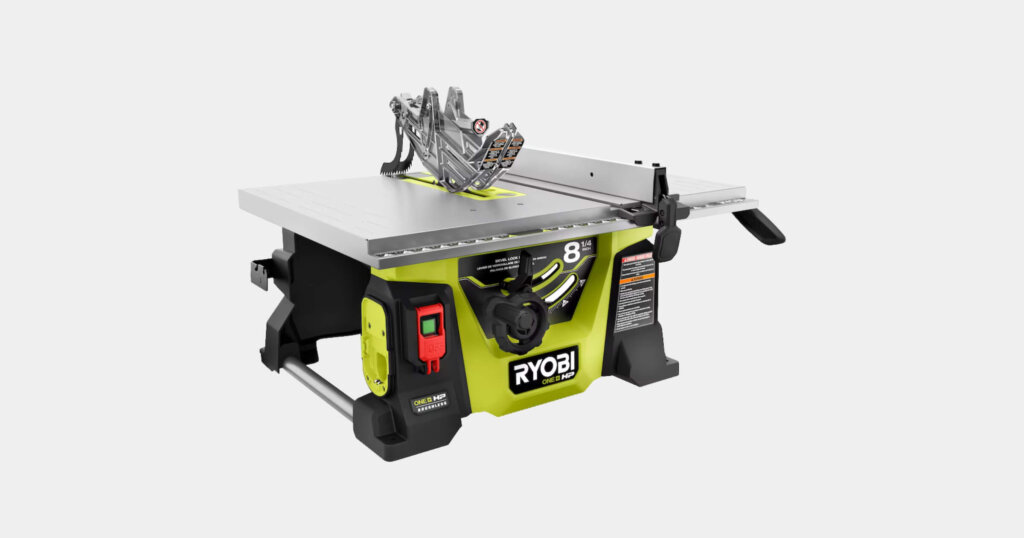
The Ryobi ONE+ HP 18V table saw comes with a brushless motor, advanced electronics, and high-performance lithium-ion batteries that deliver up to 4,500 RPM for quick, accurate, and controlled cuts. Compatible with preexisting ONE+ series batteries, the Ryobi saw has a 12-inch rip cut capacity and can rip up to 240 linear feet of material per charge.
This table saw has a self-aligning material fence, a pinion blade, and a rack height adjuster to customize cutting depth. The steel frame, like the Craftsman model, provides the strength and durability that any woodworker looks for. This table saw also comes with integrated storage for easy organization of all your tools and accessories.
Specifications comparison: How do CRAFTSMAN 8.25-in and RYOBI ONE+ HP 18V Brushless compare on paper?
Here’s how both table saws compare when we break down direct features. It’s worth noting that neither Craftsman nor Ryobi has provided a torque or vibration number.
| Category | CRAFTSMAN 8.25-in (13.0 A, corded) | RYOBI ONE+ HP 18V Brushless (8.25″) |
| Power | 120V 13-amp corded motor; standard benchtop corded power class | Brushless 18V motor; compatible with Ryobi ONE+ battery system |
| Speed | Tops out at 5,700 RPM | Tops out at 4,500 RPM |
| Battery | Corded 12V | 18V ONE+ lithium-ion system |
| Dimensions | Standard benchtop footprint—12.5” height x 28” depth x 20” width. | Table footprint is 25.5” x 17” |
| Ease of use | Straightforward benchtop setup aimed at jobsite/workshop users; good for users who want plug-in continuous power and straightforward maintenance | Cordless freedom reduces extension-cord hassle; not as basic as the Craftsman model, but not outside a rookie or beginner’s scope |
Craftsman vs Ryobi table saw: Which tool packs more punch?
Craftsman
This corded benchtop saw delivers continuous mains-powered torque and a consistent cutting speed for long sessions without worrying about run-time dips. Craftsman advertises the steel frame and carbide-tipped blades for performance that lasts. The company doesn’t publish torque ratings, but the 13A corded motor is a practical proxy for higher sustained cutting force compared to battery-powered tools.
Because the Craftsman is rated for higher no-load RPM, it will feel more consistent during lengthy cutting sessions and repeated jobs. Users won’t notice power drop-off over time in use, and there’s less chance of stalling or slowing down during demanding cuts. It’s more predictable power for those looking to plug in and go.
Ryobi
The motor and electronics are rated up to 4,500 RPM, and Ryobi markets it as “corded-like” performance, claiming up to 240 linear feet per charge when using two high-powered batteries. Because it’s battery powered, there’s a real tradeoff: peak cutting speed will be lower than the corded Craftsman. Ryobi also does not publish the torque number.
The setup is more portable thanks to its cordless design, and power depends largely on the battery’s state of charge. Compared to the Craftsman, the Ryobi is less suitable for continuous work and heavy ripping unless you carry extra charged batteries. Both saws include safety features like a blade guard, anti-kickback pawls, and a riving knife.
Ease of use & ergonomics: Which is more beginner-friendly?
In terms of ease of use and ergonomics, the Craftsman is fairly straightforward. The benchtop corded saw has a simple, easy-lock rip fence with basic adjustments. The lack of overly complex electronics, batteries, and moving parts makes setup and operation predictable and comfortable. The manual describes the saw as handling easy extending in-feed and out-feed fences, plus a miter gauge that’s adjustable to 60°, providing flexibility.
The Ryobi saw leans more into advanced, ergonomic features, including the rack-and-pinion blade-height adjustments, making changing the cut depth smooth and precise. The adjustable self-aligning material fence helps ensure straight cuts, and the on-board storage holds wrenches, accessories, and push sticks for easy operation.
Craftsman is more beginner-friendly for those who value stability and simplicity and want to skip battery handling. Ryobi is beginner-friendly, but better suited for those who want portability, a modern adjustment system, and the already familiar ONE+ 18V system.
Price and value: Which one gives more bang for your buck?
The great thing about either table saw is that neither will break the bank. You can get either for under $350, and the Craftsman is a steal at around $170. Both are reasonably priced for what you get. The Craftsman is cheaper, but you have a cord to deal with, whereas the more portable, convenient Ryobi jumps to $322.99 for the tool only. If users need to purchase the ONE+ battery, expect to spend slightly more.
- Craftsman: $169 USD on Lowe’s
- Ryobi: $322.99 USD on Home Depot
Craftsman vs Ryobi table saw: Pros and cons summary
To help you quickly recap, here are the main pros and cons of each tool:
CRAFTSMAN 8.25-in (13.0 A, corded) pros:
- Corded with 5,700 max RPM
- Standard footprint
- Consistent, reliable power and performance
- Incredibly low price at $169
CRAFTSMAN 8.25-in (13.0 A, corded) cons:
- Better for light-duty use
- Some customers cite that the rip fence is difficult to adjust
RYOBI ONE+ HP 18V Brushless pros:
- Cordless, brushless motor
- Compatible with ONE+ battery series
- More ergonomic adjustment system
- High-performance power at 4,500 RPM
RYOBI ONE+ HP 18V Brushless cons:
- Need to keep batteries charged and ready
- Inconsistent performance based on the level of charge
Which table saw should you buy?
If you’re looking for a simple table saw that gets the job done, runs on continuous power, and comes at an unbeatable cost, go with the Craftsman 13A. It has a higher no-load RPM, better performance, and can run longer without needing to swap batteries.
If a portable table saw is your priority, the Ryobi ONE+ is for you. It offers an excellent cordless performance, and the rack-and-pinion fence system is seamless. With up to 240 linear feet per charge, it might just be worth the higher cost.
Don’t forget to subscribe to the Under the Hart Hat newsletter and follow us on LinkedIn to stay in the loop about brands and tools you love.