
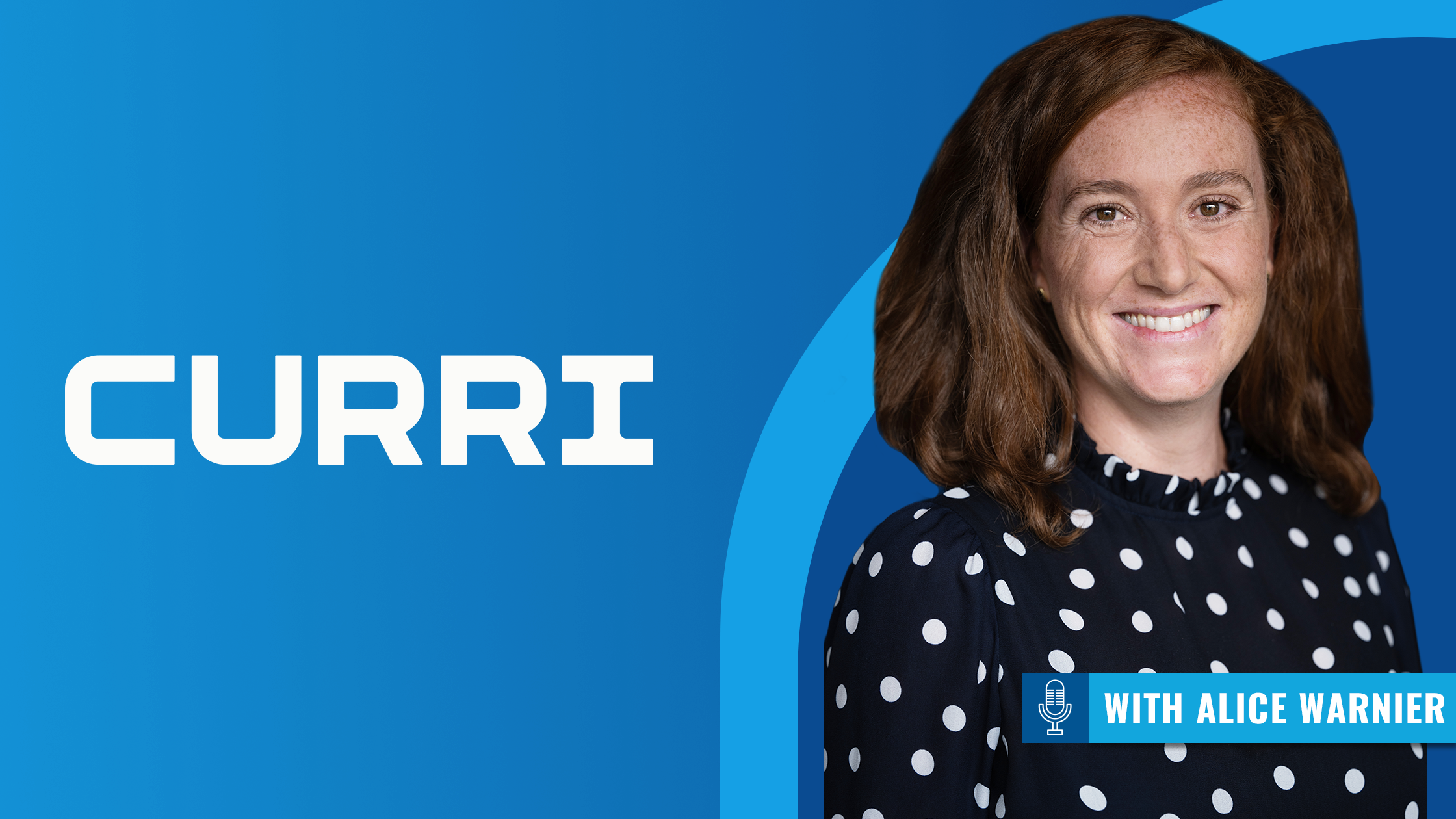
Many companies are employing new technology on the construction site, from automated machinery and AI software to sustainable 3D-printed materials. But to keep up with construction demand, a key piece of boosting productivity is delivery logistics. For Alice Warnier and Curri, that’s their whole mission. Curri is a comprehensive logistics platform that connects material and equipment distributors to a nationwide fleet of drivers who can get deliveries to job sites with ease, speed, and reliability.
Under the Hard Hat’s content contributor, Mariah Moore, sat down with Alice to talk about her trajectory in construction tech, Curri’s mission, and how they’re revolutionizing construction delivery logistics in the U.S.
This interview has been edited for clarity and conciness. To watch the full interview, check it out on our YouTube channel: https://youtu.be/PWZIpLgaIXQ
UTHH: Jumping right into your background, Alice, what inspired you to pursue a career in construction tech?
Alice: Well, I have to confess, it wasn’t my first choice. I primarily wanted to move from Belgium to Canada in 2013. I spent two years in Belgium working at a bank. And Belgium wasn’t a big enough country, I suppose. So I was fortunate to find a marketing manager position at Warmup, a British manufacturer of heating cables and smart thermostats.
I don’t even think the words construction tech existed back in 2013. I spent seven years at Warmup, and then I got the opportunity to start at Curri. And it’s been a huge leap of faith for me because I literally went from a super traditional manufacturing industry to a startup from California.
UTHH: What is Curri’s mission?
Alice: It’s an easy question. We get a reminder from our CEO every week of what our mission is. It’s to be the way the world delivers construction and industrial supplies. Think Uber, but for the delivery of construction and industrial supplies.
I’m the director of marketing at Curri, and my role is to help achieve the mission of being the way the world delivers construction and industrial supplies. And day to day, that means contributing to our business objectives, which are mainly acquiring new customers and ensuring they keep choosing Curri.
UTHH: Aside from ease of use, why would a construction supply distributor choose Curri over a conventional courier?
Alice: Good question. So the two ways our customers could go are owning their own fleet of vehicles or using a local courier. Owning their own fleet is super expensive because they need to pay a driver, own vehicles, renew insurance, pay for gas, maintenance, plus the tolls. And then you also need to have a fleet wide enough that you have the right vehicle size. You don’t want to deliver one gallon of paint in a semi truck.
The local couriers are great in their own way, but they’re not always as modern as Curri. We offer proof of delivery pictures and live tracking of the driver. You can even check how heavy the traffic is in an area to see if your delivery is going to be late. We offer tons of features to build trust.
UTHH: Many workers in construction have a hard time with change and adopting tech. Do you find that a lot from people who come to Curri? Is it a sticking point for the team?
Alice: Yeah, for sure. I was thinking the other day about how this industry has changed so much since COVID. I know a lot of things have changed, and it’s cliché sometimes to say that, but really, when I started my career at Warmup, some of our customers barely had email addresses. You could only fax them. And some of them wouldn’t even have credit card payments.
So it was really a very slow industry that would not adopt new technology. And then COVID happened, and everybody had to modernize, start doing e-commerce, and find ways to survive.
I’ve noticed that there’s a new generation also joining the workforce in our field. And these guys know more about user experience and user interface; sometimes, they even recommend new features to us. They’re more involved, and they want to adopt new technologies in their day-to-day work. So yes, I’ve definitely seen a shift in the past few years.
UTHH: Are there specific tools or techniques that you or the team use to stay grounded?
Alice: Yes. I love speaking with our customers on a super regular basis, so that’s how I stay grounded. I use their vocabulary. I understand their problems. It’s crucial, I think, for a marketer to speak with customers as often as possible. So I love to attend events. I love to conduct interviews with my customers over Zoom.
The main goal is not always to write customer stories or testimonials, but rather to stay grounded with what they actually need and what their reality really looks like.
UTHH: What would you say is the most impactful feature for Curri’s customers?
Alice: Without a doubt, I would say live tracking. Probably and proof of delivery too. Distributors can see where the driver is and get the proof of delivery, delivery photos, and signature.
Say the package is dropped somewhere precise, but then maybe the construction site is super big, and then there’s a doubt regarding where it went last. So the live tracking and proof of delivery photos change everything.
UTHH: What’s something in the AEC industry that people aren’t talking about but should be?
Alice: I love that question. It’s super biased, but I would say sustainability. I’m very interested in this topic. I follow a lot of companies on LinkedIn that help with waste management.
The way Curri tries to be more sustainable is to match our distributors with the smallest vehicle for their needs. For example, if you know they’re delivering 10 gallons of paint, they don’t necessarily need a Sprinter van. Maybe a car will do. It seems small, but in the grand scheme of things, it helps reduce emissions.
UTHH: I know Curri offers a nationwide fleet. Do you see many use cases where people come to Curri specifically because you offer such a wide delivery radius?
Alice: For sure! Our nationwide fleet allows us to deliver, like you said, across states. Imagine a distributor, even if they have their own fleet, with a couple of trucks parked on the driveway waiting for the warehouse to fill them.
They have deliveries to make on time for certain customers because punctuality is crucial in our industry. Otherwise, you have idle workers, and everybody is wasting each other’s time. So if all of the internal fleet is taken up, and you have to make a long-haul delivery, it could make or break the customer relationship.
UTHH: Is there something that you know now or that you kind of live by now that you wish you had known at the start of your career?
Alice: I got super lucky because as soon as I started my career, I found a mentor, and he was the person who hired me at my first job. He was my boss for seven years, and now he’s a business partner and a friend. Finding a mentor, someone who pushes you to improve and be a better professional, is essential.
Also, I would say keep learning because marketing is a field that constantly evolves. What I was doing 10 years ago has nothing to do with what we do now. We’re allowed to have a much more data-driven approach than we were 15 years ago. So yeah, that’s something I wish I had known. Keep learning, and find a mentor.
UTHH: And where can people connect with you or learn more about Curri?
Alice: Sure, everybody can find me on LinkedIn. Just type my name. And curri.com is our website if you want to learn more. And yes, stay tuned. We have lots of big announcements that we’re going to make in the next few weeks. We’re also hiring and have tons of job openings right now.
For more spotlights on professionals and companies making an impact in AEC, subscribe to our newsletter and follow Under the Hard Hat on LinkedIn!