
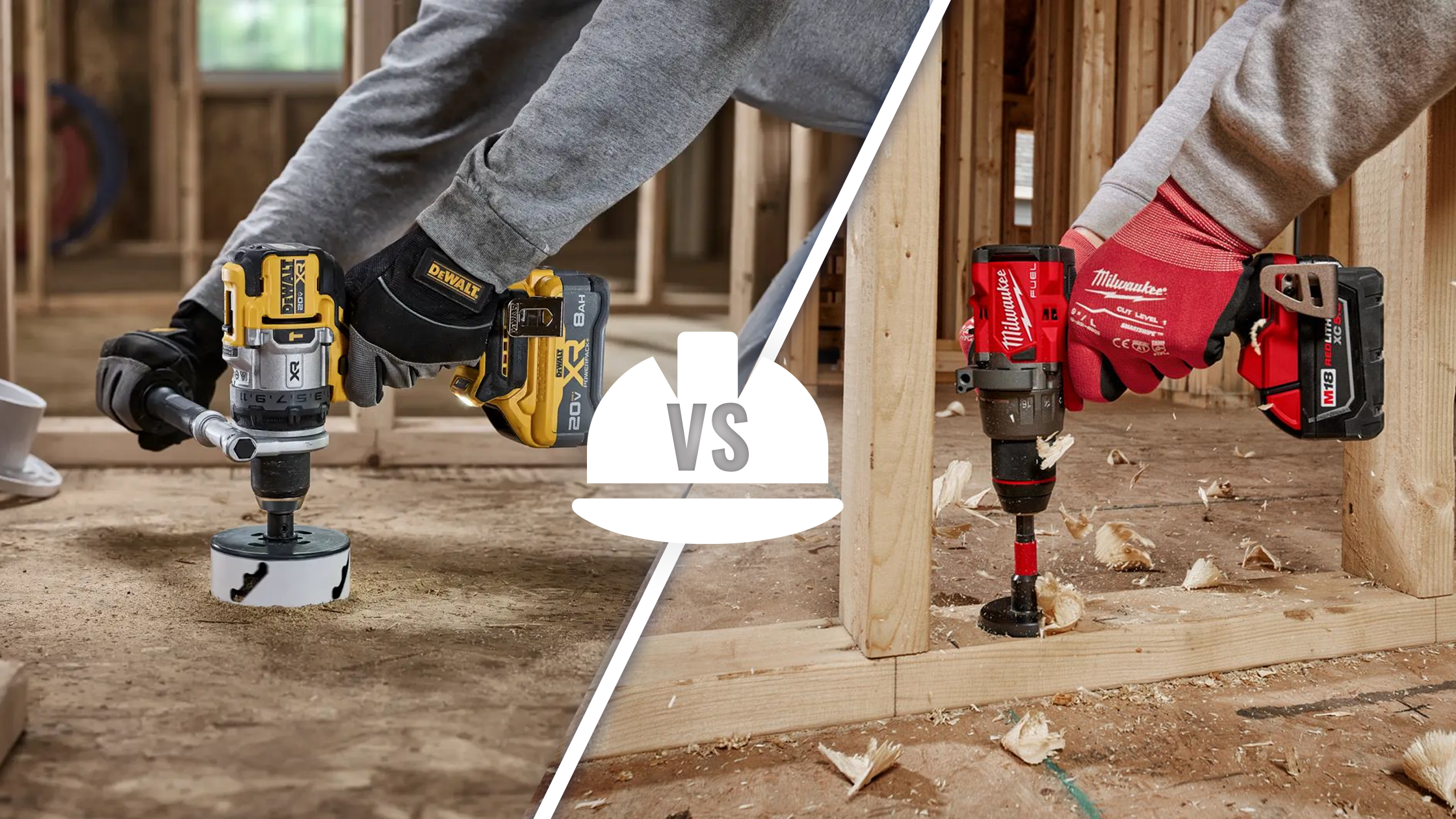
Choosing between a Dewalt vs Milwaukee hammer drill can be the difference between a smooth workday and a frustrating afternoon on the job site. This review compares the DeWalt 20V MAX XR (DCD999B) and the Milwaukee M18 FUEL (2904-20) hammer drills to see which one delivers the best performance for construction professionals. We will cover everything from raw power and battery life to how these tools actually feel in your hand when you’re drilling into tough concrete.
Specifications comparison: How do they compare on paper?
When you look at the numbers, both of these tools are designed for heavy-duty work. Here is how the top-tier cordless hammer drills from each brand stack up against each other.
| Specification | DeWalt 20V MAX XR (DCD999B) | Milwaukee M18 FUEL (2904-20) |
| Power/Motor | 20V Brushless | 18V Brushless |
| Max Speed | 0 to 2,000 RPM | 0 to 2,100 RPM |
| BPM (Impacts) | 0 to 38,250 BPM | 0 to 33,000 BPM |
| Max Torque | 1,219 UWO | 1,400 in-lbs |
| Weight (Tool only) | 3.54 lbs | 3.3 lbs |
| Length | 8.4” | 6.9” |
Performance and power: Which tool packs more punch?
In head-to-head testing on high-strength concrete, the DeWalt hammer drill often pulls ahead because of its higher BPM (blows per minute). The DCD999B is engineered with FlexVolt Advantage technology. This means the tool has a specialized high-current switch and upgraded electronics that can sense when a 60V FlexVolt battery is attached. When it detects extra juice, the motor can output up to 42% more power than with a standard 20V battery. If you spend your day drilling ½” holes into aged concrete or structural brick, that extra speed significantly reduces your trigger time and muscle strain.
The Milwaukee hammer drill (2904-20) is famous for its massive torque, which has recently been upgraded to 1,400 in-lbs. This tool is less likely to slow down or stall when you’re driving 6” structural screws into laminated veneer lumber (LVL) or using 4” hole saws in thick subflooring. While the DeWalt wins on impact speed, the Milwaukee maintains its RPM better under a heavy load. It features a digital power state brushless motor that stays cooler while working harder. This makes it a beast for heavy-duty fastening where constant, high-twisting force is the priority.
Ease of use and ergonomics: Which is more beginner-friendly?
When you are holding a tool for hours at a time, the weight and grip become just as important as the motor. Both brands have spent years researching how their tools feel, but they use very different designs.
- Handling and balance: The Milwaukee hammer drill is currently the most compact heavy-duty drill on the market. Measuring only 6.9” long, it has a much smaller nose-to-tail footprint than the DeWalt. This is a game-changer when you are working inside a tight vanity cabinet or between joists where a longer drill simply won’t fit.
- Thermal management: A major part of ease of use is how the tool handles heat. The Milwaukee 2904-20 has improved airflow over the previous generation, but because it is so small, it can still feel warm during constant use. DeWalt’s larger body allows for greater internal airflow, helping keep the handle cool during all-day masonry projects.
- Vibration and noise: Both drills use advanced motors that help reduce vibration. However, the Milwaukee hammer drill is often noted for having a smoother start when you pull the trigger. The DeWalt has a more mechanical feel that some pros prefer because it provides more feedback through the handle when the hammer mechanism is engaged.
Price and value: Which one gives more bang for your buck?
In terms of price, these two are very close. You can often find both tools priced similarly as a bare tool without the battery. The price usually sits around $160 to $190, depending on current sales.
The real value often comes down to the battery ecosystem you already own. If you are starting from scratch, the Milwaukee M18 system has over 250 tools that all use the same battery. However, the DeWalt FlexVolt system offers a unique cross-over value. Because a FlexVolt battery can switch between 20V and 60V, you can use the same battery for your DeWalt hammer drill and then pop it into a 60V circular saw or table saw. If you plan on buying heavy-duty cordless saws in the future, the DeWalt system might save you more money in the long run because you won’t need to buy separate high-output batteries for different tool categories.
Features and accessories: What extra features do they offer?
- DeWalt LED: One of the best parts of the DCD999B is the 3-mode LED light. It has a spotlight mode that stays on for 20 minutes. You can use your drill as a temporary flashlight in dark corners.
- Milwaukee Auto-Stop: The 2904-20 features AutoStop technology. This is a safety sensor that feels if the drill bit binds or kicks back. It stops the motor instantly to keep the drill from twisting your wrist. This is a huge safety upgrade for tough jobs.
Pros and cons summary
| Tool | Pros | Cons |
| DeWalt DCD999B | – High speed for fast concrete drilling – Spotlight mode is great for dark job sites – Durable all-metal chuck holds bits tight | – Longer and heavier than the Milwaukee – The motor can be quite loud at high speeds |
| Milwaukee 2904-20 | – Highest torque for heavy fastening – Very short design fits in tight spots – AutoStop safety protects your wrists | – Can get quite hot during heavy use – The battery can feel a little loose over time |
Which hammer drill should you buy?
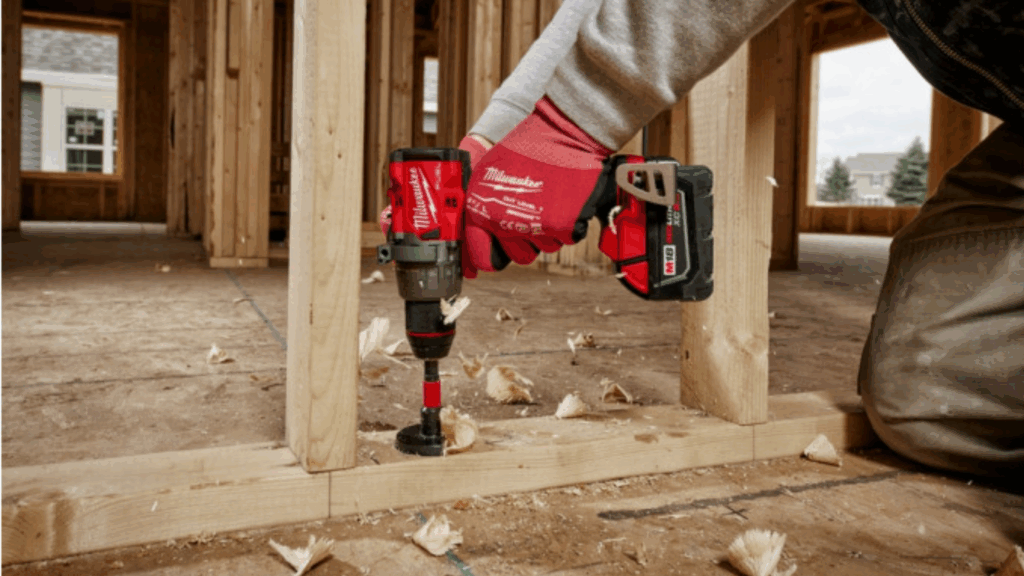
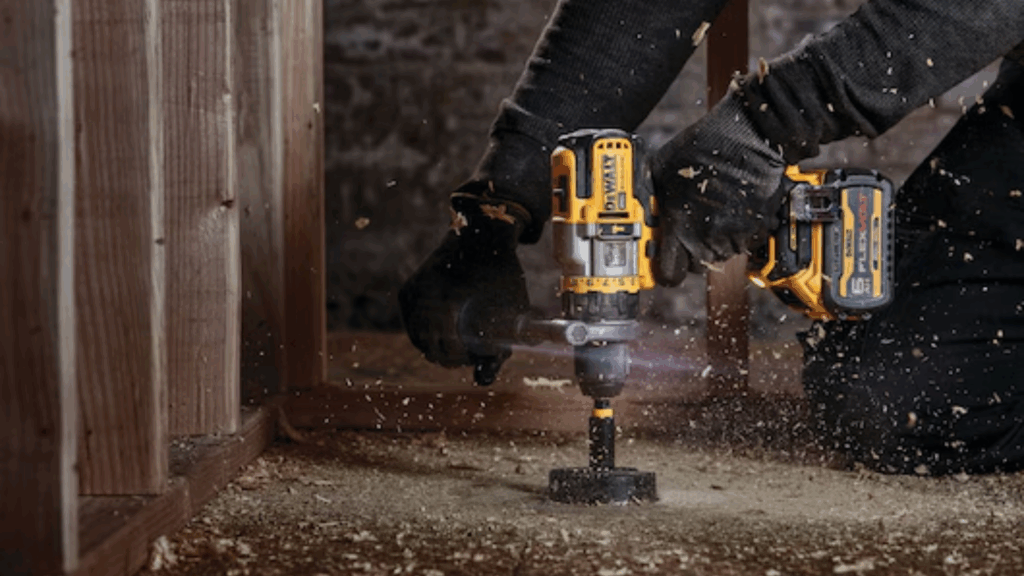
The choice usually comes down to the tasks you do most. If you spend your day drilling holes into concrete or brick, the DeWalt DCD999B is likely your best bet because of its high impact speed. If you are a plumber or electrician who needs a small powerhouse for tight spaces, go with the Milwaukee 2904-20. Both tools are top-tier. You really can’t go wrong with either one as long as you have the right batteries for the job.
Further reading
If you’re looking for more gear comparisons and construction guides, check out these other resources:
- The best Dewalt gear to keep in your car for emergencies
- UTHH top picks: cold-weather gear
- Greenworks vs Ryobi: Who makes the better lawnmower
- The 10 best cordless drills going into 2026
Want to stay updated on the latest tool reviews and job site gear? Subscribe to our newsletter today to get the best AEC insights delivered straight to your inbox.