
In 2026, the construction industry is facing a massive change. We are seeing more retirements than ever, and at the same time, we are finally seeing the 10% ceiling break for women in the workforce, with numbers climbing to 11.2%. Nour Hachem is at the center of this movement. In this interview with UTHH, Hachem talks about her inspiration, the barriers that still exist, and how breaking the cycle of typical hiring is changing the game for women in AEC.
About Nour Hachem
As the founder of Build a Dream and an award-winning leader recognized as one of Canada’s Top 100 Most Powerful Women and as Construction’s Most Influential People for 2025 by SiteNews, Hachem has spent more than two decades helping young women and their families see the skilled trades as a path to economic prosperity. What started as a small workshop in Windsor, Ontario, has grown into a national movement that has reached over 100,000 individuals over the last 12 years.
Building the dream: A conversation with Nour Hachem
UTHH: You often speak about your mother’s resilience in the auto parts industry as a major inspiration. How has your view of what women can achieve in construction changed from when you watched her to what you see now in 2026?
Nour Hachem: When I launched my first workshop, I was incredibly naive. I thought that if women just knew these jobs paid well and had free training, they would flock to them. I thought I would have a full room immediately. After 12 years in this space, I have seen that while interest is high, there are still deep barriers in the system that leave women out. The more women learn about these spaces, the more interested they are, but my knowledge of the roadblocks has grown, too.
UTHH: We finally broke past the 10% mark to hit 11.2% representation for women in construction. Was there one specific barrier breaker that caused that jump?
NH: It was a combination. The labor market demand increased so much that companies couldn’t ignore 50% of the talent pool anymore. We used a business argument to tell them they were losing out. On top of that, you saw big investments from the government in Ontario and grassroots groups like Build a Dream pushing for inclusion. Also, as more women enter and speak highly of the work, it creates a ripple effect.
UTHH: Build a Dream has supported over 100,000 people. That is a massive number. How did it grow from a local Windsor project to a national movement?
NH: That 100,000 is a conservative number. We started in 2014 with a career expo at St. Clair College in Windsor. We chose the name “Build a Dream” because parents were sometimes reluctant to bring their daughters to events that had “Skilled Trades” in the title. We wanted to shift the mindset at the dining room table. When COVID-19 hit in 2020, we pivoted to virtual events, which allowed us to reach rural communities and expand across Canada. Now, a single “Dreamer Day” event in Ontario can bring in 4,000 high school students from across the province.
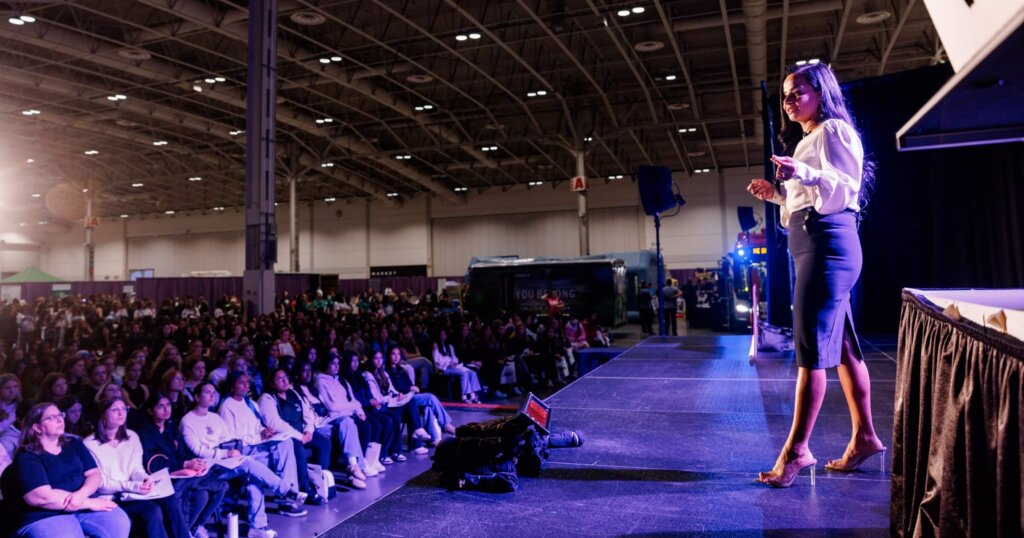
Nour Hachem speaking at the Day Dreamer Event. Photo courtesy of Nour Hachem.
UTHH: Is there one specific story of a woman entering the trades that stays with you?
NH: I always think of Delaney. She used to say she “came for the pizza and stayed for the carpentry.” She wanted to be a journalist, but she met several carpenters at one of our earliest career expos and fell in love with the trade. Now, she oversees our Career Services department and supports over 700 tradeswomen across Canada. She is the epitome of why we exist; we aren’t just raising awareness, we are planting seeds that change the labor market.
UTHH: We are seeing a “silver tsunami” of retirements right now. What is your advice for a woman who wants to move into a leadership role, like a foreperson or project manager, in the next five years?
NH: You have to look at the “Journey ticket”. We see women enter the trades, but only about 33% are completing their full certification. That is a huge loss. My advice is to seek out professional development that equips you with the tools and experts to move up. Events like our upcoming June 5 – 7 Dream and Build professional development conference in Vancouver are designed to help women move into these leadership roles.
UTHH: Awareness itself can be uncomfortable, right? Changing a perspective and shifting to an inclusive environment forces people to sit in that discomfort. In construction, where suicide rates are among the highest of any industry, this isn’t just a female-led conversation.
NH: It isn’t comfortable to walk into every conversation and say the way we’ve been doing things isn’t working and has impacted lives. We personalize it.
UTHH: And it means power has to shift.
NH: Yes, and people feel when power shifts that they are losing something. But I believe when power shifts, it actually strengthens the fabric of what you do because you’ve opened up space for new ideas where your entire team thrives.
UTHH: What is one thing that you think site supervisors and male allies can do tomorrow morning to make their job sites more inclusive for the women on their crews?
NH: Awareness is power. Being aware that the industry isn’t perfect and that it doesn’t represent what you’ve done. It’s a representation of how society has functioned, that these industries, especially construction, were designed by men for men. That’s no longer the reality of our workforce. I feel that the first step any site superintendent can take is awareness, because once we become aware and honest about the environments around us, it’s what we do with that awareness that matters. That next step is saying, “I can change this. I can make things better.”
The “joke” is not just a joke; it has real repercussions. The repercussions can include someone feeling unsafe or uncomfortable. Just because it’s always been done this way doesn’t mean it needs to continue this way. Truly, when we’re advocating for change in these workplaces and job sites, it actually makes it healthier for everyone to want to show up at work. It’s not organic or unique to women. Jokes that aren’t discriminatory or make someone feel like they don’t belong actually create a space where everyone feels safe.
UTHH: If the things we’re building are supposed to represent everyone, then everyone should help represent.
NH: Exactly. If we bring more women in, we get diverse perspectives and innovative solutions to problems that impact all Canadians.
UTHH: What’s next for Build a Dream as we move through 2026?
NH: We are focusing on retention. It is one thing to get women in the door, but we need to make sure the workplace culture is safe, supportive, and built for them to stay and thrive. We want to change the way the world views women and work at its roots. That means working across sectors, from skilled trades and construction to STEM, emergency services, manufacturing, and leadership roles, to highlight what inclusive workplaces can look like in action and to support employers in making lasting change.
A big part of that momentum will continue at our upcoming Power and Purpose Summit on March 12 in Toronto, where we’ll bring together 300 leaders, employers, community partners, and women with lived experience to move conversations into action. Tickets are available for purchase now, and award nominations have been extended to February 13 for those who want to recognize individuals and organizations driving real change.
Join the movement
Build a Dream is a community dedicated to leveling the playing field in the AEC industry. Whether you are a parent looking to support your daughter’s interests or a contractor looking to diversify your crew, there are ways to get involved.
- Learn more about their programs: Visit Build a Dream
- Support the mission: Get Involved
- Listen to the stories: Check out the Perfectly Unfiltered Podcast
Subscribe to our newsletter and stay updated on the people, processes, and technology driving the construction industry.