

Reshoring manufacturing in the U.S. has long been a point of debate. Historically, many enterprises have opted to import goods and products from overseas to reduce production costs. However, 2025 saw a resurgence of domestic manufacturing, driven by supply chain disruptions, cost-competitive automation, and geopolitical considerations. This article will cover what’s driving the increased reshoring of manufacturing, the challenges that come with it, and which companies are leading the charge in stimulating regional economies in the U.S.
What’s driving reshoring in the U.S?
Automation and robotics as enablers
Plummeting robotics and automation costs, combined with rising technology capabilities, are enabling more companies to relocate closer to home. Features such as AI and machine learning predictive maintenance, cobots, vision systems, and hands-on robotics would allow businesses to reduce labor and regulatory costs.
Many companies opting to reshore their projects are expressly pairing advanced AI and robotics systems with their new plants, ensuring high efficiency, cost competitiveness, and scalability for the future.
Policy, tariffs, and incentives push
Domestic builds are becoming increasingly attractive thanks to the Inflation Reduction Act, the CHIPS Act, and other industrial incentives and federal programs. The “buy American” sentiment sweeping the country stems from a wave of tariff uncertainty, and more companies are feeling inclined to move their operations back home to protect their bottom line.
Firms are reshoring to avoid geopolitical risk and capture subsidies, particularly in high-tech and strategic sectors that have the means to relocate their operations.
Supply chain resilience and shorter lead times
The COVID-19 pandemic has highlighted the vulnerabilities of single-source supply chains. Global disruptions, stemming from lockdowns and shipping limitations, prompted reassessments of the supply chain for many. This ripple effect encouraged companies to reduce their reliance on overseas suppliers and exporters, resulting in shorter transport times and lower costs at home.
Those who have opted to reshore operations reduce their disruption risk for the future, shortening lead times and gaining better control and visibility, even if unit cost is higher.
Labor shortages and skill gaps
Reshoring brings more jobs to the U.S. market, but many factories are already facing skilled labor shortages. Mismatched skills for advanced manufacturing are also a concern. That being said, more recent investments in apprenticeships and training have helped fill the gaps.
Robotics, cobots, and automation have also helped fill the workforce. Training and upskilling have become essential and attractive to many. Hiring automation also reinforces workforce readiness, which can break down the barriers to hiring local talent.
Sustainability and environmental considerations
Shorter supply chains reduce transportation routes and emissions, while making circularity easier. Most businesses have increasingly stringent ESG goals, prompting them to adopt low-carbon manufacturing practices. By relocating manufacturing to a domestic factory, they can better audit, improve, and innovate in the sustainability space.
Scale: from SMEs to large corporations
More small and medium enterprises (SMEs) are adopting robotics to make reshoring a viable option. These smaller businesses can more easily afford modular automation, short-run production, and microfactories. Not only does this speed up production turnaround, but it also helps companies scale and meet demand.
Larger firms with capital-rich projects in industries like pharma and semiconductors have shifted to reshoring, as they can absorb higher upfront automation costs. SMEs are reshoring more selectively when customer responsiveness, IP concerns, and logistics better justify it.
Why AI and automation make reshoring feasible
Autonomous equipment, AI, and robotics help offset some of the labor and total production costs for companies of all sizes. It allows fewer workers to manage a larger output, better oversee quality control and predictive maintenance, and reduce downtime. It’s more productive and has less room for human error, while also helping to offset the wage gap and reduce reliance on overseas manufacturing.
Digital factories, although they come with a higher upfront cost, also grant manufacturers greater speed and flexibility. Production can run smaller batches, integrate more tightly with local supply chains, and pivot output as needed. This is ideal for domestic demand with shorter lead and shipping time expectations.
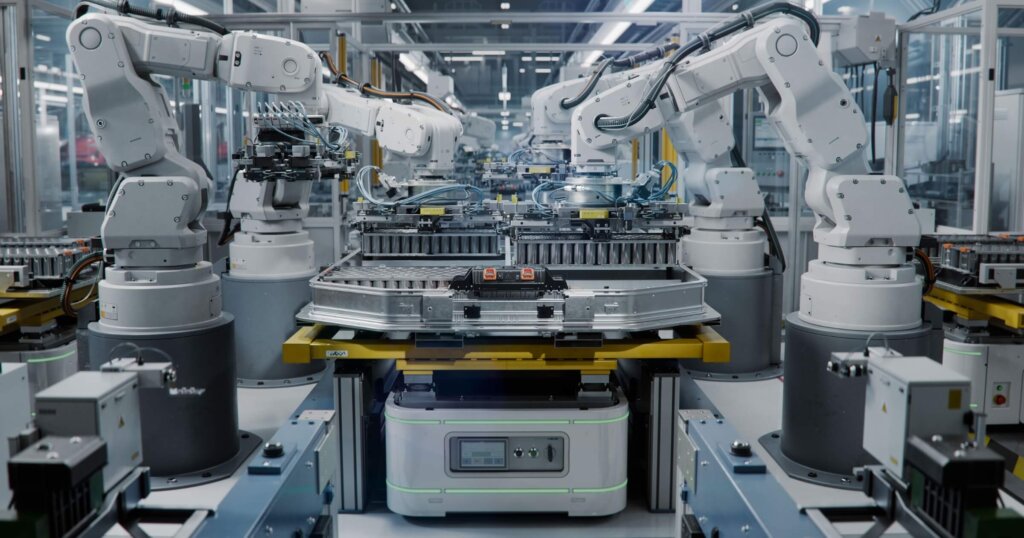
Automated robotic arms assemble a lithium-ion EV battery pack on a modern production line.
Companies leading the shift in reshoring manufacturing
Some of the first companies to make big moves with reshoring manufacturing are taking some big swings. Notable businesses and their investments include:
- GE Appliances: GE has invested over $3 billion in domestic manufacturing, bringing production of ranges, washers, and refrigerators back to states like Georgia and Kentucky.
- GlobalFoundries: Has begun expanding its semiconductor fabs in Vermont and New York.
- TSMC: Recently made new multi-billion-dollar investments under the CHIPS Act.
- Eli Lilly: Committing to new pharmaceutical manufacturing plants in the U.S.
- Hyundai: Has a new “Metaplant America” factory in Georgia, driven by AI.
Many businesses making the initial moves are larger global enterprises, able to bypass barriers with high capital. However, as robotics, AI, and automation become more accessible, we should begin to see smaller businesses follow suit.
Challenges for reshoring manufacturing to the U.S.
If reshoring manufacturing had no challenges, most U.S. companies would’ve made the shift back long ago. There are four major blockers that companies face when considering reshoring to domestic production.
- High upfront costs: Building new facilities in the U.S. requires immense upfront investment. Companies require equipment, land, and automation tooling to support their production processes. ROI, from there, will take years, which often stops the smaller businesses in their tracks.
- Workforce shortages: Despite the use of automation, there will still be a labor shortage in domestic manufacturing. If a company fails to invest in recruiting and upskilling, this bottleneck might significantly delay or block reshoring operations.
- Near-shore competition: Many businesses rely on manufacturing in Canada or Mexico, where supply chains are closer and labor costs are lower. This means fast lead times and lower costs, which can slow down those considering domestic investment.
- Unpredictable policy shifts: The reshoring momentum largely depends on federal programs, such as the CHIPS Act. Moving trade priorities, political gridlock, and the risk of policy reversals could erode investment incentives.
With these challenges in mind, it seems that reshoring manufacturing should hinge on a perfect storm of business circumstances. But many larger enterprises are opting to reshore in phases or partially to mitigate risks and keep their eye on the long-term ROI.
Final thoughts
The trajectory of reshoring manufacturing is not a perfect spike. Automation, supply chain resilience, sustainability concerns, and robotics are making it more feasible for many businesses. But others still face challenges, including labor shortages, upfront costs, and near-shore competition. It remains a construction trend to watch, and we may see domestic manufacturing further ramp up in the coming years, especially given the uncertainties surrounding the current administration.
Want to stay updated on more topics like this? Subscribe to our newsletter and follow Under the Hard Hat on LinkedIn.