Benteler and Holon are betting on autonomous shuttles, flexible fleets, and city-scale systems to expand access, cut emissions, and rethink how autonomous public transportation works.
At CES 2026, autonomous vehicles were everywhere. But instead of going the route of consumer cars, some businesses were there to improve and elevate public transportation. The Under the Hard Hat team had the chance to speak with Benjamin Pfeifer and Michael Barill from Ioki about their collaboration with Holon & Benteler to power the next generation of autonomous public transportation. Together, their vision is to make public transport in the U.S. more accessible, comfortable, and autonomous.
The Holon & Benteler vision
Founded in 2018, the experts behind Holon and Benteler have more than 150 years of vehicle manufacturing experience. The goal of their acquisition of Ioki was to become the first European full-service provider for autonomous public transportation. With Ioki’s end-to-end platform for operating on-demand shuttles this vision could be realized. HOLON builds the autonomous urban shuttle, ioki powers it with routing and on-demand transit software, and Benteler Mobility supports fleets with operations and financing.
The combination of fix-route, on-demand service, and fleet management, they believed was the missing layer that the typical self-driving tech stack can’t handle. Historically, drivers and dispatch managers need to decide who gets picked up, where vehicles go, and how service is handled at scale. That’s where the collaboration comes in.
The acquisition also enables bei ioki to better access the US market, as Holon plans to break ground on a $100 million, 580,000-square-foot manufacturing facility in Florida this spring. Bei ioki has already seen great success in European markets and is eager to break into the US. They emphasized that cities may not need to purchase transit vehicles outright but can instead pay a “mobility as a service” fee, easing public transit budget constraints.
The recipe for success: Operational flexibility
When we asked the team what sets their collaboration apart from the competitors, they said it was all about flexibility. Although they’re building rapidly toward autonomy, 90% of their services are currently driver-based. The key here is that their platform supports switching between driver-operated and autonomous operations, depending on regulatory readiness and conditions like weather. Regulatory approval is country- and state-dependent, often tied to the number of accumulated kilometers per vehicle. At this rate, the company expects to be “driver out” by next year.
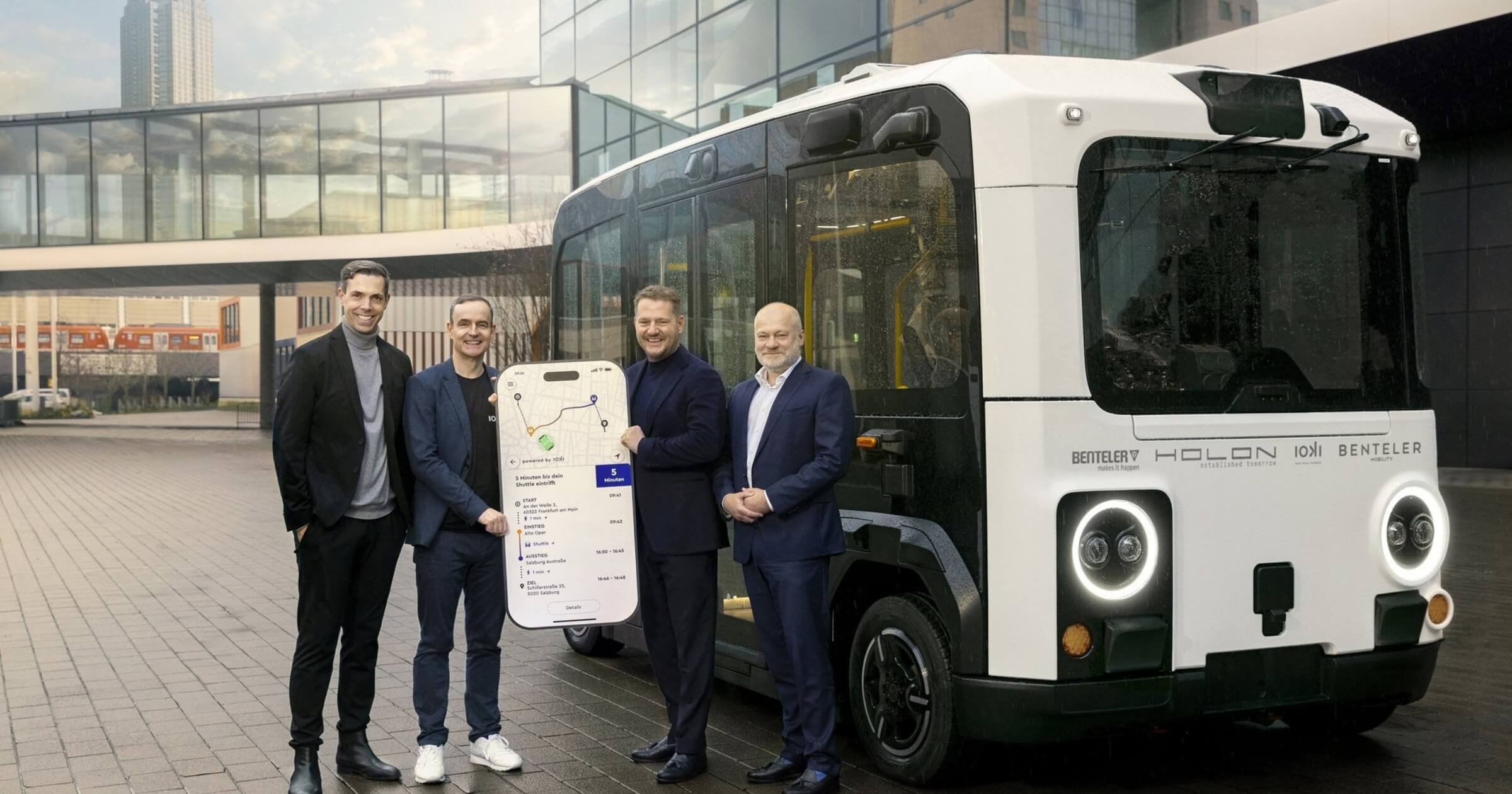
On the manufacturing side, the company expects to produce roughly 5,000 new vehicles annually, with the potential to reach 10,000 with two shifts. Florida’s planned output will change the game for the business and could help it serve the global market. The vehicles themselves aren’t quite buses but are larger than the average van, holding up to 15 people, depending on the mix of passengers, including wheelchair users or those with other mobility aids.
Holon demo of autonomous public transport vehicle to be manufactured in Florida.
Why public acceptance is key to pre-rollout
Although tech-enabled and more efficient than ever, not everyone is on board with autonomous vehicles and transit. When asked, the team said that based on early deployments, initial fears fade after the first few rides. Plus, the benefits for older adults and those with disabilities and limited mobility include greater freedom without constraints.
“In earlier testing, some people have that first fear, which was there when they did their first ride, but it was amazing because after that, everybody said, ‘Hey, wow, this is so cool. I’m 80 years old, I have the opportunity now to get from A to B,” the team said. “But we believe, as we come from public transport, this is a huge opportunity also for social inclusion for many people to be a part of the system again, because if you don’t have a driver’s license anymore, or not allowed to drive, which comes with you as you get older and older.”
The team says they have also run many mobility studies, thanks to digital twin modeling, to redesign networks and integrate autonomous shuttles into broader city mobility offerings rather than piloting them in a silo.
Sustainability and policy create an opportunity and a challenge
Sustainability is also a big piece of the core mission. It’s presented as both a planning input and a quantifiable outcome via ride pooling and reduced single-passenger trips. This enables companies and municipalities to better reach their CO2 targets and broader policy pressure. The team noted that, for many European cities, missing emissions targets could carry large penalties, so partnering with clean transit is lower risk.
In the US, the team also points out an accessibility gap, noting that 45% of people lack access to public transportation. This is a key driver for expanding into the broader US market, as transit services are much more affordable and accessible than ride-hailing models.
“As we prepared for the US market, we were pretty surprised that 45% of people do not have access to public transport, which is very high,” the team stated. “So that’s really also a society risk, because mobility is kind of a human right. So I think if you look at our hybrid driver-based and driverless approach, and moving into autonomy, that’s going to definitely increase accessibility for a lot of people over time.”
On the road to a new market
Near future operations for bei ioki, Benteler, and Holon look like greater autonomous rollout, continued US testing, and a giant leap forward in manufacturing. After seeing great success in European markets, driverless expansion is set to increase, with the same success expected in the US.
Holon and Bentler are reshaping the future of city-scale autonomous transit, rather than simply building vehicles for individual consumers. It just might be the key to raising global accessibility while keeping transportation sustainable.
Follow Under the Hard Hat on LinkedIn and subscribe to our newsletter for more on CES and other convention coverage.