

Trade schools are opening new doors for women seeking hands-on, well-paying careers in fields such as welding, HVAC, healthcare, and construction. Across the country, schools such as Rosedale Technical College, Dunwoody College of Technology, and Thaddeus Stevens College of Technology are helping women gain the skills and confidence to succeed in the trades. This guide breaks down the best trade school options for women in the U.S., including program costs, key benefits, and where to find top-rated schools that support women in technical careers.
Quick look
- Trade schools offer hands-on, affordable training in high-demand fields like HVAC, construction, and healthcare; a strong choice for women looking to build career-ready skills.
- Women-focused programs and mentorship create inclusive environments with support, scholarships, and strong connections to employers.
- Top-rated schools like Rosedale, Dunwoody, and Ivy Tech are known for high job placement rates, flexible schedules, and student-led support groups for women.
- Shorter programs and lower tuition help students graduate quickly, avoid major debt, and enter the workforce with valuable, in-demand skills.
How much does trade school cost?
If you’re considering a trade school, it’s smart to get a handle on what you’ll pay and what’s included. Tuition depends heavily on the field you choose, the length of the program, and the materials or certifications required. On average, tuition for trade school programs sits around $15,000, though it can vary widely by school and program.
Typical program lengths
Most trade school programs take between six months and two years to complete, depending on the field and the type of credential you’re earning.
Here’s a quick breakdown:
- Certificate programs (like HVAC, welding, or medical assisting) usually take 6-12 months.
- Diploma programs often take 12-18 months.
- Associate degree programs (such as electrical technology or construction management) typically last 18-24 months.
Many trade schools also offer accelerated programs or apprenticeship-based learning, allowing students to complete training faster while gaining paid on-the-job experience.
If you’re balancing work, family, or other commitments, some schools (like Ivy Tech or CNM) also provide flexible scheduling or part-time study options so you can move at your own pace.
Common fees you’ll want to budget for
When calculating cost, don’t stop at tuition. Many programs include or require extra expenses, such as:
- Tools, kits, or equipment (for example, in welding, HVAC, electrical)
- Uniforms or safety gear (hard hats, boots, protective glasses)
- Certification or licensing exam fees after graduation
- Books and supplies (some schools report an average supplies cost of around $1,700)
- In some cases, living expenses, especially if you move away from home (though many trade schools let you stay local)
Comparison table (by field of study)
Here’s a helpful overview of typical tuition ranges and program lengths by major trade fields:
| Field of Study | Average Tuition* | Typical Duration |
| Electrical | $5,000-$15,000 | One – two years |
| HVAC | $7,000-$18,000 | One – two years |
| Welding | $6,000-$16,000 | Six months – two years |
| Cosmetology | $10,000-$20,000 | Nine months – 1.5 years |
| Healthcare | $8,000-$25,000 | One – two years |
*These ranges are illustrative and approximate; actual costs will vary by state, school, and program specifics.
A few notes to keep in mind
- Some data show trade school tuition ranging from $3,800 to $16,000, depending on the program.
- Programs that require more specialized equipment (like HVAC or electrical) tend to be at the higher end of the tuition range.
- Since trade programs are short, you may save on living costs and start earning earlier than if you did a four-year degree.
- Always check what’s included in tuition; some schools bundle tools and certification, while others may charge separate fees.
Benefits of attending trade school for women
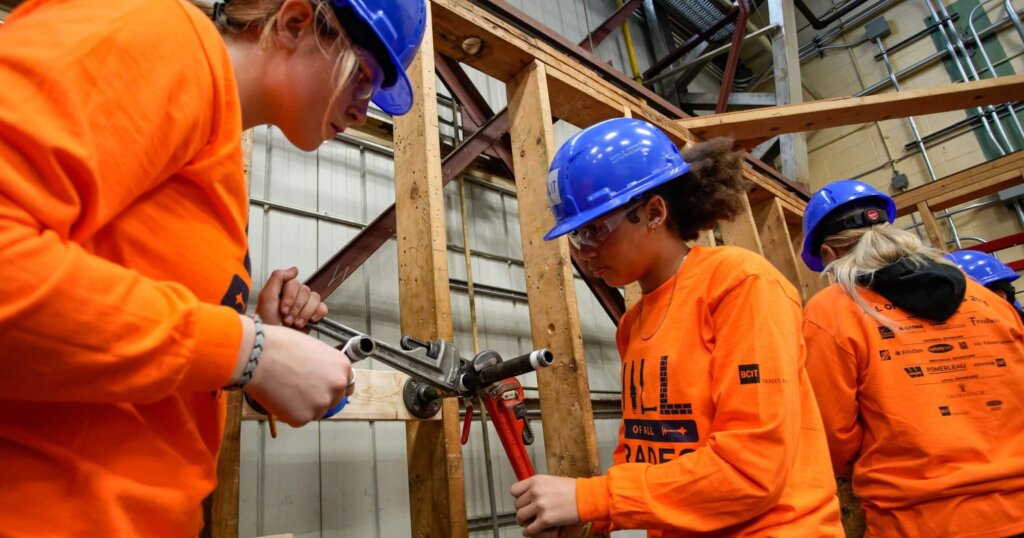
There are many trade school options for women who want to learn a skill, earn good pay, and start working sooner. These programs focus on practical training and provide the kind of real-world experience that employers value most. Here are some of the top reasons trade school can be a smart choice for women entering the skilled trades.
Hands-on learning and real experience
Trade schools focus on doing, not just reading. Students spend much of their time in labs, workshops, or job sites practicing the same skills they’ll use in their careers. Whether it’s wiring circuits, repairing engines, or building structures, this kind of hands-on learning builds confidence and helps women feel ready for real job conditions.
Mentorship and networking opportunities
Many schools offer mentorship programs and women’s support groups that connect students with professionals already working in the field. For example, the Women in Technical Careers program at Dunwoody College of Technology offers scholarships and ongoing mentoring to help women succeed in male-dominated trades. These networks can make it easier to find internships, apprenticeships, and full-time work after graduation.
On-the-job training and apprenticeships
One of the best things about trade school is that many programs include paid apprenticeships or internships. Students get real experience on the job while learning from licensed professionals, and they earn a paycheck at the same time. Many states also offer registered apprenticeships through the U.S. Department of Labor that pair classroom instruction with job placement opportunities.
Smaller class sizes and individual support
Unlike large universities, trade schools usually keep class sizes small. That means students get more one-on-one time with instructors who know the industry inside and out. This setup helps women build skills faster and feel supported throughout their training, especially in fields where they may be underrepresented.
Lower tuition and minimal student debt
Trade schools are typically much more affordable than four-year colleges. Most programs cost between $5,000 and $15,000 total, compared to an average of more than $100,000 for a bachelor’s degree. With shorter programs and faster job placement, many graduates avoid heavy student loan debt and start earning sooner.
Connections to employers and union pathways
Many trade schools work closely with local employers and unions to help students find jobs after graduation. Those partnerships often open doors to union jobs that offer good benefits, such as extra training, healthcare, and retirement plans. For example, programs at Rosedale Technical College connect students directly with regional contractors and union apprenticeship opportunities, helping women enter steady, well-paying careers.
Trade schools are communities built around opportunity, mentorship, and hands-on skill development that help women build lasting careers in the trades.
Top-rated trade schools for women in America
These schools were selected for their strong reputations, high graduation rates, and inclusive initiatives supporting women in technical careers.
Rosedale Technical College
Pittsburgh, PA
Rosedale Technical College is one of the nation’s leading trade schools for women entering hands-on industries such as HVAC, welding, automotive, and construction. Rosedale Technical College helps women get started in the trades with its Women in the Trades grant, which provides up to $2,000 in financial aid. The campus also has the Rosedale Riveters, a student group where women can connect, find mentors, and support one another as they train for careers in technical fields.
Known for its career-focused programs, Rosedale boasts a 93% job placement rate. Graduates often find employment with regional contractors and major employers soon after completing their programs.
Dunwoody College of Technology
Minneapolis, MN
Dunwoody College of Technology offers strong programs in HVAC, electrical, construction, and welding, equipping students with the hands-on skills needed in today’s technical trades.
Alongside its core training, Dunwoody emphasizes support for women in technical careers through scholarships and mentoring. While the college does not explicitly list a “Women in Technical Careers (WITC)” scholarship on its main site, it does award a wide array of scholarships ranging from $500 to $10,000 annually to students across trades. These scholarships, combined with mentoring and dynamic industry pathways, create meaningful access for women into male-dominated fields.
Thaddeus Stevens College of Technology
Lancaster, PA
Thaddeus Stevens College of Technology offers more than 20 trades, including HVAC, plumbing, electrical, carpentry, and welding. The college supports women’s success in technical careers through its student organization, Women in Technology & Trades (WITT), which provides dedicated space, peer networking, and career support resources.
The school has also been recognized for having 25% of its faculty as women, showing its commitment to inclusion and leadership opportunities for women.
Lake Area Technical College
Watertown, SD
At Lake Area Technical College, students can study trades like HVAC, diesel, aviation, welding, and building construction. The school has a reputation for helping its students succeed and was recognized with the Aspen Prize for Community College Excellence in 2017 for its strong results and supportive learning environment.
According to the school’s own outcomes reports, approximately 99% of its graduates are either employed or continuing their education within six months of graduation.
Ranken Technical College
St. Louis, MO
Ranken Technical College provides strong programs across engineering, automotive, construction, and information technology, making it a solid choice for women seeking hands-on, career-ready training. The college fosters women’s advancement through leadership and mentorship initiatives such as its “Women of Walker” (WOW) group, which offers monthly meetings for female students to connect, build support, and boost confidence in male-dominated trades.
Pennco Tech
Bristol, PA & Blackwood, NJ
Pennco Tech serves students at two campuses—one in Bristol, Pennsylvania, and one in Blackwood, New Jersey—offering programs in trades such as HVAC, auto technology, electrical work, medical assisting, plumbing, and welding. The school highlights its “Girl Power” initiative, which encourages women to enter fields that have long been male-dominated and connects them with targeted resources and career services.
Through its dedicated Career Services department, Pennco Tech supports students and graduates with job placement, resume building, and networking to connect with employers in their chosen trade.
WyoTech
Laramie, WY
WyoTech offers focused programs in automotive technology, diesel mechanics, and collision repair, designed to be completed in as little as nine months. With a curriculum built around real experience, students spend about half their time in the shop working on actual vehicles and systems.
WyoTech also emphasizes career support, connecting students with employer networks and industry certifications like ASE, EPA 609, and more.
Ivy Tech Community College
Indiana (Statewide)
Ivy Tech Community College offers flexible trade and technical programs in areas including construction, electrical, IT, and health sciences. The school supports students by delivering training across over 70 programs and offering certificates, technical credentials, and associate degrees designed to fit busy schedules.
One of Ivy Tech’s key strengths is its workforce-placement focus and partnership model. For example, the college’s apprenticeship programs enable students to earn while they learn, combining on-the-job experience with classroom instruction, a major plus for women entering technical fields.
Central New Mexico Community College
Albuquerque, NM
Central New Mexico Community College (CNM) has an extensive program in construction, trades, and utilities. Through its partnership with CNM Ingenuity, a division designed to accelerate training and workforce entry, CNM offers fast-track, flexible options in high-demand fields.
In addition, CNM’s student group Women Advancing in Technology and Trades (WATT) (formerly listed under “Women in Non-Traditional Careers”) provides women with a dedicated network for mentorship, recognition, and peer support in traditionally male-dominated careers.
Texas State Technical College (TSTC)
Multiple TX campuses
Texas State Technical College (TSTC) is one of the largest and most respected trade-focused colleges in the U.S., with campuses across Texas and more than 40 technical programs in fields like advanced manufacturing, electrical linework, welding, HVAC, and information technology.
TSTC uses a performance-based approach that focuses on real skills rather than just classroom theory. Students graduate ready to work, and the college’s partnerships with major employers such as SpaceX, Tesla, and Texas Instruments often help them land jobs soon after finishing their programs.
The school also focuses on recruiting and supporting women in technical fields through outreach events and scholarship opportunities like the Texan Success Scholarship and TSTC Foundation Awards, which help reduce financial barriers for women pursuing trade education.
Is trade school right for you?

Trade school can be an excellent fit for women who enjoy working with their hands, solving problems in the real world, and learning through experience rather than lectures. But before enrolling, it’s worth thinking about your learning style, career goals, and what kind of future you want to build.
What kind of learner succeeds in a trade environment?
Trade schools are designed for hands-on learners who thrive in active, practical settings. If you like projects that involve tools, building, repairing, or creating something you can see and touch, a trade school could be a perfect match. These programs move quickly, often combining classroom lessons with shop or lab work, so students can immediately apply what they’ve learned. For women who prefer learning by doing rather than sitting through long lectures, this environment can be especially rewarding.
Career goals and income expectations
Many trades offer strong job stability and competitive pay, particularly in high-demand fields like electrical work, HVAC, and welding. According to the U.S. Bureau of Labor Statistics, median annual wages for skilled trades such as electricians, plumbers, and construction managers range from $50,000 to over $100,000, depending on experience and specialization. For women looking to enter reliable, in-demand professions with clear growth potential, trade school can be a direct path to financial independence and career satisfaction.
Balancing cost, time, and long-term opportunity
Trade schools typically cost far less and take less time to complete than traditional four-year degrees. Most programs last six months to two years, meaning graduates can start earning sooner and often without heavy student debt. The combination of lower tuition, faster entry into the workforce, and strong demand for skilled workers makes trade school an affordable, practical route to a secure and rewarding career.
If you’re motivated, hands-on, and eager to start building your future, trade school might be exactly what you’re looking for.
Bottom line
Trade schools offer women a clear pathway to stable, high-paying, and fulfilling careers in fields once dominated by men. With hands-on learning, supportive communities, and direct connections to employers, these programs open doors to lifelong opportunities and financial independence.
Whether you’re just starting or looking to make a career change, the right trade school can set you up for success in an industry that values skill, dedication, and hard work.
Explore related articles
- Top Trade Schools for Construction
- Best Construction Management Schools in North America
- The Best Trade Apprenticeships in Construction
- How Apprenticeships Give Students a One-Up in the Trades
Subscribe to our newsletter for more resources on skilled trades and career growth!