
Hammerloop is on a high-velocity journey to transform how the construction industry hires. By reaching 1,000 worker signups in just three months and surpassing its goal for contractor involvement, the platform is proving that workers are ready and willing to build. This milestone shows that the real issue in our industry is not a lack of people, but a lack of modern ways to connect them with the right jobs. Hammerloop founders Chris “CJ” Simmons and Eric Vaughan break down why Hammerloop is catching fire, and what’s next on the platform’s roadmap.
Reaching 1,000 users in roughly 90 days is a massive win for the new construction hiring platform looking to connect trade workers with contractors. Many skeptics argue that trade workers are hard to find given the current labor shortage, but Chris Simmons, founder of Hammerloop, saw otherwise. Once the team started running social media ads, the response was immediate.
Initially, the team decided to market within the San Francisco area, and they saw success right away. The growth didn’t stay in Northern California, either. “We saw profiles starting to come in from other states and other regions within California as well,” says Simmons. “One of the things that surprised us was the amount of organic signups we were getting, which means that people were seeing the ads on Facebook, Instagram, and sharing it amongst themselves.”
Connectivity over labor shortage: The issue plaguing trades
Hammerloop is challenging the common narrative that North America is facing a massive labor shortage. Simmons believes the problem is more about visibility and lack of connectivity.
“These studies that promote the labor shortage narrative are focusing primarily on jobs that aren’t filled. And there’s a difference between jobs that aren’t filled and people who are willing to work the jobs,” Simmons says. “Looking at where people are dispersed could lead to some of the reasons why jobs aren’t filled. We’re saying there is actually a surplus of competent people willing to work these jobs and we have the capability to track this data more accurately. Is training necessary? Yes, just as it is in almost all jobs in some way”.
Currently the latest reports from ABC, AGC, and CPWR are focused on job openings as Simmons mentioned. Analysis of the labor shortage numbers show the following outlook in 2026.
Table 1: Annual labor shortage and outlook (2026-2030)
| Metric | 2026 Need | 2030 Outlook | Source |
| Incremental Workers Needed | 349,000+ | ~500,000+ (annual avg) | ABC |
| Total Job Openings | ~499,000 | 1.4 Million | AGC / CPWR |
| Retirement Impact | 20% near retirement | 41% will retire by 2031 | ABC |
Simmons argues that without the right tech tools, it’s very difficult for a contractor to get in front of the right workers. The data from the first 1,000 users on Hammerloop show that workers are grasping for more opportunities and suggest that the labor shortage could be inflated.
“When people go onto our site, they’re looking for construction jobs. It is clearly displayed what we’re about at the top of the landing page and before they download the app. The people creating profiles are willing to work these jobs, and are specifically placing themselves in a spot to be found, reached, and connected with easily.”
The Hammerloop team discovered that the most effective way to reach these workers was through direct, urgent messaging on social platforms. They found that laborers are active on social media during their breaks, and they respond to clear promises of visibility and speed, but most importantly, are excited to showcase themselves at the prospect of finding more work opportunities. What they need now, however, is contractors adopting the new technology and posting their job needs.
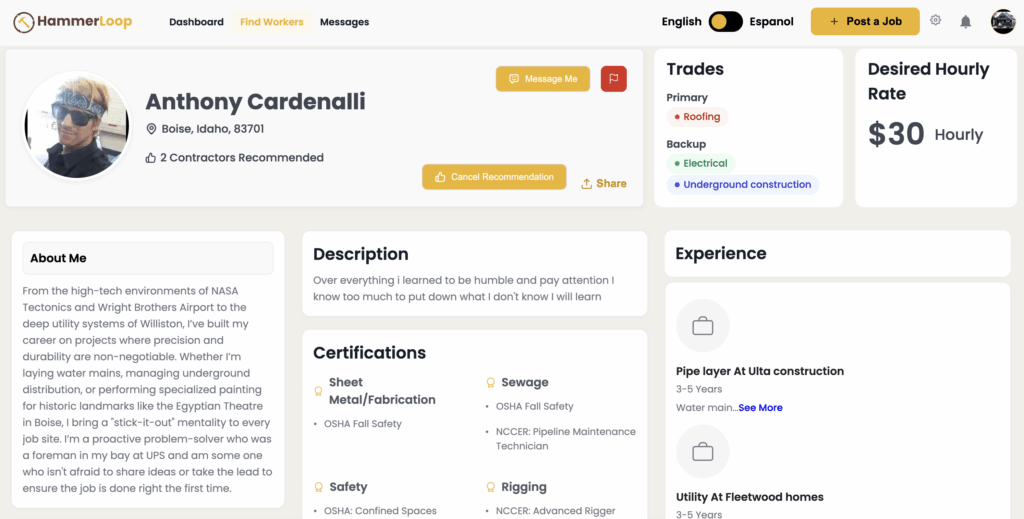
The Hammerloop team is developing the next phase of technology for the new generation of workers in the field. AI features promise to deliver job opportunities to the millennial workforce, meeting them exactly where they live. “As we progress as a company and as a platform, integrating some of the AI tools is going to have a lot more appeal to the incoming generations using it,” says Simmons. “One of the tools we’re going to introduce is an AI translation tool from Spanish to English so that the entire experience, including the content left behind by the user, is translatable. AI will also be able to read profiles to identify different candidates who may be willing to travel for work, and we’ll provide those suggestions to the contractors.” This is a huge benefit to large jobs such as data centers.
Hammerloop’s success in the field
The platform is already showing real-world results. Simmons shared a story about a concrete contractor in the Bay Area who was initially skeptical. After sitting down to create a profile and post a job, the results were almost instant. “When he woke up the next morning, he had at least five profiles to scroll through,” says Simmons.
Hammerloop acts as a digital “town square” where contractors and laborers can connect and communicate instantly. Because the app provides instant notifications, workers can see when jobs are posted in their area, pay rates, locations, and message hiring managers immediately. This level of transparency is exactly what the incoming younger, tech-native generation has come to expect from digital tools.
To make sure this platform works for everyone, Simmons is working directly with contractors to help them post their first jobs. This initial outreach taught him that contractors need a way to quickly understand who’s a fit.
By walking them through the process in person, he has seen how a simple job post translates into direct engagement from workers. The result is a more efficient hiring cycle that removes administrative hurdles.
The roadmap to national growth
With the initial goal of 1,000 workers and 100 contractors met, the team is now looking at a much larger opportunity. Surpassing the contractor goal was a big win, and a clear sign that their hands-on outreach to builder groups is working.
The next steps for Hammerloop is about scaling that success beyond a single region. By understanding the true cost of bringing a worker onto the platform, they can grow with confidence. “I want to do additional regional tests. Let’s face it, Californians are very different than Texans, and very different than Floridians, and very different than Ohioans,” says Co-founder and CFO Eric Vaughan. “We have to make sure we have the same type of reach. From that, we’ll do a more national campaign.” HammerLoop will begin it’s next phase of marketing this week targeting the Texas area.
The key to growth will be keeping contractors and workers active at the same rate. “Otherwise, you have static signups that do nothing,” says Vaughan. “We have to have outreach on the contractor side to make it work. We need contractors taking advantage of this, and even pretty much being risk-free and easy to use, it’s still not easy getting them to try something new”.
The ultimate goal is to find viable employment connections as easily as swiping on a phone. When a contractor presses the post button, it should immediately alert all relevant workers in the area. This seamless functionality is what will finally bridge the gap between those who need work and those who need workers.
And good news travels fast. “We’ve already had an unexpected request to advertise on the platform,” says Simmons. “A Post-construction jobsite cleanup company emailed our general inbox and asked when we were going to start expanding into Texas. They want to advertise to general contractors for their services in Dallas, Fort Worth, Austin, and Houston. We’re not quite there yet, but it was a total validation point for us. It means we’re doing something right.”
Want to stay ahead of the tech that’s building our future? Subscribe to our newsletter for more deep dives into the tools changing the construction industry.