
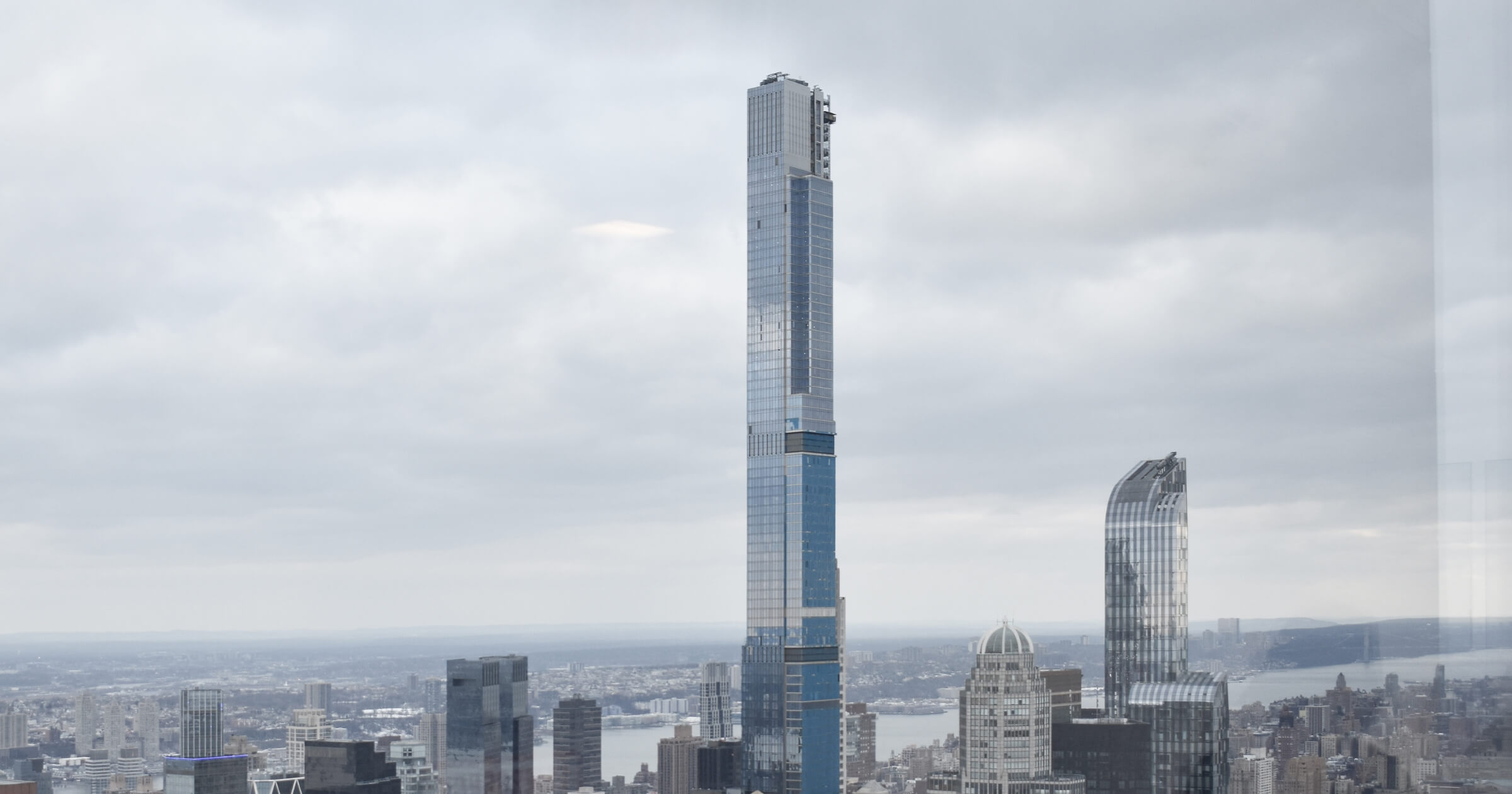
The estimated cost to build Central Park Tower reached around $3 billion USD, making it one of the most expensive residential buildings ever constructed. That figure was driven by its staggering height of 1,550 feet, premium location on Manhattan’s Billionaires’ Row, and the ultra-luxury standards demanded by buyers. This article explores what went into that $3 billion price tag, how it compares to other megaprojects, and what it reveals about the future of supertall skyscraper construction.
Central Park Tower construction cost overview
Extell Development Company broke ground on the tower in 2014 and completed it in 2021. The total cost of Central Park Tower is consistently reported to be around $3 billion. That figure includes land acquisition, design, engineering, construction, interior finishes, marketing, and financing.
Central Park Tower construction facts
| Detail | Information |
| Total construction cost | ~$3 billion USD |
| Developer / Contractor | Extell Development Company/Lendlease |
| Architects | Adrian Smith + Gordon Gill Architecture |
| Height | 1,550 ft (472 m) |
| Floor area | 1.285 million sq ft |
| Estimated build cost / sq ft | $2,300 |
| Construction timeline | 2014 – 2021 |
| Unit sale prices | $4,500 – $7,000 per sq ft |
At approximately 1.285 million square feet, the construction cost per square foot amounts to around $2,300. This is almost double the cost of One World Trade Center on a per-foot basis and nearly ten times the cost of Dubai’s Burj Khalifa, despite Central Park Tower being half as tall.
| Building | Total Cost | Cost / sq ft (approx.) | Height | Completion Year |
| Central Park Tower | $3 billion | $2,300 | 1,550 ft | 2020 |
| One World Trade Center | $3.9 billion | $1,450 | 1,776 ft | 2014 |
| Burj Khalifa | $1.5 billion | $265 | 2,717 ft | 2010 |
Building in Midtown Manhattan adds layers of cost that skyscrapers elsewhere never face—limited staging space, traffic restrictions, union labor rates, and strict noise and safety regulations.
Major cost drivers in the project
Land and location – building on Billionaires’ Row
The site sits on West 57th Street, one of the most expensive corridors in the world. Before construction began, Extell spent years assembling parcels and purchasing air rights from neighboring buildings, including the Art Students League. Reports estimate that the land and rights package alone costs hundreds of millions of dollars. Each air-rights deal expanded the tower’s allowable height, while cantilevering over an existing structure added engineering complexity and legal negotiations.
Zoning restrictions also dictated setbacks and sight-lines to preserve Central Park views—design choices that directly impacted form and cost. Building on Billionaires’ Row meant buyers would pay for exclusivity, but it also meant paying extraordinary sums for the privilege to build there.
Design and architecture – ultra-luxury vision
Designed by Adrian Smith + Gordon Gill Architecture, Central Park Tower was conceived as a global symbol of wealth and luxury. Every design choice reflected that goal. Inside are 179 residences averaging more than $20 million each.
The architects designed for an international clientele, featuring sweeping floorplates, 14-foot ceilings, and panoramic views. Interiors feature imported marble, custom millwork, and private elevators. At the top sits the Central Park Club, a 50,000-square-foot amenity spanning three floors with a ballroom, private dining rooms, and a 100-foot indoor pool. Each of these luxury elements added millions in custom design and material costs.
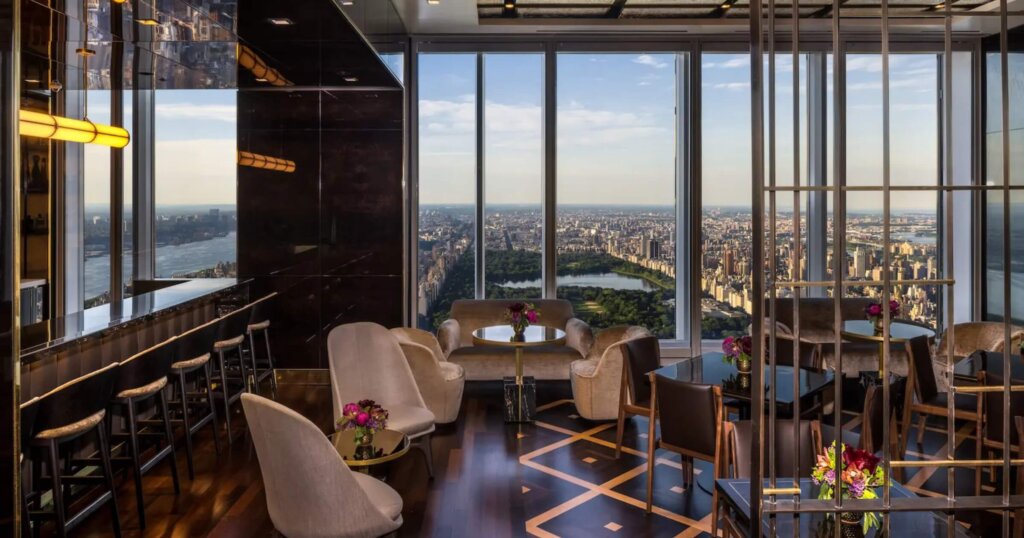
Marketing the tower as the world’s tallest residential building also meant architectural branding had to match ambition. Lighting design, facade detailing, and sky-club construction were as much about prestige as performance.
Materials and structure – strength meets elegance
The tower’s frame uses a reinforced concrete core, structural steel perimeter framing, and a high-performance glass curtain wall that maximizes views while controlling wind loads and thermal transfer.
Why it mattered:
- The reinforced concrete gives stiffness to limit sway at 1,500 ft.
- Custom steel and rebar assemblies were required for the massive cantilever over 57th Street.
- The curtain wall features low-iron glass for unmatched clarity—imported and custom-cut for each floor.
Trade-offs:
- Custom components resulted in lengthy fabrication and transportation times.
- Façade installation required specialized rigs and safety systems.
- Each upgrade multiplied the costs per floor.
Despite the precision engineering, the tower has faced resident complaints about creaking noises, water leaks, and elevator issues linked to building movement and facade stress—a reminder that even billion-dollar builds face long-term maintenance costs.
Engineering complexity – height and wind resistance
Reaching 1,550 feet in Manhattan required advanced wind-tunnel testing, tuned mass dampers, and deep foundation design. Engineers embedded a 1,200-ton mass damper near the top floors to counter sway in the building. Wind pressures were modeled for every facade zone. Even elevator systems had to be recalibrated to adjust for temperature-related building expansion and contraction.
Structural engineer WSP Global collaborated with Lendlease to coordinate concrete pours with a compressive strength exceeding 14,000 psi—among the strongest ever used in New York. Excavation reached a depth of 80 feet into Manhattan schist, necessitating extensive waterproofing and tie-back bracing to neighboring basements.
Each design safeguard added millions to both the construction and testing budgets. For comparison, the damper system alone costs tens of millions; without it, penthouse occupants would experience motion perceptible to the human body—unacceptable in luxury living.
Labor and project management
The project involved thousands of skilled tradespeople over seven years. The general contractor, Lendlease, managed every phase from excavation to fit-out. Crews worked under tight urban constraints—limited material delivery hours, tower-crane time coordination, and strict safety compliance.
Union labor rates in Manhattan remain among the highest globally, with overtime premiums and specialized certifications for high-rise work. Lendlease’s coordination between ironworkers, concrete specialists, and glass installers was crucial; each trade sequence had to align perfectly. A single delay in facade or core progression could halt multiple teams and incur hundreds of thousands of dollars in daily idle time.
The project also faced weather interruptions, protests, and occasional noise-restriction fines—all of which affected budget and timeline.
How they built Central Park Tower
Timeline overview:
- 2013–2014: Site assembly and demolition of existing mid-rise buildings.
- 2014 (May): Excavation begins; foundation and slurry wall construction.
- 2015 (February): The concrete core begins to rise; steel framing follows.
- 2017: Curtain wall installation starts on lower floors.
- 2018–2019: Interior work progresses; mechanical systems and elevators installed.
- 2019 (Sept): Structure tops out at 1,550 ft—the tallest residential tower in the world.
- 2020: Façade completion and first units delivered.
- 2021: Final amenities finished and marketing push for remaining residences.
Lendlease used jump-form systems and self-climbing cranes to move upward rapidly, often adding a floor every three days. Concrete was pumped vertically more than 1,400 feet, requiring temperature-controlled batching to prevent curing issues. The project’s cantilevered floors required precise sequencing—any deviation could lead to long-term structural imbalance.
Videos from The B1M and construction archives show the tower rising over the Art Students League building, demonstrating the extraordinary coordination needed to thread such a narrow footprint into Midtown’s skyline.
Unit economics: from cost to revenue
While construction costs averaged approximately $2,300 per square foot, condo sales prices ranged from $4,500 to $7,000 per square foot, according to CityRealty. Early projections in 2017 forecasted an average price of $7,106 per square foot, aiming for a record-breaking sell-out of over $4 billion.
A 4-bedroom, 4.5-bath residence of 4,295 sq ft listed for about $26.7 million, or $6,217 per sq ft. Penthouse #129—spanning 17,500 sq ft across three floors—initially listed at $250 million, later reduced but still among the most expensive homes in the world.
These numbers reveal how thin profit margins can be, even at the highest levels: a $3 billion build cost, a $4 billion sell-out target, and slow unit absorption due to market fluctuations result in long carrying costs. Financing through loans and equity partners incurs additional expenses. Yet the pricing strategy—selling luxury in the sky—allows Extell to recoup those costs gradually through the prestige and exclusivity it offers.
Problems arising from material choices
After occupancy began, residents and engineers noticed structural creaks, leaks, and elevator malfunctions. A Business Insider investigation revealed that high winds and temperature fluctuations caused noise and water intrusion in several units. The building’s extraordinary height and slenderness ratio (1:24) made it particularly sensitive to sway.
Experts attribute many of the issues to the very materials that made the tower iconic—thin concrete walls, post-tensioned slabs, and complex curtain-wall joints. While these choices reduced structural weight, they left less tolerance for vibration and expansion. These lessons are now influencing the next generation of super-tall design, where dampening systems and thermal break technology are being prioritized over minimalism.
What this project tells us about future skyscraper construction
The Central Park Tower’s construction costs demonstrate how ambition and location can multiply costs. A 98-story luxury tower in a mid-block Manhattan lot requires financial and engineering resources few developers can access. Yet it also shows where skyscraper design is heading—integrating materials science, AI-based modeling, and precision prefabrication to shorten timelines and mitigate risk.
Future towers will likely apply lessons from Central Park Tower’s issues, including over-engineering sway control, investing in modular facade panels that facilitate better maintenance, and balancing slender profiles with occupant comfort. For cities, the project highlights how zoning and air rights markets can influence skyline evolution as much as architecture itself.
Final thoughts
Central Park Tower stands as both a triumph of engineering and a case study in construction economics. At roughly $3 billion, it reflects what happens when architectural ambition, prime land, and high-end materials converge in one project. For construction and engineering professionals, it’s proof that design intent drives cost as much as raw materials—and that the tallest buildings in the world are also some of the most complex to deliver.
To explore more about megaprojects and skyscraper innovation, visit:
- Most expensive skyscrapers
- Supertall skyscraper construction projects
- Vancouver’s tallest skyscraper design
Subscribe to the Under the Hard Hat newsletter for weekly stories on construction trends, engineering feats, and the evolving craft of building the impossible.