
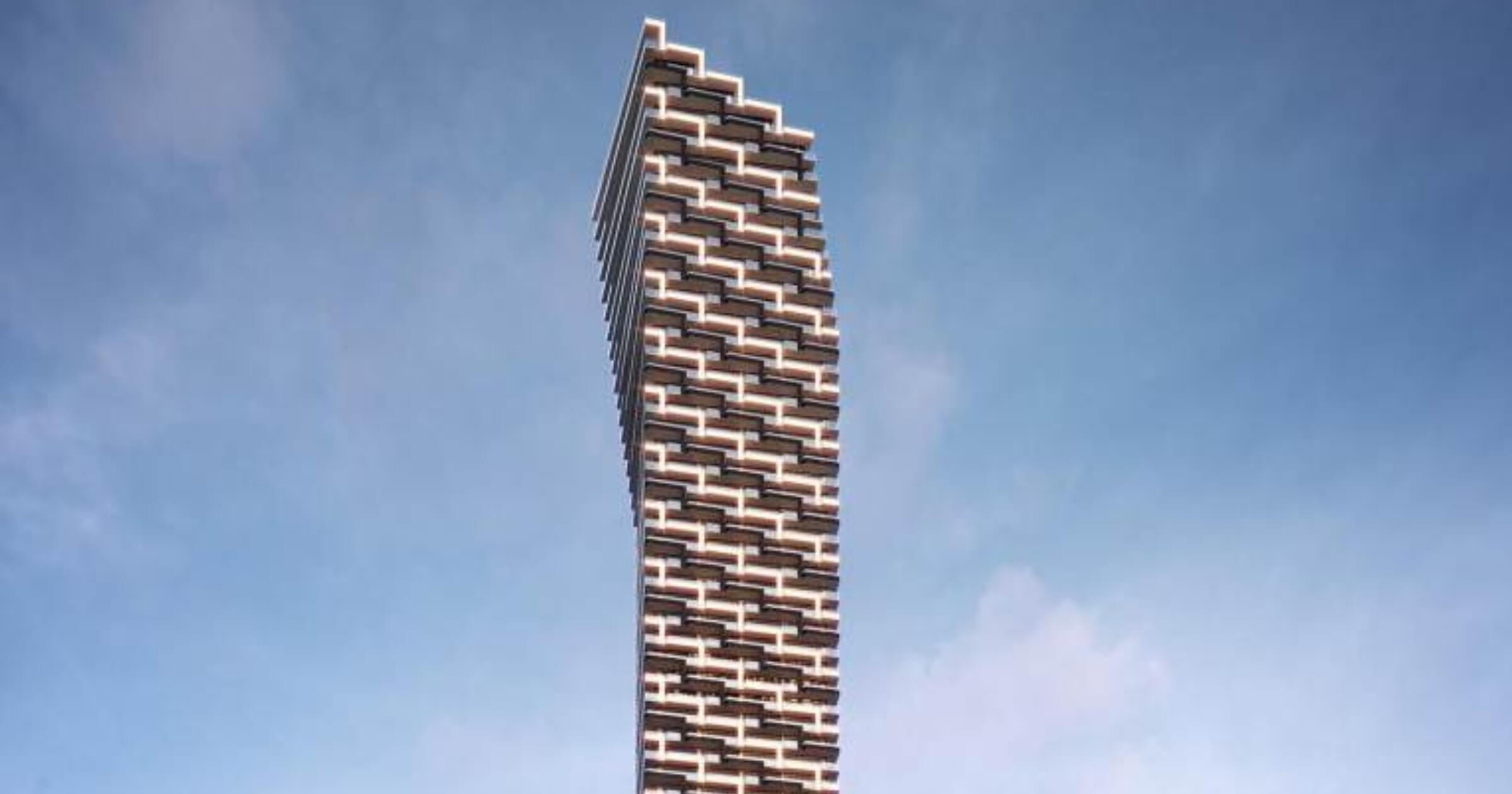
Mississauga’s new tallest skyscraper, the 83-storey M3 tower, leans an eye-catching 14 metres to the northwest. RJC Engineers utilized parametric modeling, construction sequencing, and a record-setting tuned mass damper to ensure the tower stands strong against gravity and wind.
M3 is an 83-storey residential tower in Mississauga, Ontario, rising about 258 metres. It is being built by RJC Engineers and designed by Arcadis (formerly IBI Group) as part of the larger M City development. Its bold feature is that the tower doesn’t rise straight up—it leans or tapers 14 metres toward the northwest corner. That lean creates striking architecture, but it also makes engineering a lot more complicated. RJC had to invent new ways to keep the building safe, stable, and comfortable.
One of those ways is parametric wall design. RJC ran digital models (“parametric analysis”) to vary wall thicknesses and concrete strength (moduli) so that different parts of the tower carry different loads. Because the building steps back toward the top, the load path isn’t uniform. On the side that leans, walls have to be thicker or stronger to resist extra pressure from gravity and to counteract what they call “gravity sway.”
“M3 will experience significant wind demand, comparable to taller towers in downtown Toronto, because it does not have the benefit of being shielded by other tall buildings,” said Kevin MacLean, principal at RJC Engineers. To address this, engineers designed a lateral load-resisting system and the biggest tuned mass damper (TMD) in Canada. “The TMD acts like a pendulum, counteracting building sway to keep residents comfortable during both everyday winds and rare extreme events,” said MacLean.
A second method is floor-level corrections during construction. As floors go up, the lean causes vertical and horizontal displacements. Without correction, the upper floors could drift off level. RJC developed a construction sequencing strategy that periodically corrects those displacements so that floors stay level. Trades, formwork, and structural supports are adjusted as the tower rises to compensate for the slope.
RJC Engineers relied on parametric wall modeling, mid-construction adjustments, and a tuned mass damper to handle the tower’s unusual lean and constant wind pressure. At street level, the podium brought its own hurdles. Housing everything from a pool and fitness center to retail shops and parking meant the structure had to shift between wide-open spans and heavy load-bearing walls. Coordinating those loads meant carefully tailoring the design so every part of the building worked together as one.
The M3 tower is more than just an architectural showpiece; “it’s a benchmark for how Canadian suburbs are embracing vertical living,” MacLean said. “The project demonstrates how advanced structural engineering can enable ambitious designs in new contexts, supporting city-building beyond Toronto’s core.”
If you like stories about how buildings are made, or want updates on engineering in action, subscribe to our newsletter so you don’t miss what’s next.