
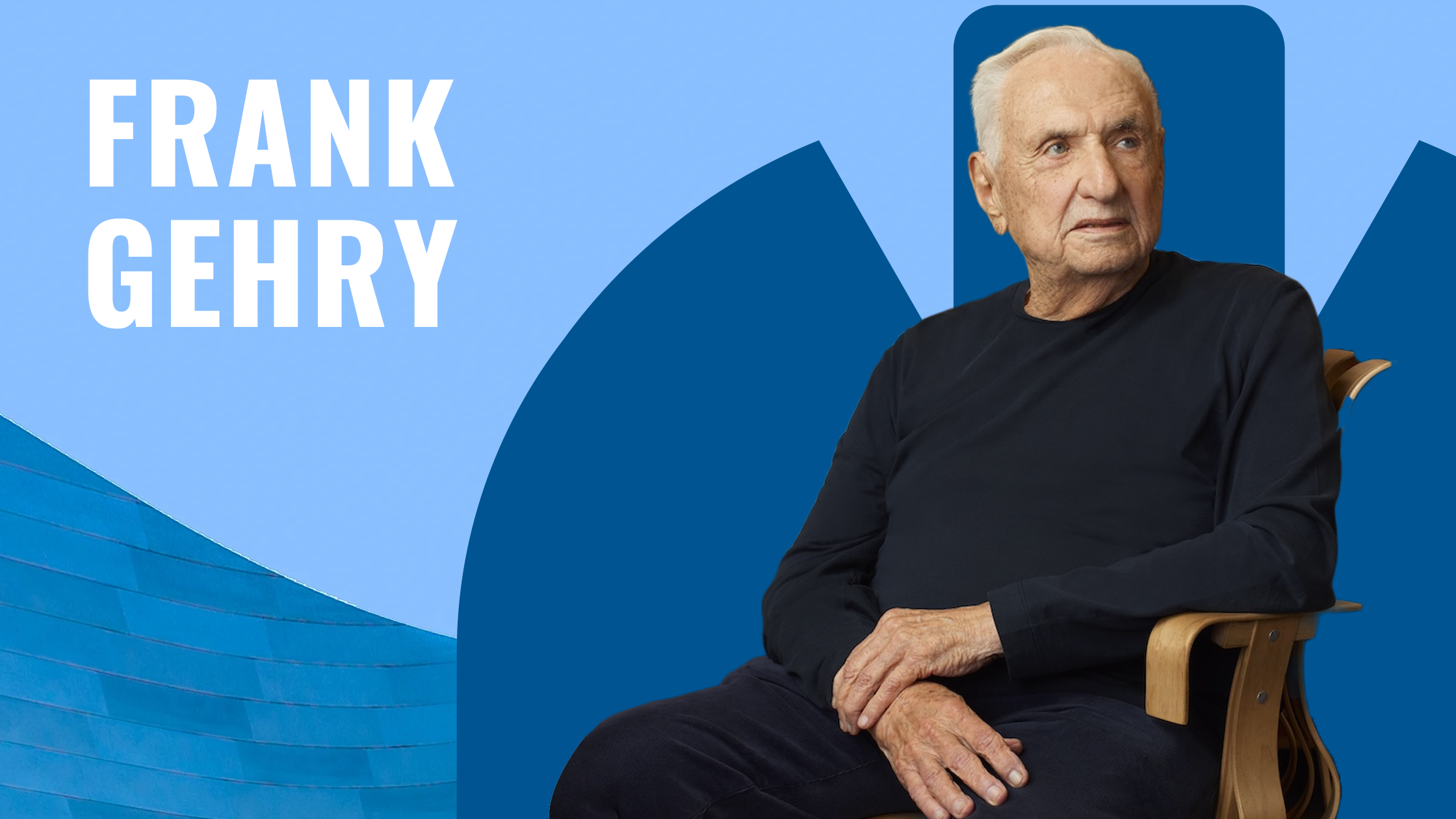
Frank Gehry didn’t follow a straight path into architectural fame, but his sense of wonder and curiosity began as a child. He spent hours building small structures from scraps of wood on his grandmother’s kitchen floor, drawn to the simple act of making things take shape. Over time, it led to some of the most widely discussed buildings of the modern era. Gehry passed away in December 2025 at age 96, still sketching and questioning long after most architects step back. This article looks at who Gehry was, how his approach to building took shape, and why his most famous projects continue to challenge architects, engineers, and construction teams today.
Who was Frank Gehry?
Frank Owen Goldberg was born in Toronto in 1929 to immigrants who had moved to Canada in search of a better life. As a kid, he loved fiddling with scraps and stuff he found lying around. Later on, critics would look back on those early experiments as sort of the roots of his architectural style—the kind that’s always pushing against neat lines and polite finishes.
When he was 17, the Goldberg family packed up and headed to LA. Those dusty streets, cheap building materials, and massive construction sites left an even bigger impression than anything he would’ve learned in a classroom. Frank graduated from USC with a degree in architecture and later checked out Harvard’s urban planning program—but even with all that formal training, it never constrained him. Instead, it gave him more to play around with, not to follow to the letter.
Gehry started in a few firms, but by the early 1960s, he went on his own, running his own practice. Those early days were challenging. His office was churning out houses, rehabs, and small commercial buildings. Peers thought his use of rough materials was just a flash in the pan rather than actual sound design. But Gehry stuck by it, trusting that something that looked crazy one day could feel great another.
By the 1970s, he was experimenting with his own house in Santa Monica—wrapping chainlink fencing, exposed wood, and corrugated metal on a small bungalow. The neighbors complained, some visitors were confused, but Gehry just kept going with it. That project was basically the first sign of the kind of radical architecture he’d make a name for himself with.
When Gehry passed away in late 2025, his entire body of work was finally laid out for all to see—decades’ worth of projects spanning continents and building types. He had a maker’s eye in his architecture, and his straightforward, often stubborn approach made a lasting impression on the field.
How Gehry earned influence without chasing approval
Frank Gehry wasn’t chasing architectural fame. He was trying to be direct about form and construction. The unusual shapes in his work aren’t decorative gestures; they are purposeful and respond to structural loads, environmental forces, and how light moves across a building.
In the early days, Gehry was all about using raw materials because they were cheap and fun. But what people often don’t realise is that on his own projects, the cardboard and bent plywood wasn’t just a placeholder for the ‘real thing’: it was a genuine test of how the structure would actually turn out. And that’s pretty rare in an industry that usually wants to polish up its image before moving on to the hard stuff.
By the time advanced modeling software like CATIA began appearing in his office in the 1990s, Gehry had built up enough trust with his clients and engineers to demand that they use it on real buildings. The software, initially designed for the aerospace industry, allowed him to translate those cardboard instincts into a set of coordinates that contractors could use to build the thing in real life. That’s why you can walk into a museum in Spain and see unique titanium panels that still fit together perfectly.
It wasn’t about following fads and trends, though—Gehry’s work could often be jarring because it wouldn’t play by the rules. Engineers would have to figure out how to live with new tolerance standards, and fabricators would have to get used to the fact that shop drawings weren’t always nice and neat, with plain right angles and straight lines. Builders had to start thinking in terms of curves and custom joints rather than plugging in a standard part. All of this made his projects much more difficult, but it also helped change how people actually solve problems in the real world.
Famous Gehry buildings that forced builders to think differently
1. Guggenheim Museum Bilbao (Bilbao, Spain — 1997)
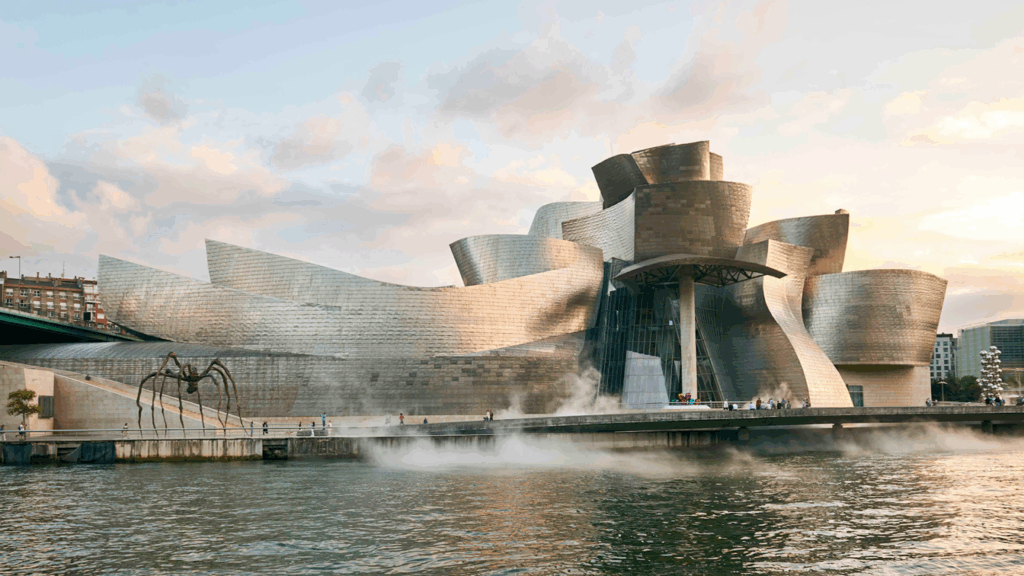
The Guggenheim Museum in Bilbao is the building for which Frank Gehry is best known. Its thirty thousand titanium panels appear to flow effortlessly like water over a rocky outcrop, catching the light in a way few buildings had before. The seemingly haphazard look of this building is the result of painstaking 3D math. You won’t find galleries lined up in tidy, straight corridors here. Instead, they twist and turn and surprise around every corner. It took an enormous amount of collaboration between Frank Gehry’s people, engineers, and builders to get the geometry right, but in the end, it was a building that turned a struggling industrial city into a major tourist destination overnight—not because of flashy glamour, but because people had never seen anything quite like it.
2. Walt Disney Concert Hall (Los Angeles, USA — 2003)
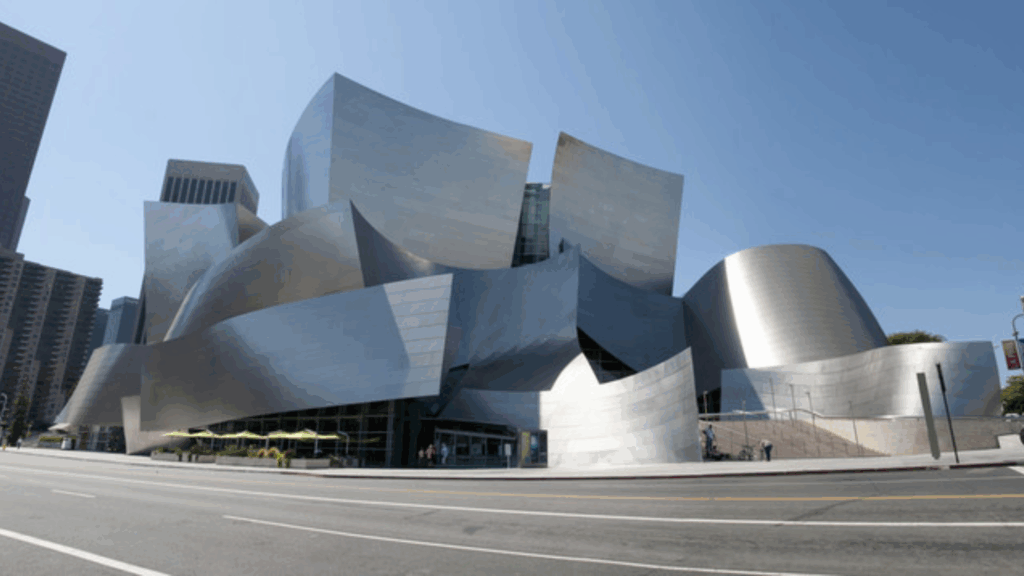
The Walt Disney Concert Hall didn’t happen overnight. Funding kept falling through, and the designs kept getting altered right up until the end. But when it was finally finished, it gave downtown Los Angeles an identity. One of the things that makes this concert hall so special is that Frank Gehry decided to place the audience right around the orchestra rather than just in front of it, which makes all the difference in the sound. Outside, the stainless steel exterior is so shiny that it casts interesting shadows all day long—though the glare in the early days was so bad that they had to go back and dull some of the panels on site. That kind of gritty, hands-on detail is the sort of thing you never see in an architect’s renderings, but it’s precisely the sort of thing that makes a building work.
3. Dancing House (Prague, Czech Republic — 1996)
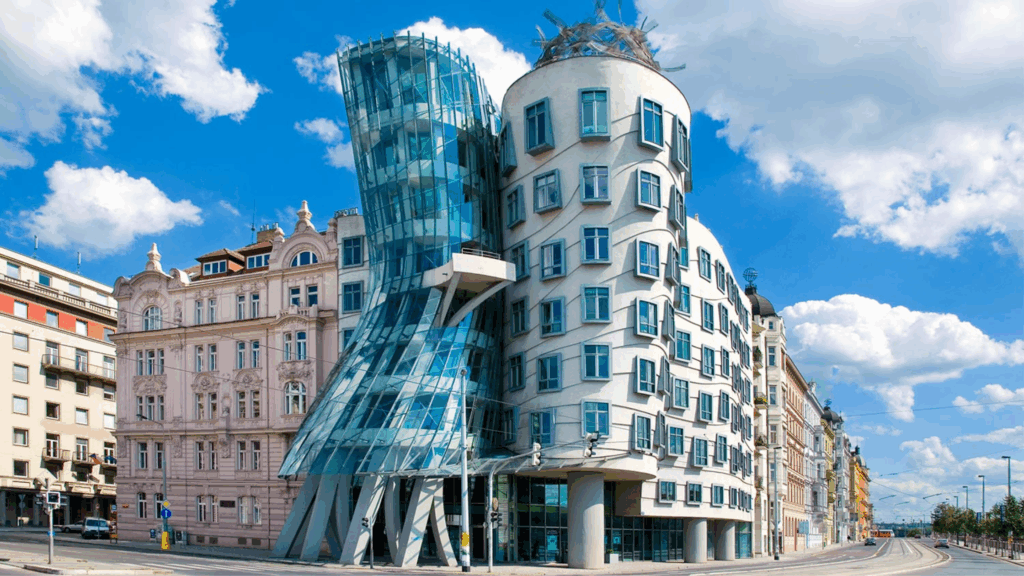
This building doesn’t sit quietly. Two towers twist toward each other like a “dance” in glass and concrete on a site that had been left empty since WWII. Gehry collaborated with Czech architect Vlado Milunić, and the result was a building that refused to imitate its stone neighbors while still fitting in. Structural engineers had to get creative to make sure that some of the more awkward angles and loads worked, but in the end, it paid off. In a city where preserving the old and traditional was (and still is) a big deal, the Dancing House really started to get noticed, and over time, it even became a bit of a beloved landmark.
4. Fondation Louis Vuitton (Paris, France — 2014)
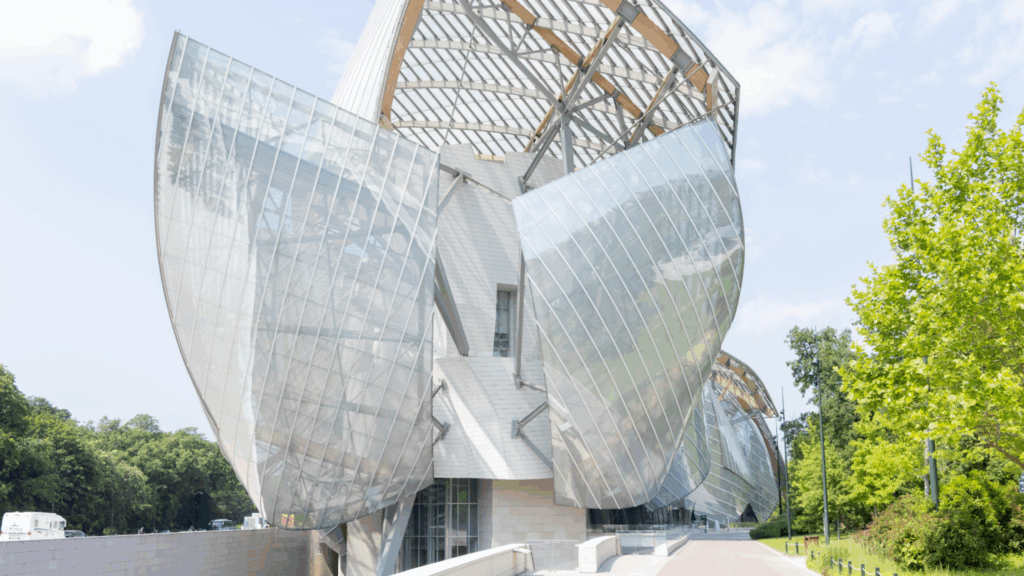
For this little museum on the edge of a Paris park, Frank Gehry took a big risk with glass, pushing it further than most crews had ever seen it pushed before. The “sails” are an intricate puzzle of uniquely curved panes, all supported by a lattice of steel and laminated timber. Each pan had to fit together like a jigsaw, and getting the angles right on site was a serious challenge. Trades were working on this project for years, checking and rechecking the angles. And let’s be honest: getting this through all the red tape and built at all was a minor miracle.
5. Vitra Design Museum (Weil am Rhein, Germany — 1989)
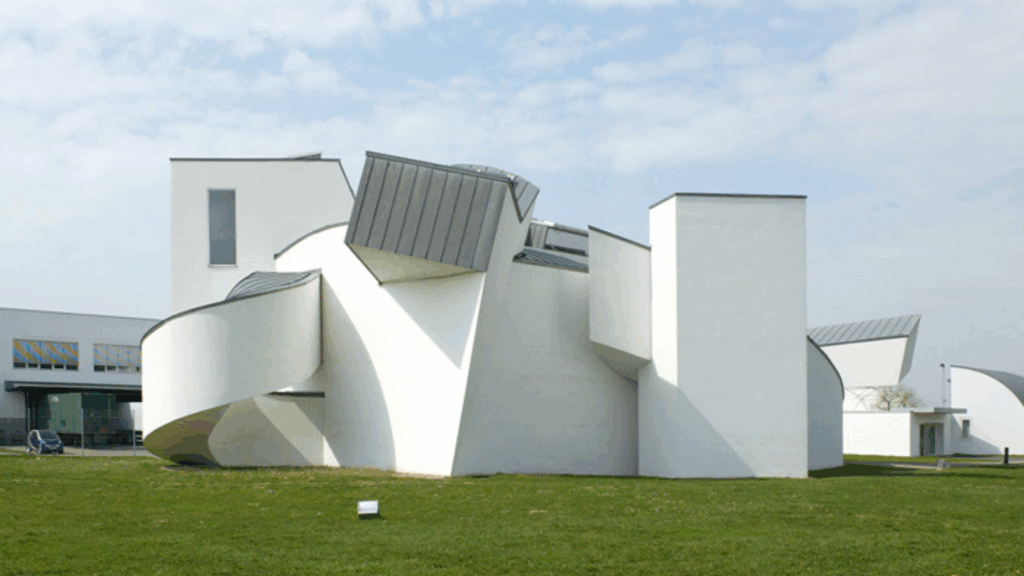
Before Gehry was a household name, this museum he built for the design campus was the real deal. It’s the building with the white plaster and titanium-zinc facade that doesn’t particularly scream for attention, but just has a real organic feel to it, like it’s actually living and breathing on its own. This building doesn’t just sit there straight up and down like most buildings; it leans, it angles, it pulls away from the regular straight lines, and that was not something you saw that often back then. The builders really pulled out all the stops to get it just right, giving the form the lead role, rather than the structure.
How Frank Gehry left a lasting mark on real building work
Frank Gehry never sought the applause; he was in it for the curiosity—what materials could do, how form could be pushed to the limit, and how movement could be incorporated into a building. He thought buildings should make you feel something, even if that feeling was just confusion or, on occasion, perhaps annoyance.
It’s that willingness to be wrong that made him a bit unpopular in more traditional architectural circles from time to time. Still, it’s that willingness to be wrong that made him as valuable as you can get to a bunch of young, enthusiastic designers who would have hated drawing boxes on paper all day. When his buildings were being put up on site, they taught the crews working there not just to assume everything was fine, but to question things, double-check the numbers, and actually look at every single panel seam and connection to see how everything really mattered.
He ran his company until his death in December 2025, mentoring younger designers and encouraging them to explore, try new things, and see where it took them. While the rest of the architectural world was chasing a perfect symmetrical look, Gehry was throwing everything at the drawing board—literally and figuratively—at every turn.
What builders and designers can take from Gehry’s path
Frank Gehry’s life was far from neat and tidy, and it was pretty unpredictable, too. It took years before his ideas finally started to get recognition on a global scale—a fact that’s worth bearing in mind if you’re just starting in a trade and having to build something from the ground up.
His work also serves as a reminder that the relationship between what you design and how it’s actually built doesn’t have to be at odds—when builders are brought into the conversation early, the project as a whole is less of a risk and feels a lot more believable. Gehry didn’t just conjure up wacky shapes out of thin air—he tried them out, built models, and then worked with people who could actually get them built. That’s a lesson worth taking on board, regardless of whether you’re working with concrete or wiring a circuit.
In a profession where certainty is often prized, Gehry showed that uncertainty, handled with real care and attention, can sometimes lead to something truly unforgettable.
More people reshaping construction
Frank Gehry’s story is one of many that we highlight at Under the Hard Hat: those who redefine what it means to build. Check out these articles:
- Ron Bogle: Reimagining America’s schools
- Lexis Czumak-Abreu: The electrician powering a career movement to trades
- How a foreman’s TikTok series turned lunch breaks into cultural storytelling
- 15 construction influencers worth following
These aren’t celebrity stories. They’re about people doing hard things on real jobsites every day.
If you want more stories about people shaping how construction actually works, join the Under the Hard Hat newsletter for weekly profiles, tool talk, and the work behind the work.