
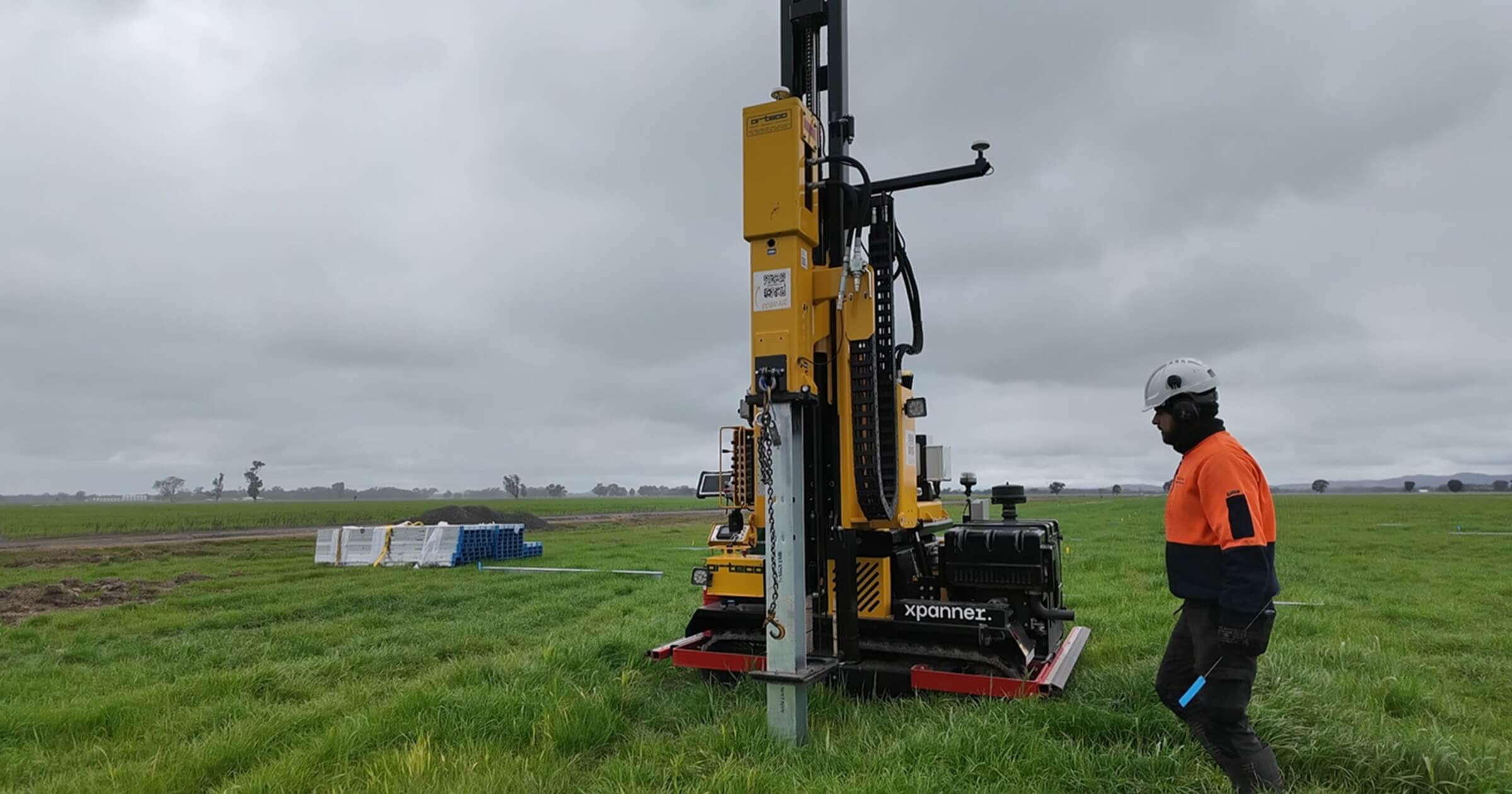
From autonomous excavators to AI-powered automation kits, a new wave of physical AI systems is helping contractors build energy grids, data centers, and other critical infrastructure faster.
Building the massive power grids and data centers our modern world depends on requires a new level of precision and speed. Labor is quickly shrinking while the demand is greatly outpacing what contractors can achieve with their current capabilities. That’s where various construction technology companies have stepped in to solve this challenge by bringing “physical AI” to the heavy machinery already found on large-scale job sites. At CONEXPO 2026, we explored several companies and how they are creating automated systems to help the industry tackle labor shortages and finish critical infrastructure projects on time.
Why the demand for infrastructure is skyrocketing
The global push for AI and digital transformation has created an urgent need for massive data centers and reliable energy grids. Traditional construction methods are struggling to keep up with a series of intense, interconnected pressures.
Skyrocketing energy demands and the data center boom
The power required to run the next generation of AI is staggering. According to the International Energy Agency (IEA), global electricity consumption from data centers is projected to double by 2026, reaching more than 1,000 terawatt-hours (TWh). This is roughly equal to the total amount of electricity used by the entire country of Japan.
The reason for this spike is simple: AI is power-hungry. A single generative AI query can consume about 10 times the electricity of a standard Google search. As a result, data centers that once occupied 100,000 square feet are being replaced by “hyperscale” campuses that cover millions of square feet and require gigawatts of power. In places like Ireland, data centers are expected to account for 32% of the country’s total energy use by the end of this year.
Massive infrastructure investment
To meet these needs, both private companies and governments are pouring record-breaking amounts of money into new projects.
- Private tech giants: In 2026, the combined capital spending of Amazon, Google, Microsoft, and Meta is expected to exceed $600 billion. Amazon alone has committed to a $200 billion investment plan for AI and AWS infrastructure.
- The “Stargate” project: Microsoft and OpenAI are currently working on a $500 billion initiative to build a series of massive AI supercomputer campuses. These sites, like the ones under development in Texas, are designed to secure a leading position in the race for artificial general intelligence.
- Government funding: Public investment is also at an all-time high. In the U.S., the Bipartisan Infrastructure Law (BIL) is providing $550 billion in new investments through 2026. This includes billions specifically for modernizing the electric grid, expanding broadband, and building the resilience needed for a digital-first economy.
Labor and time constraints
Despite the massive amount of funding available, the industry is hitting a major wall when it comes to people and time.
- A half-million worker shortage: The construction industry needs to attract approximately 500,000 new workers in 2026 just to meet current demand. This shortage is most severe in specialized roles like electricians and technicians who are essential for complex data center builds.
- The scale of modern sites: Project sizes have exploded. A single data center campus that used to require 750 workers now needs 4,000 to 5,000 people on-site daily. Managing a “small city” of workers requires new tools that traditional paperwork just can’t handle.
- Impossible deadlines: Tech companies are demanding that these facilities be built faster than ever. When project requirements change mid-build due to new AI chip releases, contractors must be able to pivot instantly. Without automated tracking, these tight 2026 timelines are becoming nearly impossible to meet.
What is physical AI?
Physical AI is the bridge between digital intelligence and mechanical action. Unlike a chatbot that lives on a screen, physical AI lives inside machines like excavators, cranes, and drills. This allows them to see and respond to their environment in real time.
To understand what physical AI looks like on a real job site, it helps to see it as more than just a brain in the cloud. It is a system of sensors and processors that allow a machine to feel the soil, see obstacles, and act with a level of precision that humans simply can’t maintain for eight hours straight.
Here are four real-world examples of physical AI in action today:
1. Gravis Robotics: Feeling the soilXpanner’s X1 deployed on a pile driver in Texas.
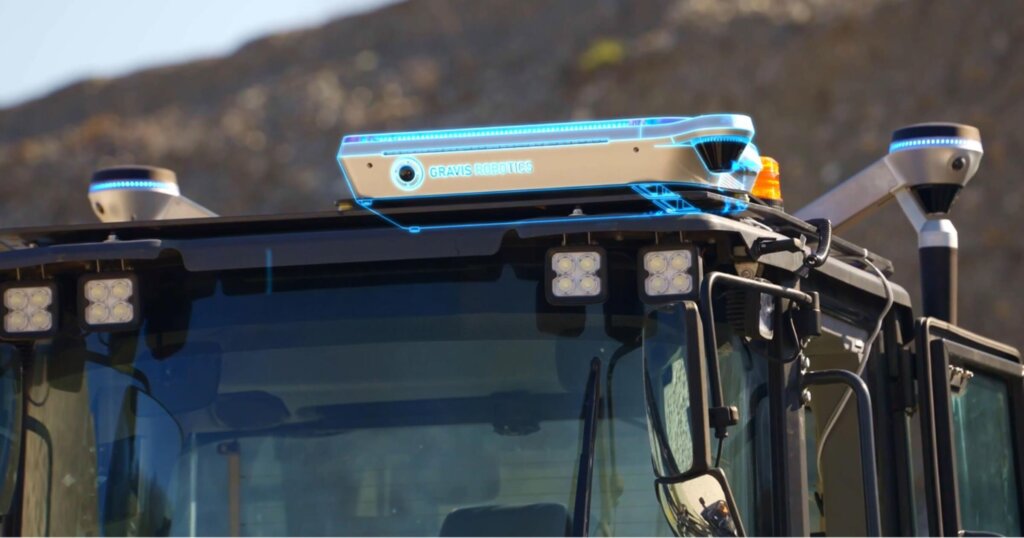
Gravis Robotics LiDar unit installed on an excavator. Courtesy of Gravis Robotics.
At ConExpo 2026, Gravis Robotics demonstrated how physical AI allows a 36-ton excavator to feel the ground. While a human operator might struggle to dig through a mix of soft dirt and hidden bedrock, the Gravis AI system uses hydraulic feedback and LiDAR to sense the soil’s resistance in real time. It then adjusts its movements instantly to ensure the bucket is always 97% full, leading to a 30% increase in productivity.
2. Built Robotics: The Exosystem trench bot
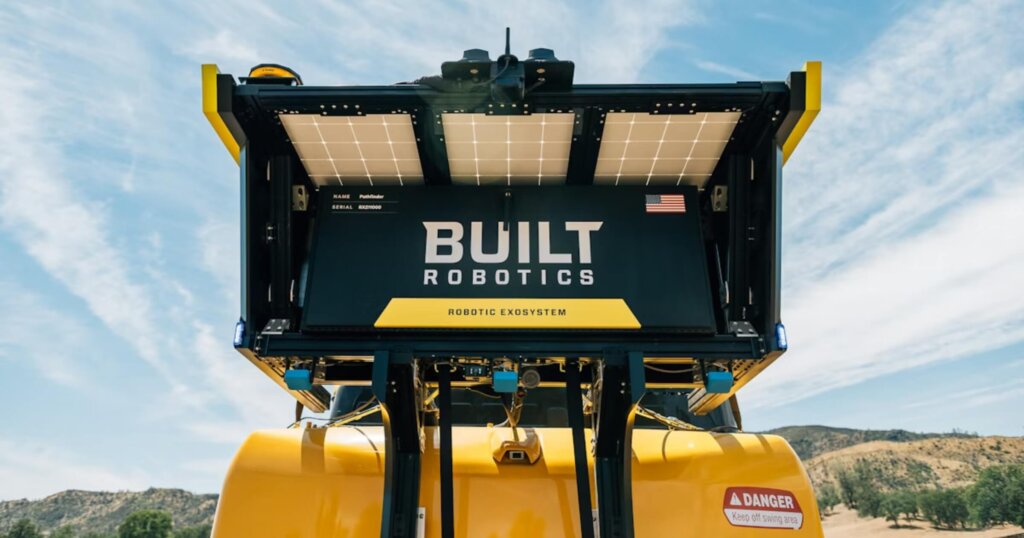
Built Robotics exosystem attached on an excavator. Courtesy of Built Robotics.
Built Robotics has turned standard excavators into autonomous trenching robots using their Exosystem. This is a physical AI kit that can be installed on almost any brand of excavator in just one day. Once active, the machine can dig hundreds of feet of perfect trench for solar farms or pipelines without a person in the cab. By handling the most repetitive and boring parts of the job, the AI achieves cost savings of 20% or better, and keeps the project moving even when there aren’t enough skilled operators available.
3. Caterpillar: Autonomous hauling at scale
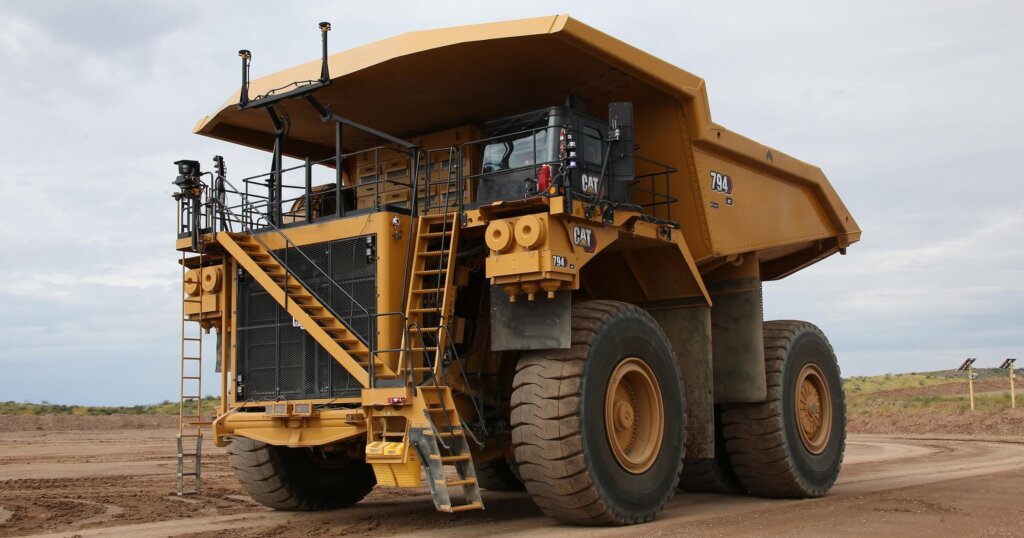
Autonomous Cat® 794 AC mining truck equipped with Cat® MineStar™ Command for hauling
Caterpillar’s MineStar Command is one of the most successful physical AI deployments in history. As of March 2026, their fleet of over 270 autonomous trucks has safely hauled more than two billion tonnes of material. These trucks use a combination of radar, LiDAR, and high-speed AI processors to navigate unmanned zones on massive job sites. They can operate 24/7 in conditions that would be too dangerous or difficult for humans, such as heavy dust, fog, or extreme heat, all while maintaining perfect speeds to save fuel.
These systems demonstrate how physical AI can augment fleets, not replace them. By letting AI handle the three D’s, tasks that are Dull, Dirty, or Dangerous, contractors can focus their human talent on the complex problem-solving that machines still can’t touch.
4. Xpanner: Automating trenching, solar panel installation, and more
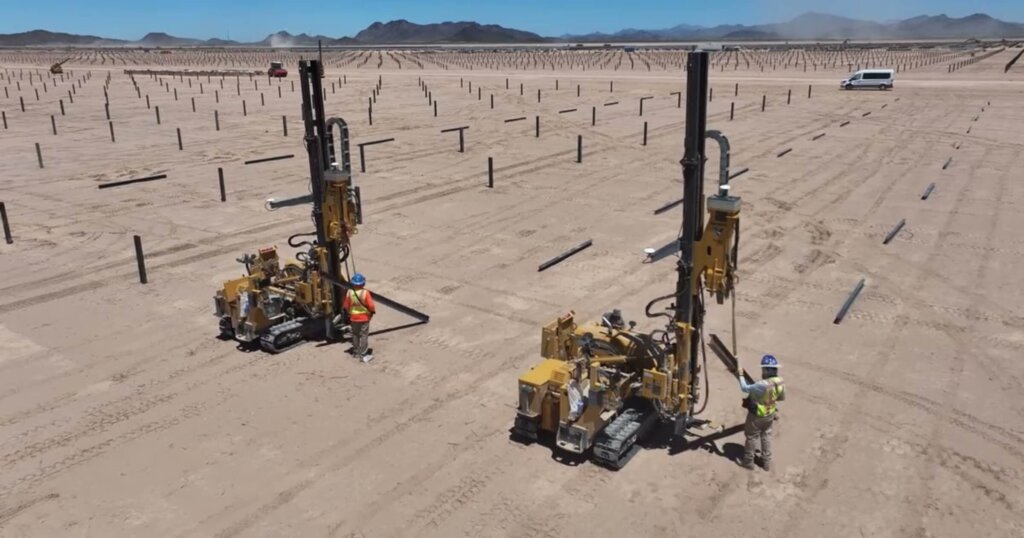
Xpanner’s X1 deployed on pile drivers in a major infrastructure project.
Xpanner focuses on making existing heavy equipment smarter through its plug-and-play automation solutions. Their X1 Automation Kit is an all-in-one retrofit solution that transforms legacy machinery into Software-Defined Machinery (SDM). By installing this hardware and software package, contractors can enable precise automation across various equipment models. This approach allows contractors to upgrade their existing fleets rather than buy entirely new, expensive machines.
This kit is the primary tool for bringing physical AI to the job site, as it includes:
- Physical AI module: This module uses sensor fusion and precise recognition to allow the machine to see and respond to its environment.
- Task-specific software: Much like a smartphone, the X1 Kit can be updated with modular software for specific tasks like piling, trenching, or grading without needing to change any hardware.
- One-touch automation: The system simplifies complex moves into automated actions, such as Automated Drive & Align, which reduces the mental and physical load on the operator.
The Xpanner technology uses advanced computer vision and machine learning to automate the most repetitive and dangerous parts of a project. “What we do is task-specific automation,” says Connor Gans, Xpanner product expert. “You’re on the job site, you bring us a pain point … whether it’s labor, whether it’s consistency, whether it’s reliability, and we can find a way to automate it and streamline it.
Xpanner’s technology is already at work across the United States, helping teams build complex projects in record time.
Building the next generation of solar farms
Solar projects require installing thousands of piles and panels across massive areas of land. Traditionally, this takes a lot of manual labor and constant measuring to get everything perfectly straight. Xpanner changes this with two main tools.
The system replaces slow manual steps with automated execution. Contractors no longer need to spend days surveying or marking pile locations and heights before they start. The machine simply knows where to go and how deep to drive each pile.
One of the most dangerous and boring jobs on a solar site is lifting heavy panels all day long. Xpanner uses an automation package that helps machines lift and place panels with perfect accuracy. This reduces the risk of injury and leads to a 52% leap in productivity. In a single shift, a crew using this system can install 88 panels compared to just 58 with traditional methods.
Civil construction and AI power infrastructure
As the world builds more data centers and battery storage sites, the need for precise earthwork has skyrocketed. Xpanner provides specialized tools for these critical projects.
From trenching to grading, the automation system helps any operator achieve the precision of an expert. It removes the need for extra workers to stand near the machine for measurements, which makes the job site much safer.
The earthwork solution is specifically designed for the high-tech sites needed for the AI era. A single versatile machine can now replace entire fleets, allowing a small team to handle everything from digging trenches to compacting the soil.
The benefits of using Physical AI systems for large-scale projects
The shift to physical AI is delivering measurable wins for contractors working on major projects. By moving beyond simple remote operation and into true autonomous execution, companies are overcoming the massive labor and timeline pressures of the modern data center and energy boom. The real-world impact of these systems is best seen through the success of industry leaders who have integrated automation solutions from companies like Built Robotics and Xpanner into their active sites.
Proven productivity gains and labor reductions
According to the latest 2026 field data, physical AI acts as a significant force multiplier on the job site.
- Qcells: By automating critical workflows like trenching and pile driving, Qcells has reported that labor requirements can be reduced by as much as 4:1 for key tasks. This has allowed them to maintain high quality and production consistency even in remote solar construction environments.
- Mortenson: The implementation of the X1 Kit on their pile-driving equipment led to a 50% increase in installation speed. Crucially, it also significantly reduced the number of personnel required to be near active, heavy machinery, creating a much safer work zone.
- Black & Veatch: Through their partnership with Xpanner, this global leader has successfully reduced project timelines by 30% while cutting their required headcount by 50%. This was achieved by using physical AI to improve real-time visibility and quality control across multiple data center substation sites.
These massive improvements are essential for the survival of large-scale infrastructure projects. As data center energy demands are projected to double by 2026, the industry simply cannot build fast enough using traditional manual methods.
Physical AI bridges this execution gap by allowing a smaller, highly skilled team to do the work of a much larger crew. This not only solves the immediate labor shortage but also ensures that projects are delivered with the precision required for high-tech energy infrastructure.
Bottom line
Physical AI is a practical necessity for building the infrastructure of tomorrow. We are witnessing a fundamental shift where 2026 marks the transition of AI from an experimental tool to the industry baseline for modern construction.
The demand for this technology is driven by a critical reality: the industry faces a shortfall of nearly 500,000 workers in 2026 while being tasked with the largest infrastructure build-out in a generation. To bridge this execution gap, 91% of construction and engineering firms now plan to invest in industrial AI and robotics to maintain their project timelines.
By turning traditional iron into intelligent, autonomous assets, physical AI allows the industry to build faster, safer, and smarter. This technology redefines what is possible on a job site and makes sure that the power grids, data centers, and renewable energy sites our world depends on are built with a level of precision and speed that human labor alone can no longer provide.
Further reading
- Largest data center construction companies in North America
- Bedrock Robotics raises $270 million in Series B to speed autonomous construction
- AI in industrial automation: Is the future filled with Smart Factories?
For more on how AI and automation are changing the face of construction, stay connected with our team. Subscribe to our newsletter today to stay in the loop!