
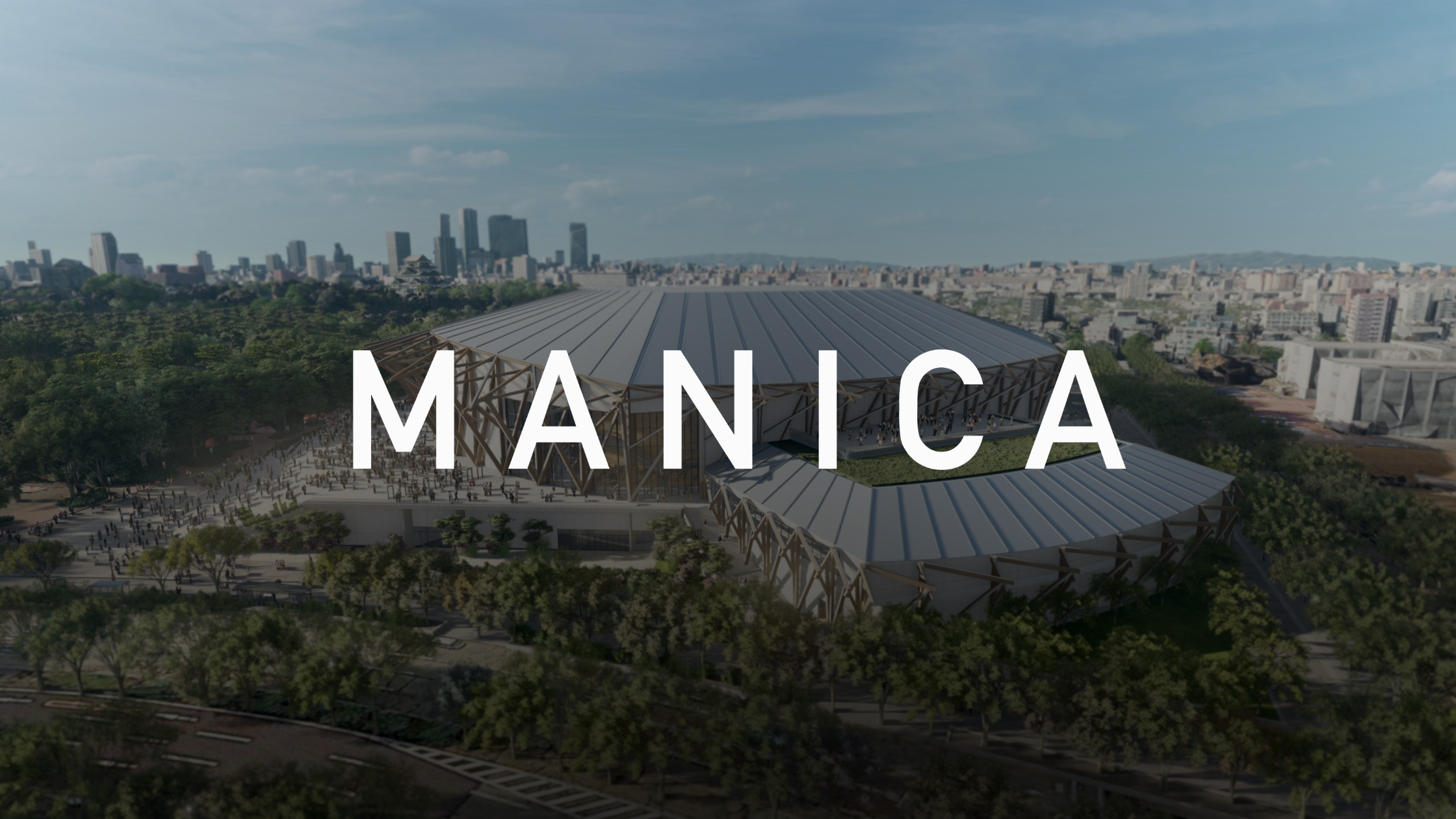
Modern stadium design is moving away from the era of massive, empty concrete shells that only see action a few times a year. Leading this change is MANICA, a global architecture firm focused on creating high-complexity venues that act as year-round anchors for their cities. We are looking at how their shift toward multi-purpose urban hubs is solving the industry problem of dark days while pushing contractors to master a new level of technical coordination.
About MANICA
MANICA is a boutique shop specializing in the high-pressure design phase of stadium and arena projects. David Manica founded the firm in 2007 with a clear goal: to provide the creative superpower behind a project while partnering with other architects to handle the actual construction documentation. It is a model that lets them focus on the big ideas at some of the world’s highest-profile venues.
Instead of treating a stadium as a closed-off bowl, MANICA starts with the site’s legacy in mind. They are designing buildings that function as open, multi-purpose environments from day one. By integrating high-density retail, hotel rooms, and even community play areas into the structure, the firm ensures the building stays relevant to the neighborhood even when there is no game on the calendar. It is a shift away from the spaceship stadiums that sterilize their surroundings and toward a district that invites people in 365 days a year.
For the construction industry, this evolution changes everything about how we build. Creating a venue that can switch from a massive concert to a football game and then host a private corporate event the next morning requires a massive shift in trade coordination. Contractors now have to manage incredibly complex MEP systems and flexible interior layouts that were unheard of a decade ago. MANICA’s approach demands greater precision in how building systems are integrated, making every square foot of the project work harder.
5 past, present, and future projects from MANICA
1. Allegiant Stadium
- Location: Las Vegas, Nevada
- Year built: 2020
- Typology: Multi-purpose stadium
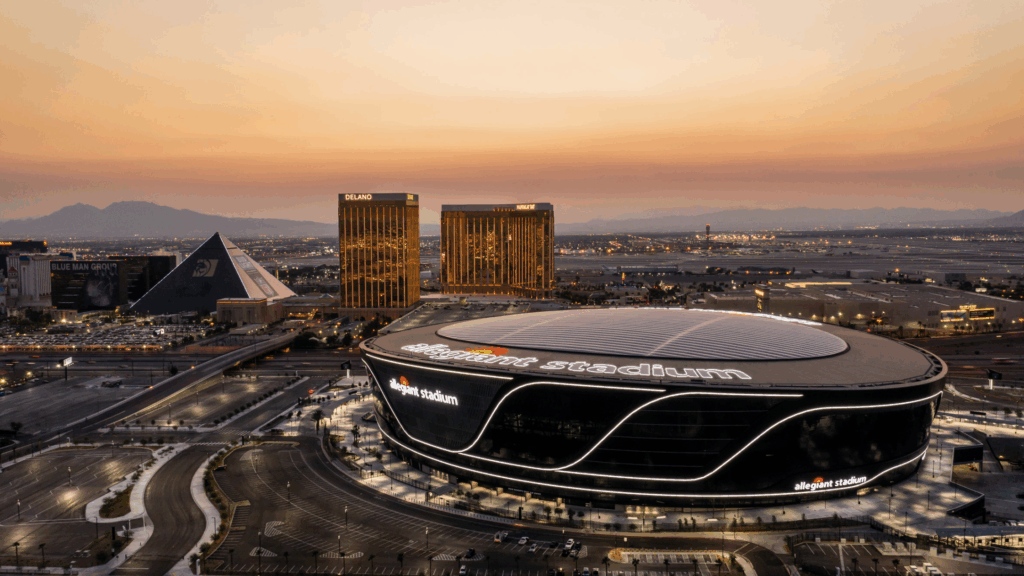
Allegiant Stadium is the home of the Las Vegas Raiders and the UNLV Rebels, situated right next to the Las Vegas Strip. Visually, the building is inspired by the sleek, aerodynamic lines of a luxury sports car, featuring a black glass exterior that has become a landmark in the desert.
What makes this project truly different is the sheer scale of kinetic engineering. It features a retractable natural-grass field tray weighing 19 million pounds. This tray sits on 540 wheels and moves along 13 rails, allowing the grass to grow outdoors in the sun on non-game days before sliding inside for the main event. The stadium also features four massive lanai doors at the north end, each nearly the size of a basketball court, that slide open to provide fans with a panoramic view of the Las Vegas skyline.
This project solved the problem of bringing real grass to a desert climate without compromising the stadium’s multi-use schedule. From a construction angle, it pushed the boundaries of trade coordination and precision. Contractors had to manage a high-tech cable-net and ETFE roofing system while installing the massive field tray, all on a fast-tracked schedule. To handle the complexity of over 150,000 roof elements, the team even developed custom digital site management tools to ensure real-time quality control.
2. Inter Miami Freedom Park Stadium
- Location: Miami, Florida
- Year built: 2024
- Typology: Multi-use sports and entertainment district
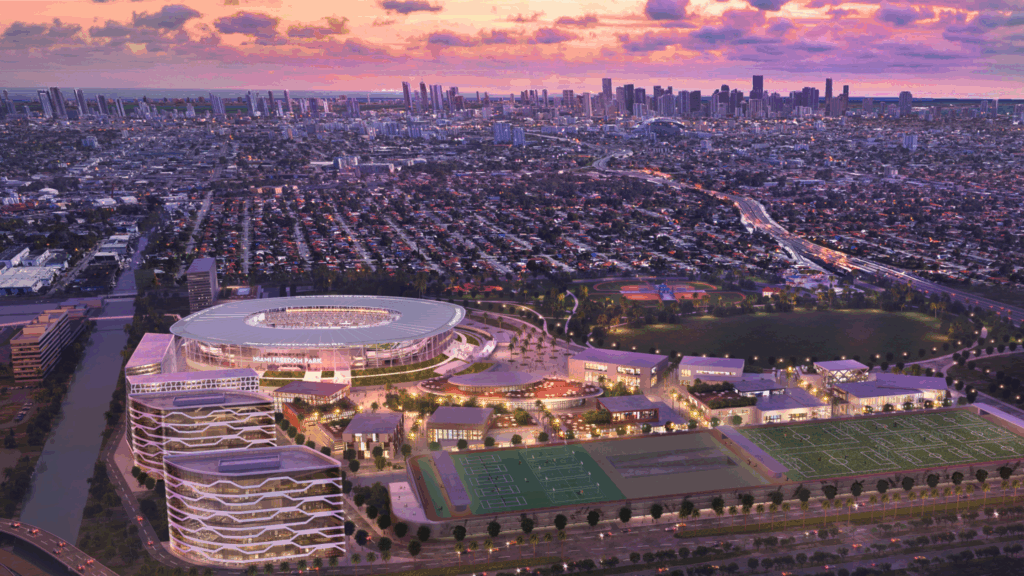
Inter Miami Freedom Park is a 131-acre site that was once a golf course and is now becoming a major tech hub. MANICA’s plan for Inter Miami Freedom Park puts a 25,000-seat stadium right in the center of a huge 58-acre park. It is a huge move for the city, especially when you factor in the 750,000 square feet of retail and commercial space that will be built out around the stadium to keep the area busy year-round.
What makes this project noteworthy is the integration of a stadium-in-a-park concept. Instead of fences and asphalt, the design is woven into 58 acres of public green space and youth athletic fields. The stadium itself features an open-air design that maximizes the Atlantic breeze while using high-tech canopy structures to provide shade for every fan in the building.
This project addresses a major environmental challenge that begins with fixing the ground itself through extensive remediation and drainage systems. The sheer scale of the 131-acre site makes it one of the most complex job sites in the region, especially since the stadium must share its footprint with a new hotel and a commercial park. For the contractors, success comes down to managing the constant flood of materials and workers across three major projects racing toward the same finish line.
3. New Nissan Stadium
- Location: Nashville, Tennessee
- Year built: 2027 (Expected)
- Typology: Enclosed multi-purpose stadium
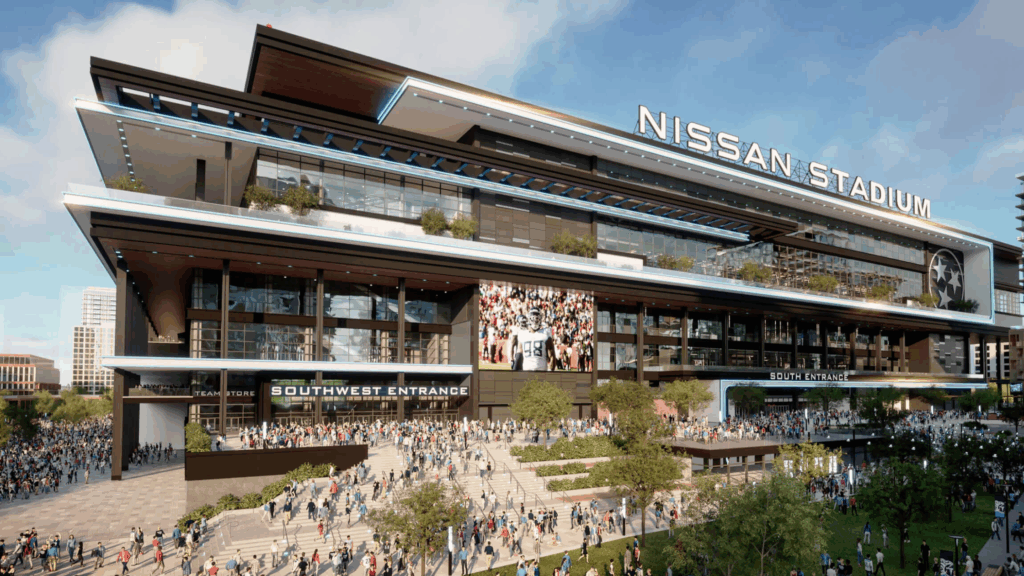
Nashville’s new 1.8-million-square-foot Nissan Stadium is a huge departure from the typical indoor venue. Most of these big, enclosed spots feel like you’re stuck in a giant shed, but MANICA is using a porch concept to keep it open. They built in wide terraces and exterior spaces that overlook the downtown skyline. It’s a clever way to handle a massive, high-capacity project while keeping it connected to the East Bank rather than a massive obstacle in the middle of it.
What makes this project noteworthy is its high-tech, translucent ETFE roof. This circular-shaped roof system allows natural light to flood the interior, creating an outdoor feel while protecting 60,000 fans from the elements year-round. To ensure the stadium lives up to Nashville’s reputation as Music City, MANICA integrated advanced acoustic ceilings and digital sound systems to handle everything from roaring NFL crowds to world-class concerts.
This project belongs on this list because it is a masterclass in building complexity and sustainability. You can’t drop a 1.8-million-square-foot stadium into a tight spot without serious planning. The jobsite is packed, with a 2,000-person crew navigating a footprint atop the old stadium. To keep the environmental impact down, they are using low-carbon concrete and ditching heavy traditional materials in favor of lighter alternatives. The roof alone is enough to keep a project manager up at night. It is a 360,000-square-foot cable-net system that relies on 68 high-tension steel cables. Getting those cables pulled into place with hydraulic lifts requires a level of precision that you don’t usually see on a standard commercial build.
4. VTB Arena – Park Arena
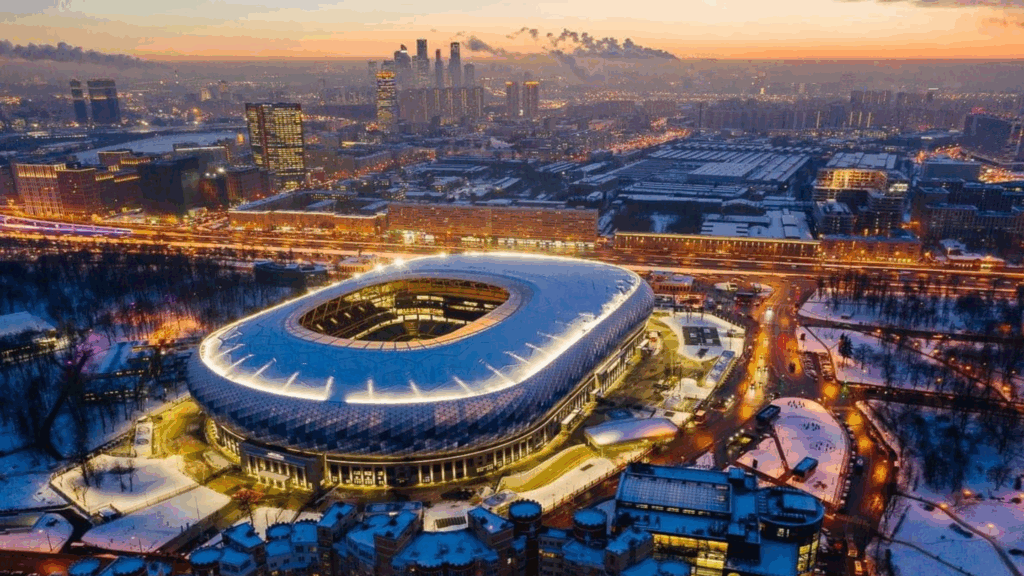
- Location: Moscow, Russia
- Year built: 2018
- Typology: Multi-use sports and entertainment complex
The layout of the VTB Arena is intense, with a 26,000-seat stadium and a 12,000-seat arena literally sharing the same roof. MANICA stacked these two venues to save space, which allowed them to keep the original stadium’s historic exterior intact. They’ve essentially built a modern sports district underneath the existing site’s footprint. It’s a smart move for a city site where you can’t keep building outward, forcing the design to go vertical to get both football and hockey into the same complex.
What makes this project noteworthy is the stadium-within-a-stadium concept. Instead of building two separate structures that would eat up valuable city land, the design shares common facilities like kitchens, loading docks, and retail zones. The entire complex is wrapped in a glowing, translucent polycarbonate skin that changes color at night, turning the building into a digital canvas visible across the city.
The construction team on this project had to solve a big thermal conflict; building a frozen hockey arena right up against a heated football pitch, which is a recipe for disaster if the insulation isn’t perfect. The contractors had to coordinate a massive MEP layout to ensure the cooling for the ice didn’t fight the heating for the stadium. This required a heavy-duty network of thermal barriers to prevent cross-contamination between the two climates. It’s a level of precision engineering that goes way beyond what you’d see on a standard single-use build.
5. Chase Center
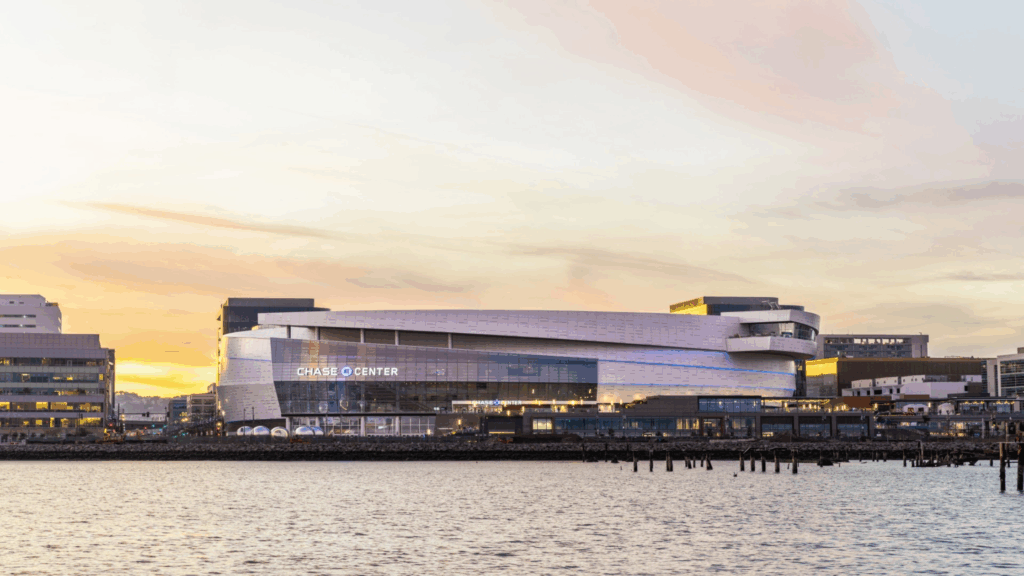
- Location: San Francisco, California
- Year built: 2019
- Typology: Multi-purpose arena and entertainment district
Chase Center is the core of an 11-acre redevelopment called Thrive City in Mission Bay. Most arenas are surrounded by an empty sea of asphalt, but this project flipped that model on its head. MANICA designed it to be a dense, high-traffic meeting place that is actually part of the city. They built it right into the fabric of the neighborhood, surrounding the arena with office towers, retail shops, and a public park right on the waterfront.
What makes this project noteworthy is its complex stacked drum geometry. The building’s massing consists of 14 different drums of varying sizes stacked on top of one another. This unique form required a high-performance rain-screen enclosure comprising over 1,100 mega-panels, each with approximately 7,500 individual metal panels. This intricate facade gives the arena a dynamic, flowing form that reflects the nautical history of the surrounding Bay Area.
This project belongs on this list because it represents a triumph of design-assist collaboration and modular construction. To manage the geometric complexity, MANICA and the construction team used extensive 3D parametric modeling to optimize panel layouts and secondary steel connections. For contractors, the primary challenge was the logistical coordination required to build on a highly congested 11-acre site simultaneously with two adjacent office towers. It serves as a prime example of how modular mega-panel systems can be used to execute high-concept architecture on a tight urban schedule while achieving LEED Gold certification.
Bottom line
The work coming out of MANICA indicates that the era of the single-use stadium is over. For the AEC industry, this means that future projects will be defined by their ability to change. When a building has to function as a professional sports venue one night and a climate-controlled retail hub the next morning, the margin for error in construction disappears. We’re seeing a move toward venues that are more like complex machines than static buildings.
The expertise required of contractors today is next-level, thanks to firms like MANICA. When a design calls for a 20-million-pound field to slide across the floor or a translucent roof made of high-tech film, the old ways of building don’t measure up. You need specialized crews who understand the material science behind ETFE and the heavy-duty mechanics of kinetic steel. In addition to being built on time, all these moving parts and high-tech layers must work together perfectly, so the venue doesn’t experience a mechanical failure a year after opening.
Ultimately, MANICA’s projects prove that success in modern sports construction is built on collaboration. The complexity of these projects requires MEP, structural, and architectural teams to work in a unified digital environment from the outset. As these multi-purpose anchors become the new standard for urban development, the contractors who master this level of multi-trade coordination will lead the industry forward.
Stadium and large-scale venue construction is one of the most technically demanding environments in the industry. For more breakdowns on the firms, designs, and construction challenges shaping high-complexity builds, subscribe to the Under the Hard Hat newsletter.