NBBJ has built a reputation for designing buildings that go beyond appearance and change how people work, recover, and move through space. Their projects range from dense urban office campuses to highly technical healthcare facilities and large-scale civic buildings. Some, like the Amazon Spheres, are instantly recognizable. Others stand out for how they solve difficult site conditions or rethink construction methods. This article looks at 10 NBBJ projects that push design forward, including the Amazon Spheres, Tencent’s Seafront Towers, and Rainier Square Tower.
NBBJ
NBBJ is a global architecture firm known for blending design with performance. The firm was founded in 1943 and has grown from a regional practice in the United States into an international studio with offices across North America, Europe, and Asia. Over the decades, it has worked on everything from hospitals and corporate headquarters to large-scale civic and mixed-use developments.
Their work often focuses on how buildings function over time—how people interact with them, how they’re built, and how they adapt. NBBJ built much of its reputation through healthcare design, where layout, circulation, and environment directly affect outcomes. That same thinking has carried into their corporate and commercial work, where the focus shifts to collaboration, productivity, and long-term usability.
Today, the firm continues to take a research-driven approach to design, using data and user behavior to inform decisions. Whether it’s a hospital, office campus, or public building, the goal is usually the same: create spaces that work better for the people using them, not just spaces that look good on paper.
10 past, present, and future projects from NBBJ
1. Amazon Spheres
Location: Seattle, Washington, USA
Year built: 2018
Typology: Workplace/biophilic office
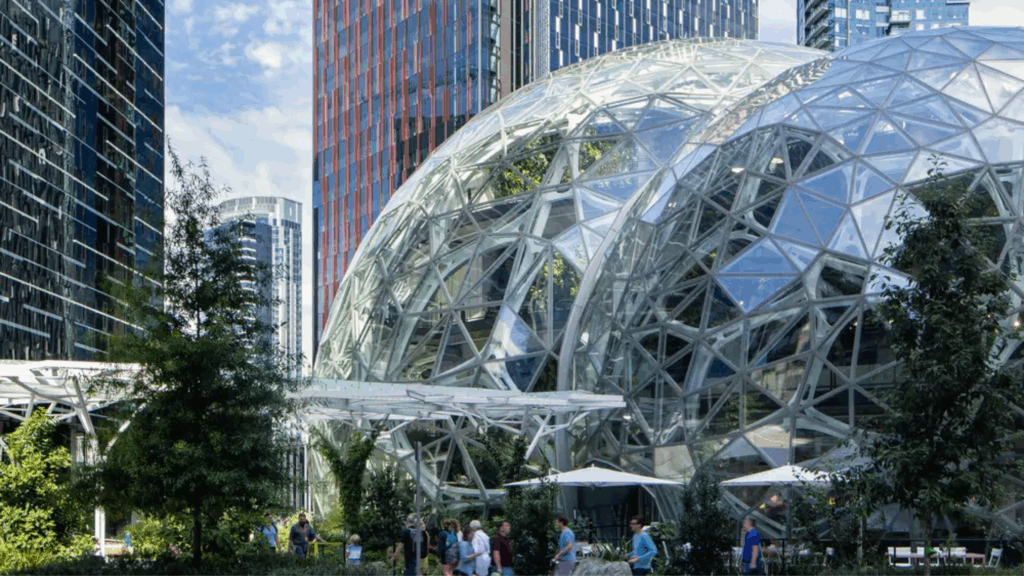
The Amazon Spheres are part of a 3.3-million-square-foot urban campus that spans three city blocks, but the Spheres themselves occupy only about 67,000 square feet—making their impact far greater than their size. The structure consists of three intersecting glass domes, each up to 90 feet tall, built on a steel diagrid composed of pentagonal modules. Over 2,600 glass panels create a highly controlled interior climate that maintains humidity and temperature levels suitable for more than 40,000 plants from around the world.
What makes this project stand out isn’t only the form—it’s how it was built and used. The team used computational design to optimize the geometry and prefabricate steel components, which were then assembled on site. Inside, there are no traditional desks. Instead, spaces are designed for informal work, with suspended meeting rooms and multi-level terraces. It’s a rare example of a workplace designed around environmental psychology rather than efficiency alone. This shift toward human-centered design is changing how offices are planned, with a greater focus on well-being and the environment rather than just density.
2. University of Oxford, Life and Mind Building
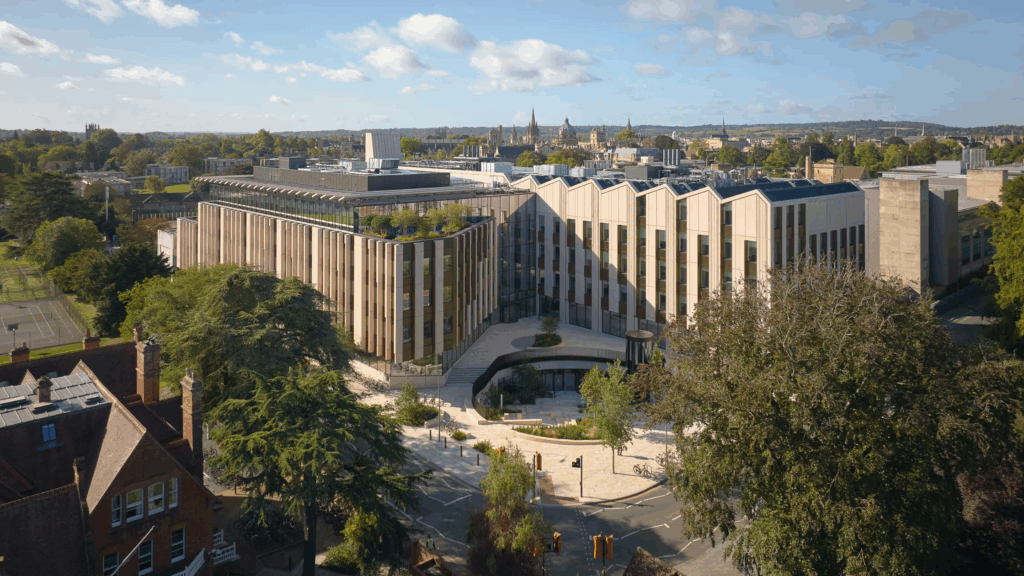
Location: Oxford, UK
Year built: 2025
Typology: Academic/research/life sciences
The University of Oxford’s Life and Mind Building is one of the strongest research-focused projects in NBBJ’s portfolio. Designed as Oxford’s largest-ever construction project and described by NBBJ as the UK’s largest laboratory designed to Passivhaus principles, the building brings together the university’s psychological and biological sciences in one integrated facility.
The project includes flexible laboratory platforms, shared research and teaching spaces, offices, study areas, a cafe, an exhibition space, and a public plaza, all within a more compact, efficient footprint. Research facilities are moving toward more integrated layouts, where collaboration across disciplines is built into the structure itself. What makes it especially memorable is the way it balances technical research requirements with public presence—the sculpted stone façade even incorporates a brainwave pattern recorded from an Oxford researcher during the design process.
3. Samsung North America Headquarters
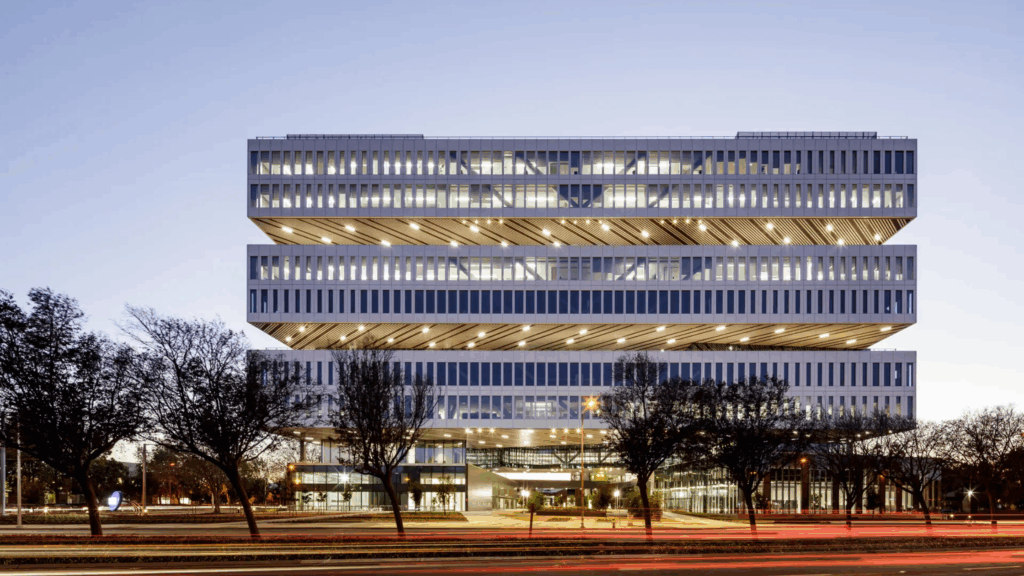
Location: San Jose, California, USA
Year built: 2015
Typology: Corporate office
Samsung’s headquarters is centered on an impressive central courtyard that serves as both a visual and functional core of the building. At 10 stories high, the building features open floor plans that encourage people to move between departments. The façade uses a layered system of horizontal sunshades and glazing to reduce solar heat gain while maintaining daylight access—critical in Silicon Valley’s climate.
Inside, circulation paths are designed to pull employees into shared spaces rather than keeping them isolated on individual floors. The intentional layout is truly impressive, as the building isn’t about maximizing desk space—it’s about forcing interaction. Every major circulation path runs through shared zones, which changes how teams work day to day. Here, the layout actively shapes how people interact, reflecting a broader shift toward offices that guide behavior rather than leaving it to chance.
4. Google South Lake Union office
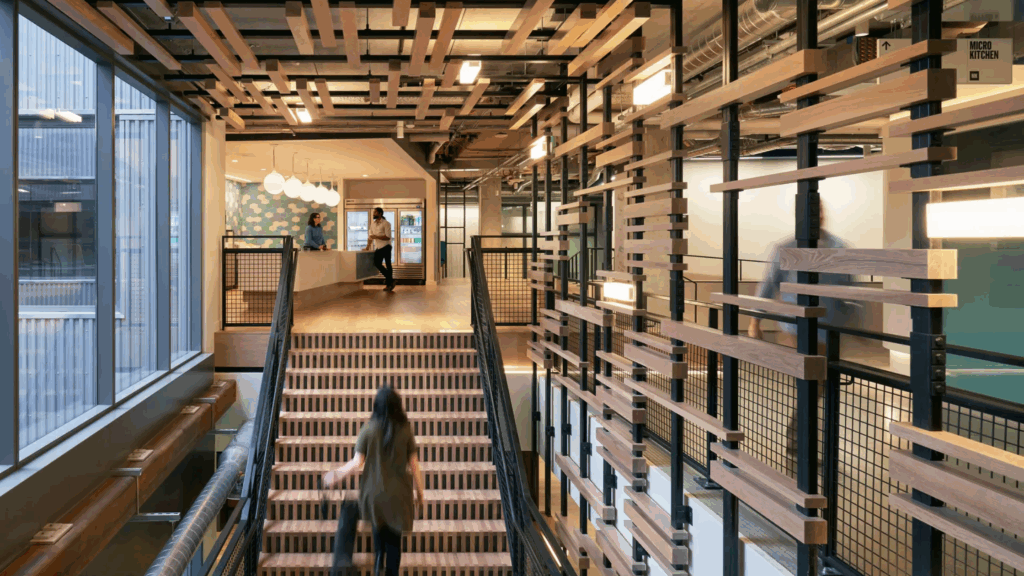
Location: Seattle, Washington, USA
Year built: Phased completion (2019–2022)
Typology: Corporate office / urban campus
Google’s South Lake Union campus is not a single building—it’s a multi-block urban development totaling over 600,000 square feet across several buildings, designed as part of Seattle’s rapidly growing tech corridor. At ground level, there are plazas, shops, and walkways, all connected—so the site stays lively even when the workday’s done. The workspace itself is set up to let people move around and choose their own work environment; you could be in a quiet spot one minute, then swing over to a more communal area, then grab a coffee in an informal space.
Large tech campuses are beginning to blend into the surrounding city, moving away from isolated workplaces toward mixed-use urban environments. It reflects a broader shift toward offices that function less like standalone spaces and more like integrated, flexible parts of the urban fabric.
5. Tencent Seafront Towers (Tencent Binhai Mansion)
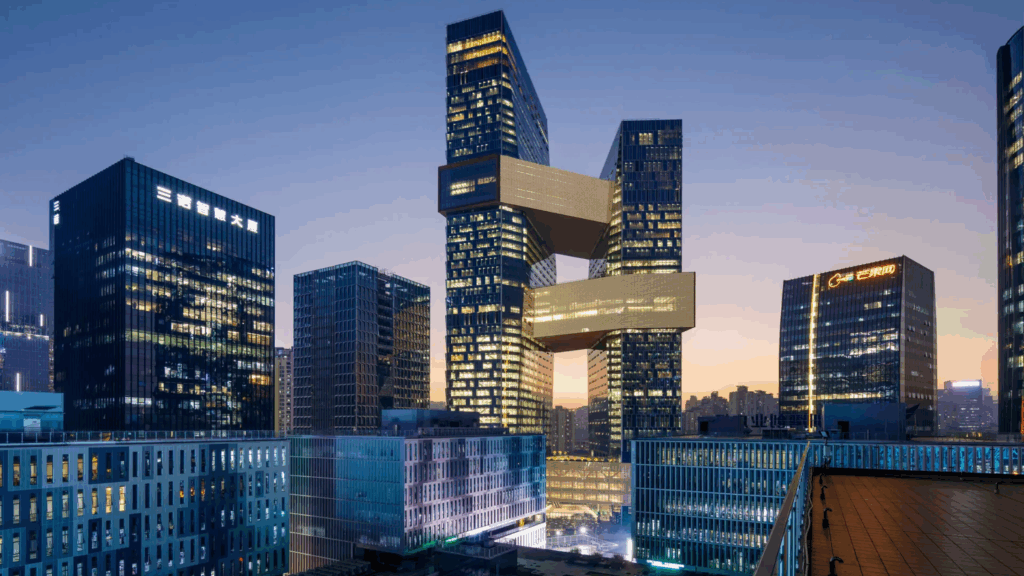
Location: Shenzhen, China
Year built: 2017
Typology: Office towers
The Tencent Seafront Towers consist of two connected skyscrapers, each rising 248 and 194 meters and with 50 and 41 floors, respectively. Instead of treating the towers as separate buildings, NBBJ designed them as a single connected system. Large sky bridges link the towers, creating shared spaces across multiple levels. These bridges house meeting areas, lounges, and circulation zones.
The project is designed around the idea of vertical communities. Employees don’t stay on one floor—they move between levels, which changes how teams interact. From a structural standpoint, connecting two towers at height adds complexity, particularly regarding load transfer and movement between the structures. High-rise design is shifting to support movement and shared space at height, rather than simply stacking independent floors.
6. Bill & Melinda Gates Foundation campus
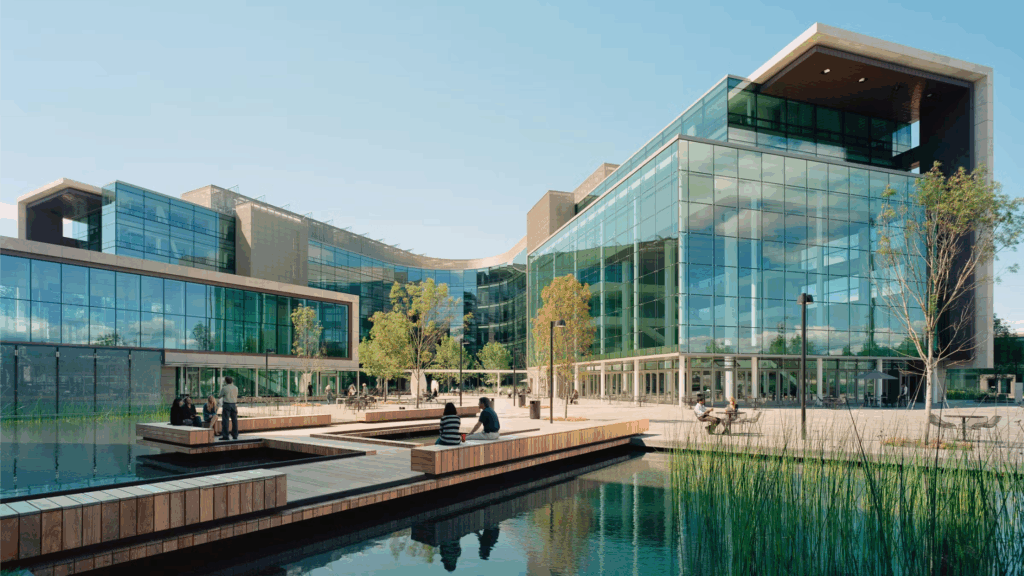
Location: Seattle, Washington, USA
Year built: 2011
Typology: Institutional campus
This campus broke all the rules and was designed with one main goal in mind: to connect a series of low-rise buildings, each with its own unique character, through beautiful outdoor spaces. Using wood, glass, and steel, the buildings blend seamlessly into the Pacific Northwest landscape, almost as if they grew there. The large overhangs and shading systems control daylight, yet people can still look out the window and enjoy the view.
What really sets this place apart, though, is how it scales up without getting too big and overwhelming. It’s all about moving smoothly between spaces and how that supports people working together on large projects. There’s a clear move toward breaking large campuses into smaller, connected buildings that feel more accessible at a human scale.
7. Rainier Square Tower
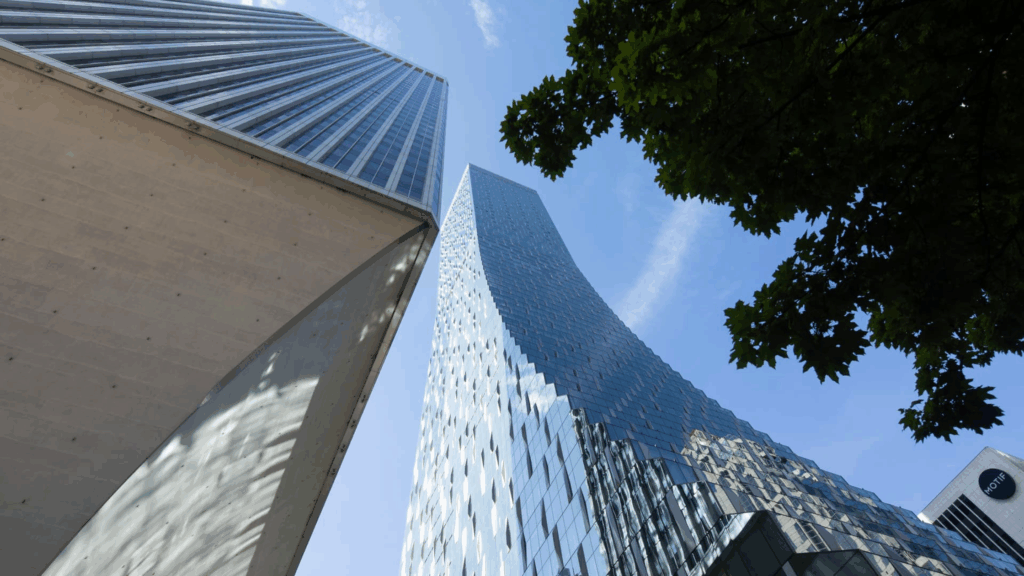
Location: Seattle, Washington, USA
Year built: 2020
Typology: Mixed-use high-rise
Rainier Square Tower stands out for its building system. Instead of a concrete core, the team used a steel plate shear wall system. This approach has big impacts for the construction schedule, as the core was built off-site, saving months of construction time. The tower itself has offices, apartments, and other retail areas inside, all wrapped in faceted glass façade that responds to light.
From a construction standpoint, they pioneered a faster way to build large high-rise cores in earthquake-prone areas. This approach shows how seismic design is starting to influence not only how buildings perform during an earthquake, but how quickly and efficiently they can be constructed in regions where safety requirements are highest.
8. Statue of Liberty Museum
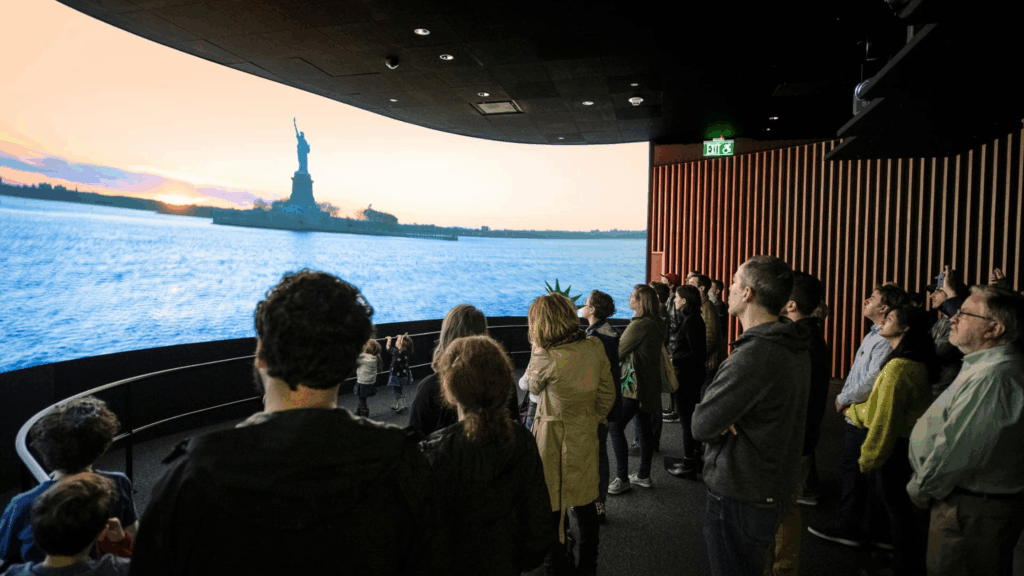
Location: New York, New York, USA
Year built: 2019
Typology: Museum/cultural
The Statue of Liberty Museum is a 26,000-square-foot cultural facility on Liberty Island, designed to accommodate millions of visitors each year while telling the story of one of the world’s most recognized landmarks. The museum is organized into three main gallery zones: an immersive cinema space, an interactive gallery, and an inspiration gallery. One striking thing about it is the way they use large digital screens to tell the story. By using curved screens, motion graphics, and interactive displays, they’ve created a story that keeps going, rather than simple, static exhibits.
Museums are shifting toward this immersive, technology-driven storytelling that keeps visitors engaged from start to finish. It all comes to a head when they show off the statue’s original torch set against the backdrop of the New York skyline—a powerful way of tying the physical structure back to where and how it’s meant to be seen.
9. University Medical Center New Orleans
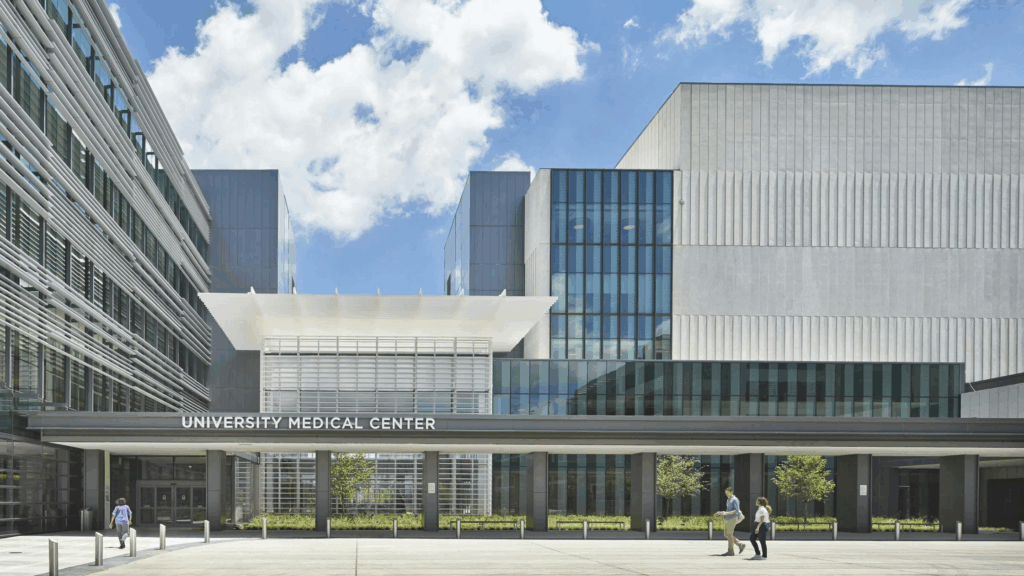
Location: New Orleans, Louisiana, USA
Year built: 2015
Typology: Healthcare/hospital
University Medical Center New Orleans is a massive 1.5-million-square-foot, 448-bed hospital that plays a very important role in Southeast Louisiana as the region’s only Level I trauma center. Built to replace the facilities destroyed by Hurricane Katrina, the project was about getting healthcare back on track while also anticipating how the next disaster might play out. The campus includes multiple components: inpatient towers, a diagnostics and treatment building, ambulatory care facilities, and expansion-ready infrastructure. Its scale and program complexity make it one of the most significant healthcare projects in NBBJ’s portfolio.
Resilience is a major part of the design. Critical systems are elevated above ground level to protect against flooding, while the building envelope is engineered to withstand hurricane-force winds and debris. The facility also includes features such as an ambulance ramp accessible by boat and helipads sized for large evacuation helicopters, ensuring continued operations during emergencies.
10. Massachusetts General Hospital Lunder Building
Location: Boston, Massachusetts, USA
Year built: 2011
Typology: Healthcare/hospital
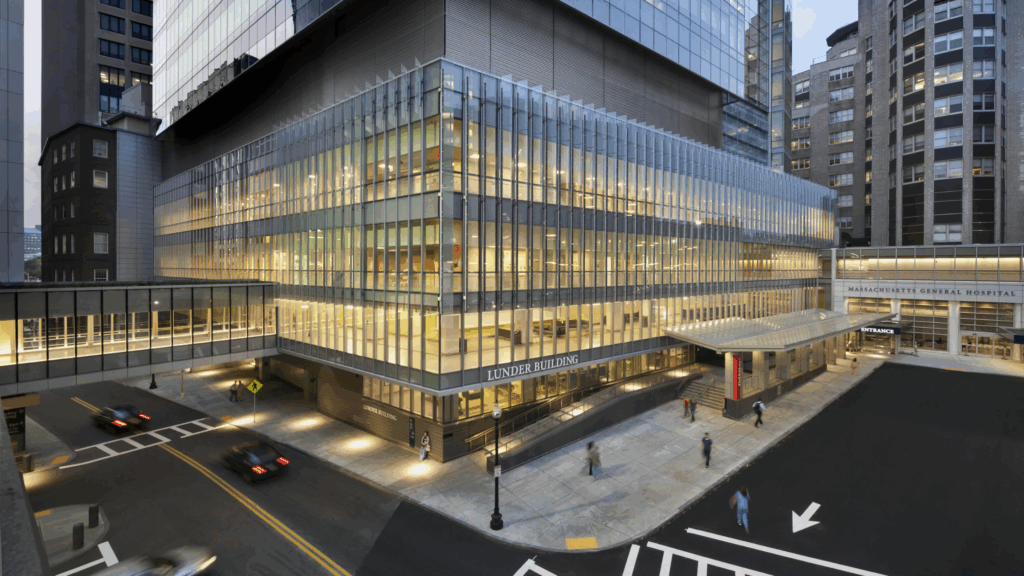
The Lunder Building is a massive addition to the Massachusetts General Hospital campus, with 535,000 square feet of inpatient and procedural space spread over 14 floors. It includes 150 single-bed patient rooms, a 35,000-square-foot radiation oncology department, and 28 state-of-the-art operating and procedural rooms. Given its cramped 42,000-square-foot urban footprint, the build required clever phasing to keep the hospital running during construction. NBBJ got creative and split the building up into angular chunks to soften its massive presence and let some natural light in to the surrounding areas. The result is a layered look made from clear glass, frosted glass panels, and solid bits to balance how much people can see in from the outside, how much privacy patients need, and how well the building is going to perform.
Final thoughts
NBBJ’s projects don’t follow a single style. What ties them together is how they respond to real logistical constraints—tight urban sites, complex programs, or changing workplace needs. Some push structural systems forward, while others rethink how people use space.
If you want more breakdowns like this on major projects and the construction thinking behind them, subscribe to the Under the Hard Hat newsletter and stay up to date with what’s shaping the industry.