
Nail guns are a staple on residential and commercial job sites, driving productivity across everything from framing to interior trim. But speed comes with risk. Thousands of construction workers are injured every year due to accidental discharge, recoil, and unsafe trigger use. The difference between efficiency and emergency often comes down to training, trigger selection, and consistent safety practices.
Quick look
- Nail guns are a leading cause of injury in construction, sending tens of thousands of workers to the emergency room each year.
- Using a full-sequential trigger nailer instead of a contact-trigger nailer can significantly reduce nail gun injuries.
- Common causes of injury include unintentional discharge, recoil double-fires, bypassed safety tips, and loss of balance.
- Keeping your finger off the trigger, staying clear of the line of fire, and disconnecting compressed air before clearing jams prevent many serious injuries.
- Consistent training, proper PPE, and clear company policies on trigger selection are critical to improving nail gun safety on residential and commercial construction jobs.
Why nail gun injuries are still happening
Nail guns are easy to operate. That’s part of the problem. A pneumatic nailer powered by compressed air can fire hundreds of fasteners in minutes. When something goes wrong, it happens fast.
According to the National Institute for Occupational Safety and Health (NIOSH), tens of thousands of work-related trips to the emergency room every year happen because of nail gun injuries. Research by CPWR and NIOSH puts the number at over 37,000 a year, and it’s no surprise that most of those are among construction workers—they’re the ones on the front line, using these tools day in and day out.
Most injuries are puncture wounds to fingers and hands. Some involve fractures when the nail strikes bone. Others include eye injuries from ricochet or flying debris. In rare cases, a nail can penetrate the chest or head, resulting in fatality.
Why are nail gun injuries common despite awareness and occupational safety and health training?
Several patterns show up repeatedly:
- Unintentional discharge: The nail gun will fire when the safety-contact tip is depressed, and the trigger is pulled. If a worker’s finger rests on the trigger when holding or carrying the tool, discharge can happen unexpectedly.
- Recoil double-fires: With a contact trigger or a multi-shot contact trigger, recoil can unintentionally cause the nailer to fire a second time. That second nail may miss the intended target.
- Contact trip triggers (“bump fire”): When using nail guns equipped with contact triggers, the tool fires whenever the safety tip touches a surface while the trigger is depressed. This increases the risk of firing out of sequence.
- Bypassed safety mechanisms: Some workers modify or disable safety tips. Removing the spring from the safety-contact tip or tampering with the mechanism removes a layer of protection.
- Loss of balance: Many construction jobs involve working in tight spaces, on ladders, on scaffolding, and with uneven lumber. A slip while firing can redirect the nail into a hand or a coworker.
NIOSH reports that new and younger workers are at higher risk. Inexperience with trigger types and line-of-fire awareness plays a role. Many injuries occur during residential construction framing, where speed often outweighs caution.
The trigger system matters more than most contractors realize
Sequential trigger vs. contact trip trigger
The difference between trigger systems is not minor. It directly affects injury risk.
A full sequential trigger (or single-shot sequential trigger) requires the worker to press the safety tip against the surface before pulling the trigger for each nail. If the sequence is broken, the nail gun will not fire.
A contact trip trigger, often called bump fire, allows firing whenever the safety tip is depressed while the trigger is already pulled. This enables rapid nailing but increases unintended discharge and double-fires.
The Nail Gun Safety Guide from NIOSH states that using full sequential trigger nailers can significantly reduce nail gun injuries. Studies found that contractors who switched to full sequential triggers had lower injury rates than those using contact triggers.
The use of nail guns with contact triggers may slightly boost productivity, but the increase in risk is measurable.
Company policy on trigger selection
Employers should standardise sequential trigger nail guns for most tasks. Having a mix of different trigger systems on the same worksite is a recipe for confusion, which can be problematic. A carpenter who’s used to one type of trigger may end up handling another one completely wrong.
A clear and solid occupational safety and health policy should include a no-go on modifying trigger systems in any way. No fiddling with springs, no disabling safety tips, and no altering the manufacturer’s settings.
The more consistent we are, the less hazardous the job site.
Safe operating practices that prevent most injuries
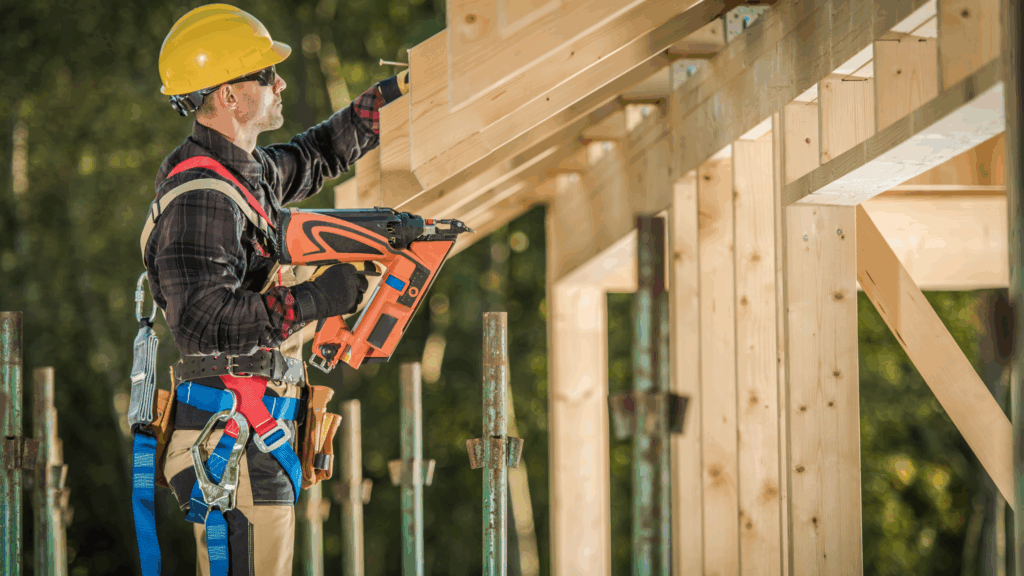
Most nail gun injuries are preventable with disciplined habits:
- Don’t put your finger on the trigger until you’re ready to fire it. People often rest their finger on the trigger while moving around, and that increases the risk of it going off accidentally.
- Don’t bypass or modify safety mechanisms. Don’t mess around with the spring on the safety-contact tip, and don’t alter the nail gun in any way.
- Keep your footing stable. Don’t fire the nail gun while you’re standing on a ladder or a scaffold—make sure you’ve got a solid footing before you pull the trigger.
- Keep your free hand clear of the nail path. Many hand injuries occur when holding material too close to the firing point.
- Watch the line of fire. Nails can pass through lumber or miss framing members. Be aware of anyone behind the nailing surface.
- Never point a nailer at anyone. Treat it like any other high-powered tool, even when disconnected.
- Disconnect compressed air before clearing jams. Remove the hose and release the pressure before maintenance. A nail gun can discharge while being serviced.
- Maintain safe spacing between workers. Crowded framing areas increase the chance of striking someone during recoil or ricochet.
These safety tips apply whether using pneumatic nailers or other powered nail guns.
PPE and jobsite controls that reduce severity
OSHA requires workers to wear eye protection when using nail guns. Safety glasses with side shields help protect against ricochet, flying debris, and nails that deflect off knots or hidden metal fasteners.
Proper footwear reduces the chance of slipping while firing, especially on uneven framing or loose sheathing. Gloves may help prevent minor cuts and abrasions, but they will not stop a nail from penetrating the hand.
Work zones need to be controlled during framing and sheathing, ideally by keeping non-essential workers well out of areas where nail guns are used and by using clear boundaries to prevent anyone from wandering into a live firing zone.
You must be extra careful when using nail guns on ladders or elevated platforms because, if you fall and a nail gun goes off, the results can be really serious. And avoid ‘bump firing’ from a height—it’s an accident waiting to happen.
Training and supervision for nail gun safety
Training on nail guns shouldn’t just focus on how to use the tool; it should also cover the dangers of using one, what different triggers do, what can go wrong if you’re not careful, and how to respond in an emergency.
Hands-on practice with sequential-trigger nail guns is a must, and you need to make sure everyone has read the manufacturer’s instructions and understands how they work. Don’t just assume people know what they’re doing. The fact is, supervision really matters. If you’ve got new people on the job, you need to keep a closer eye on them. That’s not just a one-off, either; safety reminders about nail guns should be an ongoing part of toolbox talks. Don’t just ignore close calls—report them and discuss what went wrong.
Getting the safety culture right on site really pays off, though—when you’re serious about safe firing techniques, you tend to end up with fewer visits to the emergency room down the line.
Final thoughts
Nail gun injuries are not random; they happen when trigger systems, rushed habits, and poor supervision combine. Nail gun safety improves when contractors choose full sequential triggers, enforce safe operating practices, require proper PPE, and invest in training. Nail guns boost productivity for nailing tasks. They also carry hazards when misused. The difference comes down to discipline and policy.
If you want more construction safety coverage and practical occupational safety and health guidance, subscribe to the Under the Hard Hat newsletter.